Tag: choral music

  • The Benefits of Singing in the Community

    The Benefits of Singing in the Community Calgary Children's Choir

    The Calgary Children’s Choir performs three major concerts a year, including our upcoming Christmas Concert on Saturday, December 9th. Interspersed with these concerts are a variety of events out and about in the community, and it’s always such an exciting opportunity for our choir to experience these performances:

    #1. Fresh Perspective:
    New performance opportunities are always beneficial to the choristers, because it adds variety to their concert series, and allows them to understand performance in a variety of settings. Musical aspects such as acoustics, choir placement, and differences in audiences are all important factors for choristers to learn to adapt to. Having different performance opportunities are always a great learning experience!

    #2. Community Service:
    One of the best parts of singing out and about in the community is the sense of service this develops in our choristers. When we sing at a Senior’s Home, or a Christmas market, we are contributing to people’s sense of well-being and belonging. This is doubly beneficial for our choristers, because it increases our own sense of what it means to be part of a larger community!

    #3. Meeting New People:
    Music is all about communication and connection, and the more varied concert opportunities we have, the more we get to meet new people, and connect with all kinds of different audiences. Encountering as many different people, from all walks of life demonstrates how much we all have in common, and the ability to share our musical gift with the community, brings us all a little bit closer together!

    What is another benefit from singing in the community? Tell us in the comments below!

    We are thrilled to be performing at The Calgary Winter Club’s Christmas Market on Wednesday November 22nd at 6:00 pm!

    Winter Club Christmas Market

    *Tickets are now available for our Christmas Concert on Saturday, December 9th, 2017!

    Calgary Children's Choir

  • 4 Conductor Secrets

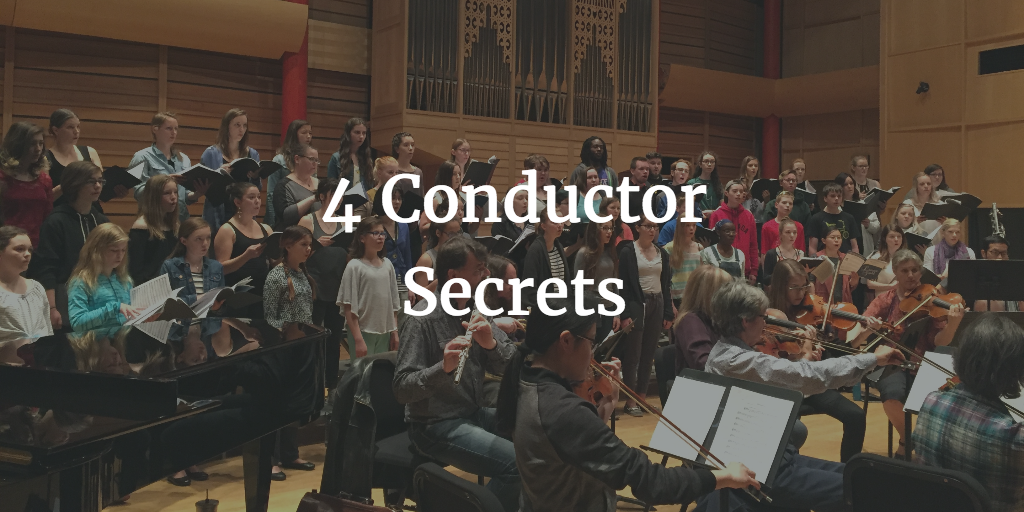
    4 Conductor Secrets

    #1. We can see EVERYTHING:

    For real.

    It’s a prerequisite for conductors to have extra ‘nonsense’ senses, but we’re at the front of the room, and often we’re standing while choristers are sitting. We can see you, choristers. Even when you think you’re being sneaky and hiding your phone, or a snack, or a gerbil, behind your music. We can see you.

    #2. Mistakes are not a problem:

    Many choristers feel immediate embarrassment when/if they make a mistake, especially if their fellow choristers react, or give them some side-eye. Conductors can almost always catch these mistakes too, but our reaction is different. For us, mistakes are par for the course, especially if we’re all still learning a piece. When we hear a mistake, we don’t think ‘uh oh, that’s not right,’, we think ‘I know how to fix that,’. Mistakes are not a problem, and should not be a source of embarrassment.

    #3. We think about the beat A LOT:

    For the most part, choristers are thinking largely about breathing and tone. And while conductors are thinking about those things as well, we spend an inordinate amount of time thinking about the beat. Because we have to set it, and set it well, not just for the choristers, but for the accompanist, and for any other musicians playing along. We also have to think about maintaining a steady beat, while thirty other voices try to push and pull at the rhythm.

    #4. We know how you feel:

    We won’t make absolutist statements, but there are exceptionally few people who are conductors, who have not also been on the other side of the stand. Which means, that we know exactly how it feels to be conducted. We know which hand movements we prefer, which cues we need, and what kind of energy we want to feel from the conductor. Which is why we as conductors try to send that back out to our choristers.

    i-feel-you

    What other secrets do you think conductors might have? Tell us in the comments below!

    Calgary Children's Choir

  • The Benefits of Solfege in Singing

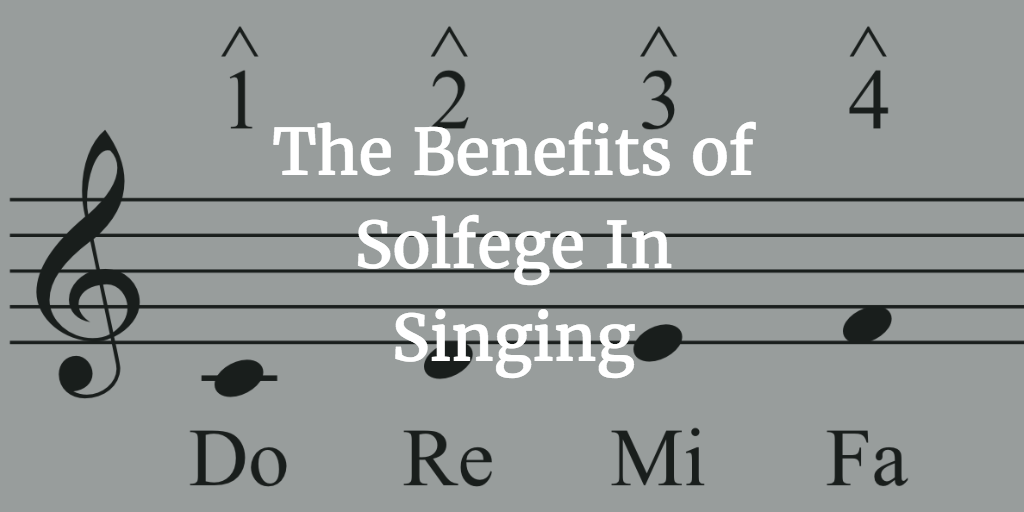
    The Benefits of Solfege In Singing

    Solfege is sometimes considered a drag in choir, since some choristers can find it frustrating, or boring, and fail to see the use of the method.

    Still, solfege, part of the Kodaly method, is actually an incredibly useful tool, particularly in singing. At the CCC we are most fortunate to have teachers who are well-versed in the Kodaly method, and implementing solfege into rehearsals. Here are three benefits to using solfege in singing:

    #1. Movable ‘do’:
    Instead of assigning note names to pitches, the notational centre of a scale or piece becomes ‘do’ in major keys, and ‘la’ in minor keys. This has two benefits. First, it allows those who don’t yet have a firm grasp on traditional musical notation to still make sense of the music, and it reinforces the relationship between notes, regardless of key.

    #2. Accelerated sight singing:
    Once a singer understand the relationship between pitches, and most importantly their relationship to one another, sight singing becomes much easier. Fourths and fifths no longer look like gargantuan leaps of faith,  and instead become carefully calculated and precise movements between notes. The nuances of singing semitones, or the subtleties of shifting between major and minor becomes much clearer.

    #3. Intonation:
    One of the greatest benefits of learning solfege is intonation and tuning. The Kodaly method really allows singers to hone in on the centre of the pitch, and to observe how inconsistencies in tuning can sabotage attempts to sing intervals. The open vowel sounds in solfege also allow singers to observe how changing vowel sounds requires additional modification to their tuning. Since intonation is an essential aspect of singing, and particularly choral music, solfege can have a huge impact on a choir!

    What other benefits are there for using solfege in singing? Tell us in the comments below!

    Calgary Children's Choir

  • The Importance of Musicianship in Singing

    The Importance of Musicianship In Singing

    Musicianship is a musical term used to describe the skills a musician possesses related to their aural skills; intonation, ear training. Musicianship is absolutely a skill as well that can be learned, and should be carefully honed. Here are three reasons why musicianship is an essential skill in singing:

    #1. Sight singing:

    There are few instruments that require a finely honed ear in the way that voice does. Sight singing is a bit of a misnomer, because it really is about hearing, and how a singer’s brain perceives what they are hearing. Understanding the nuances between pitches, and how to ‘translate’ what’s in the sheet music to the voice, is essential to learning how to sight sing well!

    #2. Blended sound:

    Because of the unique timbre of each individual singer’s voice, blending is an essential aspect of the singing experience. This is compounded when singers come together to create blended choral sound. The objective of choral sound is to make many voices sound as one. This can be achieved when singers make a concerted effort to listen to the voices of others and modify their own sound. Musicianship skills allow singers to not only hear the differences between voices, but to analyze what specifically they must change to accommodate blend.

    #3. Versatility:

    Musicianship skills allow singers to be incredibly versatile in both the genres they sing, as well as in their own vocal technique. Musicianship is what allows the fantastic pitch bending often found in jazz music, and it is a huge contributor to success in such interesting techniques as two-toned singing.

    Why else might musicianship be important in singing? Tell us in the comments below!

    Calgary Children's Choir

  • 5 Tips To Help You Get The Most Out of Choir

    5 Tips To Help You Get the Most Out of Choir

    Starting in choir can be a bit intimidating, particularly if you’re new to music, or to singing. Here are 5 tips to help you get the most out of your choir experience!

    #1. Listen:
    Choir is different from singing solos, for several important reasons (read more about that here.) But listening is an incredibly important aspect of the choral experience. A chorister needs to listen to the other voices in their section, they need to listen to the accompanying piano, or other instruments, and they need to listen for the voices singing other parts, so that everyone can create a blended sound.

    Listening to the conductor as well is essential, since they are the person with the best idea of the big picture, and the musical knowledge to bring all of the disparate aspects of choral music together.

    #2. Talk to your neighbours:
    It may be obvious, but don’t do this while a rehearsal is ongoing. Still, there are breaks, and before and after rehearsal to get to know the people sitting around you! You should absolutely get to know these people, since you’ll be spending quite a bit of time with them!

    Choir can be a wonderful experience because of the people, and here at the CCC we feel like family, so get to know your fellow choristers, and those friendships will greatly enhance your musical experience as well!

    #3. Bring your music:
    You will receive music during the first few rehearsals, and it will be your responsibility to care for your music throughout the year. By all means, make markings with pencil throughout rehearsal to note entrances, or dynamic markings, or anything else the conductor might suggest. While your neighbours will likely be more than happy to share your music on the (hopefully!) rare occasion that your forget it, remembering to bring your own music, with your individual notes on it, will greatly enhance your choral experience!

    #4. Personal research:
    There is so much that goes into music, and vocal music in particular. While we spend a great deal of time teaching our choristers sight reading skills, some basic theory, and of course good vocal production, there is still so much to learn. If you find an interesting aspect of the piece, by all means – do your own personal research! Forging a personal connection with the music will make your interpretation well informed, and your research can help other choristers learn as well!

    #5. Have fun!
    We assume you’ve joined choir because you love music, and singing, and because you want to share that with other people, and we assure you that everyone sitting in the rehearsal hall with you feels exactly the same way. So relax, enjoy the music, get to know your fellow choristers, and have fun!


    How else can you get the most out of choir? Tell us in the comments below!

    Calgary Children's Choir


  • Welcome to our 2017-2018 Singing Season!

    Music

    Welcome to the Calgary Children’s Choir’s 31st Singing Season!

    Our Calgary Children’s Choir and Calgary Youth Choir start rehearsals tomorrow (Tuesday, September 12th, 2017)
    Our Music Makers and Calgary Junior Choir start rehearsals on Thursday (Thursday September 14th, 2017)

    We are delighted to be back after our wonderful 30th Anniversary Celebrations in May, and an amazing tour to Italy over the summer!

    There are some important changes to the choir this year! Our wonderful Artistic Director, Marni Strome, is taking a sabbatical to finish her Master’s Degree in the United States. We are thrilled that she is continuing to oversee her artistic vision for the choir while she is away, and are very excited for her to bring all of her knowledge and experience back to us next year! Best of luck with your program Ms. Strome!

    For the upcoming season, we have some important staff changes:

    *Music Makers will be taught by Shinia Van
    *The Calgary Junior Children’s Choir will be conducted by Lindsay Phillips
    *The Calgary Children’s Choir will be conducted by Kathryn Berko
    *The Calgary Youth Choir will be conducted by Andreas Berko

    We look forward to new perspectives, and interesting information from our wonderful CCC team! Please give our new staff members a very warm CCC welcome!

    We are off to choir camp in just a few weeks! This is one of our favourites events of the year! Please speak to our business manager Linda White if you haven’t signed up for camp yet!

    The CCC will be presenting three concerts this year:

    Christmas Concert: Saturday, December 9th, 2017 – Rozsa Centre, University of Calgary –  7:00pm

    Annual Concert: Saturday, March 10th, 2018 – Rozsa Centre, University of Calgary 7:00pm

    Spring Concert: Saturday, May 12th, 2018- Rozsa Centre, University of Calgary 7:00pm

    And all of the events for the year can be found on our Event calendar here.

    What are you most looking forward to in our 2017-2018 singing season? Tell us in the comments below!

    Calgary Children's Choir

  • The Music of Karl Jenkins – Concert Roundup!

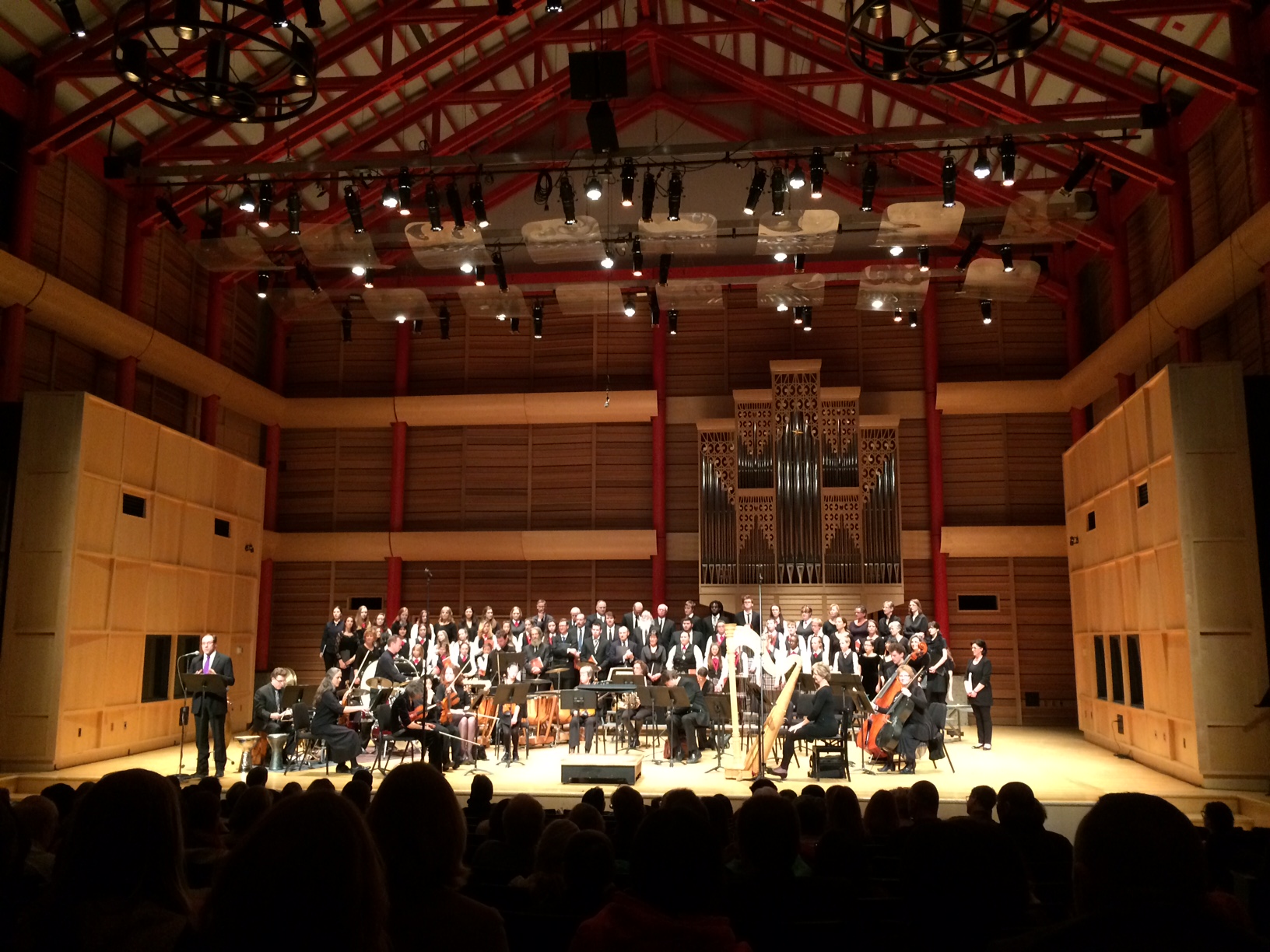
    CCC Mass Choir concert

    What was the highlight of Saturday night’s concert? Was it seeing Brent Van Dusen, Rob Maciak, and Bob Fenske cover six percussion parts between the three of them – often a different instrument and rhythm in hands and feet (!)?

    Was it the beautiful solos sung by Paul Grindlay, Jessica Lutzak and Win Hume? Was it the virtuosic harp solos (Gianetta Baril), and saxophone improvisation (Brendan Oberhamer)? Perhaps it was Tim Janz, playing flute to sound like a Shakuhachi, and singing all the lines in between…

    Could it be the choir, made up of the Calgary Children’s Choir, St. Giles Choir, friends, family, and alumni who nailed it – every movement? The junior choir also made two cameos in the Jenkins work. They crept in like quiet mice, and then, standing in the aisles, joined in the singing. They also performed for an attentive audience in the lobby during intermission!

    Was it the absolute professionalism of the orchestral ensemble, including two violin students, Stephanie and Leo? Perhaps it was the great camaraderie and relaxed interaction between the singers and players. Maybe it was the total focus and concentration of everyone, who passionately played and sang their parts – even bringing a sense of fun to the whole evening?

    Whatever the highlight was for you, for me it was all of the above. As a choir, we feel like a family. After the past two months of rehearsals, and Saturday night’s concert, I think we feel very much like an extended family! I’m not sure if I’m ready to say goodbye to that music, and I sure look forward to another opportunity for us all to work together again.

    – Marnie Strome

    What was your favourite part of the concert? Tell us in the comments below!

    Calgary Children's Choir

  • Math and Science In Music – Engineering Instruments:

    Math and Science In Music - Engineering Instruments

    Music is such a wonderful pursuit for mind and body because it is not just an art form, but combines a myriad of other disciplines, including mathematics, biology, and physics. This series, Math and Science in Music will explore the many ways in which music incorporates a variety of these disciplines.

    ENGINEERING INSTRUMENTS

    Music is discipline for both the mind and body, which is why it’s important that we have the best tools available to enable us to play beautiful music. For those of us who are singers, our instruments are built right into our bodies, but all other musicians require a physical instrument that they can hold and manipulate to create beautiful sounds.

    Crafting musical instruments requires a varied skill-set, including engineering abilities. These skills allow engineers to create instruments that have unique timbres, and tone while still conforming to the basic specifications of the instrument they are crafting.

    Engineers use the physics of sound to assess how frequencies will perform within a given instruments; observing aspects like size, shape, and material to create the best and most unique tone possible. They also have to consider comfort and the aesthetic quality of the instruments; thinking about an instrument from the inside to the outside.

    This isn’t just for ‘classical’ instruments either, engineering students continue to come up with new, unique sounding instruments, as part of their engineering studies. Check out this cool article about engineering students creating unique instruments at Yale!

    How else is engineering important in music? Tell us in the comments below!

    Calgary Children's Choir


  • The Purpose Of Choir Workshops

    Calgary Children's Choir

    For every major concert that we have, we also have a choir workshop. These choir workshops occur on the Saturday two weeks before the concert. They are an essential aspect of our choir year.

    Here are several reasons why choir workshops are important:

    #1. To work the music:
    This is the number one reason why we have choir workshops. Our usual rehearsals only allow us a certain amount of time with our music, so a three hour workshop gives us a lot more time to get down to the detailed aspects of our music. It also allows us to rehearse with other musicians or musical guests we may be performing with at our concert.

    #2. To learn new things: 
    Often times our workshops include guest conductors, clinicians, musicians or other choirs who will be joining us in our concert. Working with them gives our choristers a new perspective, or new information about music. As well, it gives us a chance to work with, and learn from professional musicians from the local Calgary music scene.

    #3. To talk about the music:
    A comprehensive understanding of each piece of music is essential to performance, and to a well-rounded musical education. It is never enough to just know the words, notes, and rhythms. We spend time during rehearsals, and at our workshops discussing how the text informs the music we’re singing. It gives us a larger sense of the choral music, and it makes us better musicians!

    #4. To spend time with fellow choristers:
    Part of being in a choir is the great pleasure of singing as part of a group. We are so lucky at the Calgary Children’s Choir to have very inclusive, and engaging choristers! The reason why our choristers enjoy spending time together, is because we encourage them to get to know one another at choir camp, rehearsals, and of course – at choir workshops. At workshops, choristers have time during sectionals, and at breaks to spend time with one another, and find out more about the people they’re singing with!


    What is your favourite part of a choir workshop? Tell us in the comments below!

    = Calgary Children's Choir

  • The Olympics and Choral Music

    olympics1

    The Opening Ceremonies of the Olympics are often a great occasion to demonstrate fun and unique choral music. In celebration of the Opening Ceremonies of the XXII Winter Olympics in Sochi, Russia, here is a look at some of the great choral music from the Olympics!

    Calgary Winter Olympics 1988 – Can You Feel It:

    And check out this video from the CBC Digital Archives about the Calgary Winter Games!


    Atlanta Summer Olympics 1996 – The Power of A Dream:


    Sydney Summer Olympics 2000 – The Flame:

    http://www.youtube.com/watch?v=XFy_s1-YrIE


    Torino Winter Olympics 2006 – Nabucco Va Pensiero:

    http://www.youtube.com/watch?v=J5OfG5DABRM


    London Summer Olympics 2012 – Caliban’s Dream:


    Sochi Winter Olympics 2014 – Daft Punk – Get Lucky:

    http://www.youtube.com/watch?v=8Np5rP5vBMI


    So, what are your favourite choral moments from Olympic Opening Ceremonies? Tell us in the comments below!

    = Calgary Children's Choir