Blog

  • The Alumni Advantage

    the-alumni-advantage

    As we approach our 30th Reunion Celebrations, it is important to look back over the past years, at all of the people who have come and gone from our organization. Choir is ultimately about people, and how those people come together for a time and form a community.

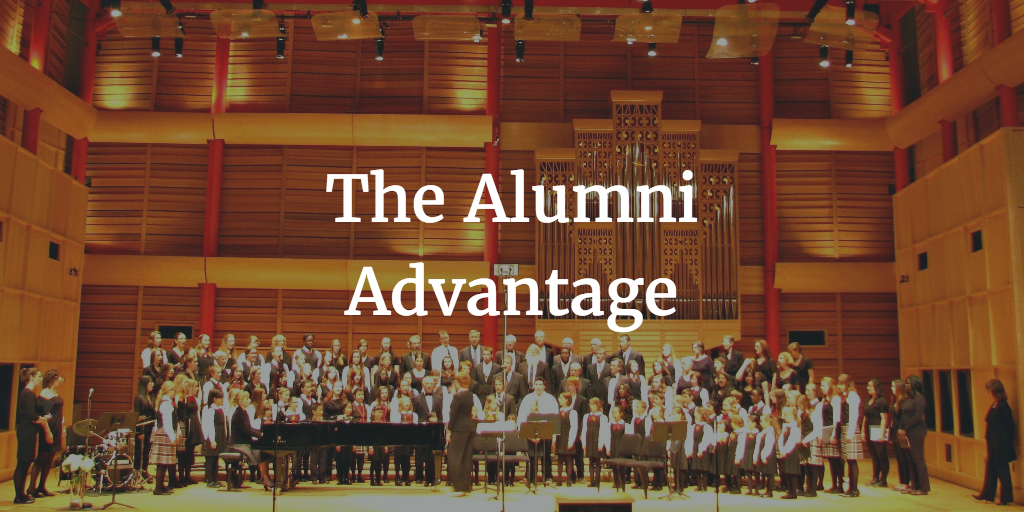
    The ‘alumni advantage’ then is the lasting benefit we receive from the ever-connected web of people who have been directly, and indirectly impacted by their time with the Calgary Children’s Choir. This is an on-going, mutually beneficial relationship. The current choir members can benefit from the mentorship, and relationship with alumni who come back; to teach, to perform as soloists, or collaborate as guest musicians, and those who support the choir in other ways.
    The alumni benefit from always having a welcoming place to come back to, and a comfortable group with whom they can share their talents, and who will always support them.

    Re-connecting with alumni is rewarding, and inspiring – we get to see what our choristers have been up to since they’ve left our organization, and see how they’ve changed, and how they’ve stayed true to themselves. We are so grateful that every five years, our alumni come back home, to help us celebrate another milestone in the CCC legacy!

    How else do alumni benefit our organization? Tell us in the comments!

    Calgary Children's Choir

  • Prized Pieces

    prized pieces

    As we near our 30th Reunion celebration (sign-up here if you haven’t already!), we start to think about all of our old favourite pieces, and which ones we hope to be singing in a few weeks time. There are many reasons why a piece of music might become a prized favourite, and sometimes the reasons can surprise us.

    #1. Memory:
    We have so many wonderful experiences in choir; meeting new people, encountering new music and new ideas, and all of the amazing experiences we have together – great concerts, and eye opening tours. Music can serve as a portal, to transport us back to the memory of those fun times. Often when we hear a piece of music, we associate it with the time in our lives when we first hear it, and loved it. Hearing that piece again returns us, often quite viscerally to the memory of that moment in our lives.

    #2. Meaning:
    Music can elevate our everyday experiences, by using poetry and musical nuance to enhance the way we think about things. Often song lyrics seem much more meaningful because of the metaphorical use of language. Changing your perspective can open your mind, and enhance your perspective on the world. Sometimes a piece of music truly speaks to us, tell us something about ourselves and the way we view the world, and the lyrics seem to be speaking directly to us, or about us. This is another reason a piece can become a favourite.

    #3. Mastery:
    We are very fortunate to have tackled some exceptionally difficult pieces of music in our 30 years at the CCC. One of the most amazing things about taking on difficult music (or difficult tasks in general) is the feeling of absolute elation you feel when you finally master the task. Working hard on something that is challenging is reward in and of itself; by pushing yourself just a bit more, you begin to see just how much you can accomplish. And mastering difficult pieces as a choir, as a team, is that much more rewarding. Some of our favourite pieces are the ones we found the most challenging, and ultimately the most rewarding!

    What are some of the pieces you’re hoping to sing/hear at our upcoming 30th Reunion celebration? Tell us in the comments below!

    Calgary Children's Choir

  • Remembering With Music

    remembering

    This past Sunday, Canada remembered the Battle of Vimy Ridge, on its 100th anniversary. In 1922, France gave to Canada the land for the memorial, and the surrounding area “forever and in perpetuity,” and the memorial was unveiled in 1936. The shining white marble standing stark against the skyline, remembers the 3598 soldiers who died during the assualt on Vimy Ridge in 1917, as well as the 11, 285 soldier who died in France during the war, and have no grave. Their names are etched into the marble base of the memorial, and the figure representing Canada looks out across the field of battle.

    Music accompanies us during our celebrations, but it is also with us in our most solemn times. It helps us to express ourselves when words simply are not enough. It prefaces, and enhances the silence that follows, when we bow our heads together to remember.

    During our tour to France and England in 2003 the Calgary Children’s Choir visited the Vimy Ridge War Memorial, very early one summer morning, when the mist was still hanging in the fields below, and the white marble shone against a crystalline blue sky. We were quiet and solemn; confronted by the sheer immensity of the marble figures against the vastness of the sky, and the silent fields below, feeling the weight of that moment. We gathered on the steps of the memorial to sing; offering up our voices together in song to pay our respects.

    The Calgary Children’s Choir returned again to France, and to the Vimy Ridge War Memorial in 2013, a decade later, returning to those steps again, to sing, to be silent, and to remember.

    Music not only serves as a testament of reverence and remembrance, but it can act as a portal through time, since music is so intrinsically tied to memory. Many of our choristers have remarked that they think of our visit to Vimy Ridge every time they sing or hear ‘Un Canadian Errant,’ one of the pieces we sang on the steps of the memorial. This speaks to the power of music; that it can transport us through time and space, aid us in remembering fine details of events that occurred decades past, and most importantly, keep in living memory the important deeds of those who have come and passed before us.

    We welcome your thoughts, and remembrances in the comments below.

    Calgary Children's Choir

  • Singing In Sacred Spaces

    sacred-space-singing

    We are very excited about many aspects of our upcoming summer tour to Italy, the food, the weather, the art; but we are perhaps most excited for the amazing performance opportunities afforded to us. During our travels we will be singing in a variety of sacred spaces, in Rome, Venice, Lucca, and others!

    interieur-st-pierre-vatican

    One of these amazing performance opportunities, will be the Calgary Children’s Choir participation in Mass at St. Peter’s Basilica in Vatican City. Perhaps one of the most iconic sacred spaces in the world, St. Peter’s Basilica was finished its second construction in 1626 and is considered one of the most beautiful architectural spaces in the Renaissance style. The Basilica, and the colonnade, and plaza outside were designed by several prominent artists: Michaelangeo, Bernini, Maderno, and Bramante.

    san-pietro

    Singing in sacred spaces is different than singing in a concert hall or theatre. Sacred spaces require a solemnity, and a respect for the purpose of the space, whether you personally subscribe to those beliefs or not.
    Often in sacred spaces, a particular set of music is required; as will be the case during the CCC’s performance at St. Peter’s. We will be singing Mass, which includes music that has been set to a very specific set of liturgical texts. Our performance will also be acapella, a common requirement of singing in sacred spaces.

    Most poignant of all, singing in a sacred space, especially one as old and as iconic as St. Peter’s Basilica, reminds us of all those who have used the space before us. Sacred spaces, such as churches, basilicas, and cathedrals are communal places, gathering spaces for the community to come together and share a common set of values and beliefs. In a sacred space as old and as iconic as St. Peter’s, it is remarkable to think of the many hundreds of thousands who visited, or gathered in worship at the Basilica. This will surely have a profound effect on our performance this summer.

    Which performance are you most excited about for our July tour to Italy? Tell us in the comments below!

    Calgary Children's Choir

  • Mentorship In Choir

    mentorship-in-choir

    Choir is wonderful for a myriad of reasons, but one of the best reasons is the community it creates. This is not just a community among peers, but among singers of all ages, abilities, and backgrounds. This creates a wonderful place to develop leadership skills. Here are three ways in which mentorship plays a huge role in our choir community:

    #1. Learning Music:
    Because we are not an auditioned choir, we accept singers at all stages of their musical development. Sometimes this can be challenging for those without any musical experience, so we encourage our choristers to help out anyone they observe to be struggling. This can mean, helping them to follow along in the music, helping with pronunciation of the song is in a different language, teaching them how to organize their music, or listening carefully to their own part! Learning from our peers is just as important as learning from our director!

    #2. Modelling Behavior:
    At the CCC we have a buddy system, where one of our younger Calgary Junior Choir members is matched with an older child in the Calgary Children’s Choir. This is a mutually beneficial relationship, where the younger chorister learns the behavior expected from our choristers, and the older child has the responsibility of modelling that behavior. We have always been impressed with how our choristers have risen to the occasion. Having an older chorister to look up to, encourages our younger singers to keep going, so one day they can be the older buddy!

    #3. Moral Support:
    Part of this supportive choir community, means that there is always someone on whom you can rely. This moral support is imperative in creating kind, generous choristers, who in turn can help others who need it. This is a positive feedback loop, where we encourage our choristers to help out those around them when needed, and then if they ever need support, we can give it back to them. Understanding that support from your choir family is unconditional helps us to create a wonderful, welcoming CCC community!

    How else is mentorship in choir important? Tell us in the comments below!

    Calgary Children's Choir

  • How Singing Can Help You Learn More About Language

    language

    Singing can help with learning in a myriad of ways, but one of the most subtle aspects of singing is in the acquisition of language. Here are three ways in which singing can help you learn more about language:

    #1. Libretto:
    Since the language often contained in vocal pieces is commonly in the form of libretto, there is a great deal a singer can learn from language by viewing it in the context of poetry instead of prose. Libretto often takes into account cadence, and emphasis, rhythm and pulse. This causes a singer to think about language differently than most people, because a singer needs to choose which words to emphasize, and which to de-emphasize. Singers also need to interpret what can sometimes be obscure phrases – poetry is after all, subjective. Textual analysis is an essential skill for singers, and can offer so many subtleties to the acquisition of language.

    #2. Placement:
    Singers spend a rather astounding amount of time thinking about their mouths. This is important because it means we are able to think not only about producing words and sound, but about how those sounds are produced. Elements of language that most people ignore, such as diphthongs, vowel modification, voiced and unvoiced consonants, and projection are the bread and butter of a singer’s life. Thus, a singer spends an inordinate amount of time thinking about where in the mouth, language is placed, and how to modify that placement to create the best vocal sound.

    #3. Pronunciation:
    Pronunciation is extremely important to a singer, because of the subtleties of vocal production and its changing relationship with pitch frequencies. Pronunciation becomes even more important when a singer is performing a piece in a language other than their native tongue. Where a sound is placed in English, for example, is quite a bit different than where sounds are placed in French. Additionally, many languages have sounds that aren’t found in other languages. Learning how to create these sounds is a difficult task, but an incredibly important skill for a singer!

    How else can singing help in the acquisition of language? Tell us in the comments below!

    Calgary Children's Choir

  • Italy and Music

    italy-and-music

    We are so thrilled to be going to Italy this summer on an exciting tour! Italy is one of the most exciting places for musicians, because it is home to some of the most beautiful art, architecture, and musical history in the world! There are many aspects that make Italy an intriguing place for those who love the arts to visit:

    The Renaissance:
    The ‘rebirth’ of Western Music took place in Italy, and is considered a cultural movement that pulled Europe out of the Middle Ages, a dark time in our history, where science, and progress were stagnant. Italy was the home of this cultural movement, and experienced an explosion in innovation and artistic pursuits during this time. Many of the beautiful, amazing buildings and art we are fortunate to enjoy now, came out of this rebirth, and we are very excited to get to see all of this beauty during our trip this summer!

    Art and Culture:
    Italy is home to a great deal of Western art and culture – from the remnants of the immense Roman Empire seen at the Coliseum, the Forum, and the Pantheon, to the modern fashion we see come out of the fashion capitals like Rome and Milan, we are most fortunate indeed that these aspects of our history have been preserved so beautifully, and that legacy of art continue into the modern day. Italy is also home to the City State of the Vatican, which has massive museums, filled with a myriad of art from various eras. In Florence, the Medici family were great patrons of the arts, and that patronage has imbued the city with a wealth of beautiful art.

    Italian opera:
    Italy experienced a resurgence in importance during the Romantic era, when Romantic Opera came to the forefront once again. Composers such as Bellini, Rossini, and Puccini, all enjoyed huge commercial success, and their operas are considered some of the most beautiful examples of Western vocal music. Italian Romantic Opera was large in scope, and full of beautiful arias, which most people (even those who don’t know much about music!) are familiar with, including ‘Nessun Dorma’, and ‘O Mio Babbino Caro’!

    We would love for you to join us this Saturday, March 11th, 2017 for our concert featuring beautiful Italian music!

    in-italia

    Calgary Children's Choir

  • Silent Singing

    silent-singing

    Singers are often thought to be ‘delicate’ compared to other musicians. But because our body is our instrument, we have to take special care of it. This means that we cannot practice in the same way, or for the same amount of time that other musicians practice. Still, there are many ways to practice our music, that don’t actually involve singing.

    Silent singing is one of these methods, and can be practiced in a variety of ways:

    • listening to a recording while following along with the sheet music
    • language study
    • repetition of a specific passage

    #1. Different perspective:
    Silent practice affords the singer a new perspective on the music. Instead of focusing on vocal production, singers can focus on breathing, placement, their interpretation of the music, the subtleties of language, and much more! Silent practice is beneficial not just when a singer is sick, or their voice is fatigued, but it is an important aspect of practice to highlight other areas of singing!

    #2. Language practice:
    Language is such an important aspect of music. Even if a piece is written in a singer’s native tongue, there are a myriad of differences between singing language and speaking language. Silent singing allows singers to practice these subtle differences in a focused an deliberate manner!

    #3. Anytime, anywhere:
    One of the greatest benefits of silent singing is that it can be done almost anytime and anywhere! With headphones on the bus, in a coffee shop, even at the library! This ability to practice in virtually any environment, at any time, means singers can practice just as much as any other musician, just in a different manner.

    How else can silent singing benefit us? Tell us in the comments below!

    Calgary Children's Choir

  • The Importance of Singing Earnestly

    the-importance-of-singing-earnestly

    To be earnest, is to show depth in sincerity and feeling, and in a world of increasing cynicism and negativity, it is an exceptionally important characteristic.

    Though singing is sometimes considered a vain pursuit, nothing could be further from the truth. In order to truly convey the emotional range and depth of a musical piece, a singer’s ego must be completely subsumed. This is even more true in a choir, where there is no one important singer; just many voices, blending to sound as one.

    Singing earnestly requires complete commitment to the piece of music, and to communicating the emotional breadth of that piece. To be earnest, requires a certain vulnerability, that be hard to access while in our difficult teenage years, and even more difficult to access during a performance, when we are acutely aware that all eyes are on us.

    Still, the ability to sing with earnestness, is what allows us to truly connect to music. It gives us permission to put aside what we are personally feeling in order to communicate the emotion conveyed in the piece. Singing earnestly allows us to show how much we enjoy and are moved by music, without fear of judgement, or reproach. Earnestness, while it can feel vulnerable, is instead, the most freeing of emotions, and is an essential aspect of truly moving music.

    Why do you think it’s important to sing earnestly? Tell us in the comments below!

    Calgary Children's Choir

  • Maturity In Musical Taste

    maturity-in-musical-taste

    Musical taste is something that develops continuously throughout your life. Hearing different genres, from different periods in musical history, allows your ear, and your taste to synthesize what it likes about certain types of music, and what you dislike.

    Because of the prevalence of pop music, (it’s called ‘popular music’ for a reason!) much of what choristers are used to hearing when they start singing in choir, is what is currently popular on the radio. While pop music is fun, and can be complex in terms of instrumentation, and often contains interestingly synthesized sounds, pop music is inherently simplistic. This is why it is popular – simple melodies, catchy rhythms, easily remembered lyrics, all help to cement pop tunes in our minds.

    Many choristers have never heard true choral sound, many don’t know how to differentiate the sounds of different musical instruments, and increasingly, many are used to the synthesized sounds so commonly heard in pop music. While there is nothing inherently wrong with this, choir, and early childhood musical instruction affords choristers increased exposure to a multitude of different musical styles, and this exposure aids in accelerating maturity in musical taste.

    Choristers are introduced not just to classical music, which is strikingly more difficult than pop in complexity, they are introduced to folk music, music from other cultures, sometimes sung in different languages, electroacoustic music, sung speech poems, soundscapes and much, much more.

    This diverse instruction aids in choristers understanding and appreciation of not only more complex forms of music, but an inherent understanding of how such forms of music are created. Music theory and music history help to inform these opinions, as well as in-depth discussions of text, and compositional context. These are important skills in analyzing music, and this deeper understanding of music, helps choristers form informed opinions about their musical preferences.

    How else does choir shape your musical taste? Tell us in the comments below!

    Calgary Children's Choir

  • The Benefits of Auditioning

    the-benefits-of-auditioning

    Here at the CCC, we do not audition choristers for entry into the choir for several reasons. We firmly believe that anyone can, and should sing! Our motto is, ‘Singing For the Joy of It’, and we are happy to include everyone. Still, we do audition for solos, or small groups, and encourage our choristers to prepare auditions for school, or other artistic pursuits, because there are many benefits to auditioning:

    #1. Preparation:
    Auditioning teaches you how to prepare yourself. You cannot expect to just stand up, sight-read a piece, and earn a solo. That’s just not how it works. Singing by oneself is a completely different experience than singing as part of a group, and it needs to be prepared differently. In much the same way one prepares for a work interview, or a presentation at a conference, one must prepare a piece for audition, considering tone quality, intonation, and projection, as well as presentation, and emotive qualities. These are all essential life skills!

    #2. Managing Emotions:
    A certain level of emotionality is expected during an audition. Music is after all, a highly emotional pursuit, and singers are expected to emote while they perform. Still, emotions like nervousness, fear, and anxiety are all common when getting up to do an audition. Learning how to manage these emotions is not only an essential skill for singing, but is an important life skill. How choristers handle these emotions, are as unique as the choristers themselves, and no one way will work for every singer. Learning what works best for you, and for your audition is best.

    #3. Confidence:
    Confidence is important, and it’s not like a switch that you can turn on or off. Confidence is built upon, layer by layer, and experience by experience. Knowing that you are able to do something, and do it well, is a learned behavior. It starts by first taking a chance, preparing and managing yourself well, and then analyzing not only how you could make it better next time, but acknowledging what you did well! By accumulating these experiences, and by having the respect and support of your fellow choristers, your confidence will grow!

    How else can auditioning benefit you? Tell us in the comments below!

    Calgary Children's Choir

  • 3 Ways In Which Choir Makes You More Adventurous!

    Calgary Children's Choir

    Choir is an excellent place to test out uncertain waters. It is safe, and communal, and supportive, and it’s a great place to become more adventurous!

    #1. Weird warmups:
    Singing makes many demands of us, and nowhere is this more true than when it comes to strange warmups. We are often tasked with creating sounds rarely heard by human ears, making odd faces, windmilling our arms, wandering around whilst our eyes are closed, singing on various vowels, all of which can feel slightly disconcerting. All of these strange activities help make us better singers, but participating in something that makes us feel slightly uncomfortable, can also help us discover how to push through our own self-imposed limitations.

    #2. Meeting new people:
    Choir is an excellent way to meet new people, because it is, by definition, a group activity! It is also an activity in which new people are constantly being introduced. The CCC accepts new members all year, so there are often new friends to be made, and we regularly work with local musicians, composers, and sometimes other members of the Calgary arts community, like dancers, puppeteers, and actors! Constantly being introduced to new people is an adventure in and of itself, and a great way to become more adventurous!

    #3. Travel:
    We are very fortunate that we get to travel every few years as a choir (including a tour to Italy this summer!) Travel is almost always a rewarding experience, but traveling with the choir is a different kind of reward. It teaches us how to be independent, how to be problem-solvers, how to communicate in other languages and how to enjoy other different cultures. It opens our eyes, and our minds to different experiences, and ways of life.

    How else can choir make you more adventurous? Tell us in the comments below!

    Calgary Children's Choir

  • Fear In Singing

    Fear In Singing

    Fear is a common emotional response in singing, and it’s a difficult emotion to combat. Here are three ways to re-frame fear in singing:

    #1. Fear can be positive:
    Fear as a human emotion, is actually there for good reason. It prevents us from things that may harm us. While singing is not actually harmful, the social fear of rejection is often what our body and mind object to. But fear of singing can also serve a useful purpose, in telling us how important music is to us. Fear before a concert can help us realize how important doing a good job is to us. It can also tell us if we haven’t prepared well.

    #2. Using Your Instrument:
    Many peoples’ fears in music come from a lack of control. We are afraid to sing, because we are uncertain about what sound might come out of our mouths. We are afraid of poor tone, of voice cracks, of running out of air, and a myriad of other problems. And yet, the only way to mitigate these problems is to use our voices. In every other instrument there is the expectation of a learning process, and yet with our voices we believe we either have a good voice, or we don’t. This is a fallacy. Allow yourself time and space to learn to use your instrument properly, and you will start to see great results!

    #3. Support:
    One of the best ways to get over a fear of singing, is through a positive support system. An introduction to singing through choir is a great way to accomplish this. Because choir is a community of like-minded people, whose voices are stronger together, singing in a choir takes a great deal of pressure off of the individual. Choir is also social, and we are much more likely to try new, and difficult things, if we feel we have strong social support behind us!

    How else can you combat fear in singing? Tell us in the comments below!

    Calgary Children's Choir

  • Collaboration In Choir

    Calgary Children's Choir

    Choir is, by definition, an exercise in collaboration. It is inherently collective; a shared experience, and it can help choristers to develop the essential skill of collaboration, both personally and musically.

    #1. Working together:
    This may seem self evident, but working together within a choral setting is fundamental. This isn’t just a musical point as well. Choristers learn in choir that sometimes external differences must be put aside in order to aid in the musical experience. Choristers must work together within their section, the sections must work together to create blended sound, and choristers must collaborate with their conductor to ensure that their voices are unified.

    #2. Working with other choirs:
    Collaborating with other choirs is a unique experience, because while there are many similarities, there can also be great differences between choral groups, and synthesizing those differences can be an excellent learning experience. Not every choral experience is the same, just as every conductor is not the same. Acknowledging similarities, and understanding, appreciating, and most importantly respecting differences are not just essential characteristics in music, but in life as well!

    #3. Working with other musicians:
    We are very fortunate in the CCC to have the opportunity to work with many other instrumentalists, whether we’re doing a larger work with orchestra, or working with one or two other musicians. Collaborating with other musicians is an important aspect of musical education, because it allows our young singers to understand the differences in sound. Balance, blend, and timbre change greatly when there are new instruments, and listening for these differences, and adjusting your own sound to accommodate these differences are important skills!

    How else is collaboration important in choir? Tell us in the comments below!

    Calgary Children's Choir

  • Welcome to 2017!

    2017

    Happy New Year! Welcome to 2017!

    We are very excited to start 2017, because we have so many wonderful things happening in this new singing season.

    -Rehearsals begin again on Tuesday, January 3rd, 2017!

    -At the end of January we will be heading out to Camp Horizon once more for a Winter Retreat!

    – On March 11th, 2017, we will be having our annual concert at the Rozsa Centre!

    -Then, in May, we are thrilled to be celebrating our 30th Anniversary. You can read more about the founding of the Calgary Children’s Choir here. We are very excited to be welcoming back alumni and celebrating 30 wonderful years together with both current and former choristers!

    -We are also looking forward to the summer, when we will be going on another international tour, this time to Italy!

    There are so many wonderful events to look forward to in 2017! We’d love to know what you’re most excited about this year! Tell us in the comments below.

    Calgary Children's Choir

  • Celebrating With Song

    Celebrating With Song

    Holidays are a time for celebration, and there are few things more celebratory than music! Singing in particular offers a great way to manifest that celebratory feeling:

    #1. Communication:
    Celebration is all about communicating a feeling experience by many people at once. Music offers that ability in a manner that transcends language, culture, and religion. Making music is one of the most ancient and respected of human endeavours, and it plays an essential role in our celebratory tradition!

    #2. Community:
    Singing offers a feeling of belonging; many people at once offering up a song as a an observance of the festivities. Singing as part of a group enhances this feeling even further; particularly since choral music is all about creating, and serving a community. Music increases feelings of cohesion and community, and singing as part of a community enhances those feeling (and even prompts physiological changes in the body!)

    #3. Expression:
    Words offer another important layer to music, and singing allows for the expression of musical celebration to be even more evident through the important use of text. Expressing ourselves both through music as well as language allows us to communicate the reason for the season as effectively as possible!

    How else can we celebrate with song? Tell us in the comments below!

    Calgary Children's Choir

  • Trust In Singing

    Trust In Singing

    Singing, and music in general engender many emotions, as discussed in this post. There are many positive emotions that arise from singing, as well as the occasional one. One aspect of positive emotion found particularly in choral singing, is trust. Trust is a powerful emotion because it takes time and effort to build, but can be broken in an instant.

    #1. Trusting the director:
    The director of an ensemble is the leader in many ways. From selecting the music we sing, to facilitating our learning of a new piece, to ensuring that all the disparate parts of the choir come together, to creating artistic, musical moments in live performances, the director is responsible for so many aspects of our choral experience. This would be an impossible job without the trust of the choristers under their charge.

    #2. Trusting other choristers:
    Singing with others means trusting them to do their part. Choir is about disparate parts making up a whole, and in order to do that, choristers have to subsume their ego, and blend into a sound larger, and grander than they can make by themselves. This requires a delicate balance between doing your best for the group, and supporting other choristers in doing their best for the group.

    #3. Trusting the music:
    This can be the most difficult aspect of singing, because while we are singing, we don’t actually hear the piece the way the audience does. In a performance, we must trust our training, trust the director, trust the other choristers, but most of all, we must trust the music, and the emotion we feel during a performance, to help inspire our singing, and drive us towards our best singing selves.

    How else is trust important in singing? Tell us in the comments below!

    Calgary Children's Choir


  • How Emotions Affect Singing

    How Emotions Affect Singing

    Emotion is necessary in musical expression, but our emotions can have a very strong effect on how we sing. Here are 3 ways in which our emotions can affect our singing:

    #1. Positive emotions:
    Positive emotions, such as joy, excitement, and love, often have an equally positive impact on our singing. These emotions help us to feel confident and engaged in what we’re doing, meaning our breathing is more free, our sound is focused, and we blend well with other singers around us!

    #2. Negative emotions:
    Negative emotions, such as fear, stress, or anger, can have a deleterious effect on our singing. These emotions inhibit musical expression, often dragging pitch down, introducing bodily tension, hindering supported breathing, and freedom in our singing.

    #3. Changing emotions:
    One of the most wonderful aspects of music is how engaging in it, whether through listening, or playing an instrument, can actually change your mood! If you’re experiencing negative emotions, one of the best things you can do is start singing! Singing forces you to pay attention to your body, to stay in the present moment, and to regulate your breathing that creates a meditative effect. Plus, singing in a choir with others, has been shown to have a very positive effect on mental health!

    How else might our emotions affect how we sing? Tell us in the comments below!

    Calgary Children's Choir

  • Singing For Wellness

    Singing For Wellness

    There are many studies that have shown the benefits of music on cognitive function, and childhood development, but perhaps one of the greatest benefits of music, and singing in particular is the benefits to our sense of well being.

    #1. Physical Well-being:

    Singing requires a great deal of physicality, and an excellent sense of self. Because a singer’s body is their instrument, there is a far greater emphasis placed on understanding your body. Singers need to ensure that they eat properly, sleep properly and rest their voices, so that their voices are at their best!

    #2. Mental Well-being:

    Singing is also an incredibly cerebral activity. It involves conceptualizing one’s voice internally, since a singer is unable to view, and manipulate their instrument in the same way other musicians can. Stress, fear, and uncertainty all influence the way the human voice sounds, as do excitement, anticipation, and happiness, so it is important for singers to understand, and address the emotions they are feeling.

    #3. Singing With Others:

    Perhaps the greatest benefit of singing, is that singing with others has been shown to greatly enhance one’s sense of well-being. Since choir is a social activity that requires members to pay great attention to what those around them are doing, a choir becomes a very close knit group; supporting, and unconditionally accepting the diversity of its members.

    How else can singing enhance your wellness? Tell us in the comments below!

    Calgary Children's Choir

  • The Sounds of Silence

    The Sound of Silence

    Choir, and music in general is all about how to organize sound, so it seems incongruous to discuss the importance of silence in singing. But silence is an exceptionally important aspect of music, and here are three reasons why:

    #1. Audience:
    In classical settings, unlike more popular music concerts, the audience is expected to be quiet while the musicians are performing. This is so that everyone has the same opportunity to hear the subtleties and nuances of the music, so the musicians are not distracted by unnecessary noise, and because classical musicians rarely use electronic amplification.

    #2. Applause:
    Applause is generally the way an audience shows appreciation for the music they’ve just heard, but in some cultures, the audience expresses their appreciation through silence. This stems from the belief that applause interrupts the mood the music has just created. Applause is also often not used for music performed in religious ceremonies, or music that is part of a larger multi-movement work.

    #3. Enhancement:
    Within the music itself there can be silence as well. For a choir, the effect of singing acapella (without accompaniment) creates a feeling of greater intimacy with the audience. The composer can often use rests and pauses to great effect – using sudden silences as punctuation, or to enhance the emotional aspect of a given performance.
    Listen to the emotional, and musical effect of small pauses between each phrase in our performance of ‘All Too Soon’:

    How else can silence be important to music? Tell us in the comments below!

    Calgary Children's Choir

  • The Benefit of Sectionals

    The Benefit of Sectionals

    We spend a lot of time discussing how important it is to sing as a group, to listen to the other parts, and to blend seamlessly, but it’s just as important for sections of the choir to break off sometimes and have their own time in a sectional, separate from the rest of the choir:

    #1. Bashing notes:
    At its most basic function, sectionals provide the opportunity for everyone in that section to really learn the notes and the rhythm. This is the significantly less glamorous aspect of choir, singing the same section of a piece over and over again, until everyone has the note, but it serves an important function. Not everyone learns at the same rate, and some choristers need more time within their own section to really feel confident in their part

    #2. Section unity:
    Going off in different sections of the choir is important because of the social aspect as well. There is something about identifying as a part, soprano, altos, tenors, or basses, that makes choristers feel like they belong. This is important in their singing as well. By knowing the people in your section, and their voices, you know who to rely on in the more difficult parts of a piece.

    #3. Listening:
    As we’ve discussed before, listening is just as important as singing in a choir. Breaking off into sectionals forces choristers to listen in a different, and often more nuanced way. No longer are choristers trying to hear their part against others, and blend their voices within a myriad of different timbres; instead they must contend with the difficulties of unison singing – blending their voice with others that have similar timbres, ensuring that rhythms and pitches are crisp and clear.

    How else do sectionals benefit choristers? Tell us in the comments below!

    Calgary Children's Choir

  • Atmospheric Music

    Atmospheric Music

    Happy Halloween!

    In honour of this spooktacular day, we thought we would discuss how important music can be in the creation of atmosphere!

    #1. Creating tension:
    Try watching a scary movie without the sound, and suddenly, it becomes significantly less terrifying. This is because music and sound are used to great effect, in enhancing tension. By using dissonance (pitches close together), music can create a sense of suspense, and discordance that can be used, usually quite subtly, to heighten the emotional aspects of a scene.

    #2. Mimicry:
    Instruments can be used to great effect to mimic terrifying sounds. Wind instruments are extremely successful at making ghostly winds, and fluttering, and violins can be used to mimic screaming sounds. Percussive instruments like cymbals, clavicles, chimes, are very versatile at mimicking familiar sounds. These instruments can be used within pieces, or as their own sound effects to create a sense of creepy familiarity!

    #3. Leitmotifs:
    Leitmotifs are musical phrases, designed to represent a person, place or idea. In the movie Jaws, the sinister shark is represented by a minor second interval, played over and over again. The viewer becomes attuned to those pitches, and understands that whenever they are played, it means the shark will make an appearance. This greatly enhances the scary atmosphere of the movie. Leitmotifs are often used in horror films to foreshadow the villain’s arrival!

    How else does music contribute to creating an atmosphere? Tell us in the comments!

    Calgary Children's Choir

  • Discipline In Singing

    Discipline In Singing

    One of the most important aspects of learning music, is the discipline that it requires. Studying music is not like many other pursuits; it  requires continual and dedicated time, patience, and discipline.

    #1. Little by little:
    Music, like learning a new language, is best done in small, but consistent portions of time. The repetition required to really understand musical concepts, means that it is essentially impossible to ‘cram’ for music. The most successful musicians and singers understand that music is a daily practice; a habit to be worked on every day for concerted period of time. Singing is best practiced little by little, every day.

    #2. Accumulation of knowledge:
    Music is one of those areas of study in which there is always something more to learn. And musical knowledge always builds on more basic concepts learned first. Thus, in music and in singing, it is necessary to develop fundamental skills first, and then build on those skills, challenging yourself with more difficult music, as you gain the necessary skills. This requires dedication and discipline, and an understanding that the study of music is never really finished.

    #3. Process over product:
    Singing is most effectively learned when you focus on the process of singing, and not the final product. Because the nature of singing is inherently variable, a piece of music is never sung the exact same way twice. This can be difficult for beginning singers, because we live in a ‘results’ obsessed society. Understanding your instrument, how it works, what factors affect it, and how your emotions, and perspective influence your instrument, are much more important to beginner singers than whether any given performance sounded the way you wanted.

    How else is discipline a necessary component in the study of music? Tell us in the comments below!

    Calgary Children's Choir

  • The Importance of Early Music Education

    The Importance of Early Music Education

    Every day we learn more about the many benefits of music education. There have been numerous studies in recent years highlighting the myriad ways in which learning music can benefit people in both mind, and body! Nowhere is this more evident than in early childhood:

    #1. Sound is natural:
    Sound is everywhere. It is as much a part of our natural world as anything else. Teaching children to feel the beat, or hear pitches organized in a certain way, feels as natural to them as learning to identify the colours they see around them, or to count the number of blocks they’re playing with. By teaching them musical concepts at an early age, we reinforce that music and sound are a natural part of our lives, and we provide guidance to our children about how to navigate those sounds.

    #2. Fundamentals:
    By teaching small children the fundamentals of music early, we ensure that by the time they are old enough for junior choir, or even private lessons in a particular instrument, they possess an inherent understanding of the fundamentals of music. Learning music at such a young age, also helps children develop a fundamental understanding of language, how to use their bodies and even basic mathematical concepts!

    #3. Early socialization:
    It is very rare that one learns music completely by oneself. Our music programs reinforce the concept of learning with others. Music is a shared experience; learning with others helps children to reinforce the concepts they’re learning, as they watch other children, and learn in different ways from each other. It also helps to socialize children early, preparing them to interact well with others.

    You can learn more about our Early Music Education program, the Music Makers here!

    How else is early music education important? Tell us in the comments below!

    Calgary Children's Choir

  • Present Focused Performance

    Present Focused Performance

    Performing is a unique aspect of singing with a group. By the time a performance rolls around, the basic necessities of learning a piece of music are already accomplished. The notes, and rhythms have been learned, the words have been memorized. Performance evokes something completely different in musicians. It makes demands of your present self:

    #1. Forgiving Mistakes:
    One of the most beautiful things about music is that there is never perfection. A performance only highlights this, because there are a myriad of factors that contribute to a successful performance, and very rarely do they all go off without a hitch. In a choir setting, there is also the variable of many more voices. Thus, mistakes, even small ones are bound to happen in a live performance. To stay present focused, instantaneous forgiveness of any mistakes is crucial.

    #2. Responsiveness:
    In a choral performance, the conductor is not simply there to keep the beat, or to bring everyone in on their respective entrances. It is the unique responsibility of the conductor to respond to the energy of both the audience and the performers, to enhance the musicality at any given moment. By remaining focused on the present, singers are able to respond to the slightest direction from their conductor, making the performance that much more sensitive and nuanced.

    #3. Creating a moment:
    Performing is different from just learning a piece of music, and singing it for yourself. By allowing an audience to hear the music that you have spent time and energy working on, a new opportunity opens up. Performers who are present focused, can respond, in real time to the reactions, emotion, and energy from their audience, heightening heightening the musical experience for all! Creating a musical moment like this can only happen when a performer is focused on the present.

    How else does performance encourage you to stay focused on the present? Tell us in the comments below!

    Calgary Children's Choir