
Author: Kevin Jones

  • 2019 Tour | Day 7 – Leipzig

    2019 Tour | Day 7 – Leipzig

    We were lucky to have a bit of a later start today, leaving the hotel at 9:30 for a walking tour of Leipzig. On the tour, we saw quite a few prominent places including the university, the stock exchange, and some of the stunning buildings, along with some statues of Bach and Mendelssohn. 

    After our tour we headed to St. Thomas church; the last resting place of Bach. While there we were invited to sing in a short prayer service. We then sang a 20 minute concert for the people inside the church. Followed by a more intimate performance of the Bach Aria around the grave of Bach. Which was in the center of the sanctuary inside the church. 

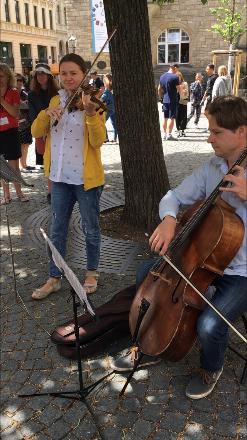
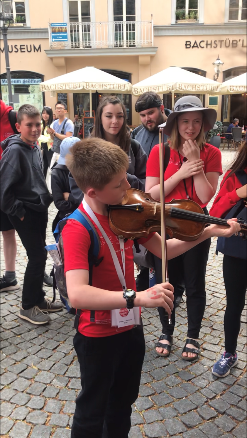
    Outside the church, there was a string duo busking. (The same duo that some of the youth choir had met the night before.) They recognized the group and asked us to sing as a whole choir with them. We sang what we could remember of Ave Maria and were very we received by passers by. 

    Pearson then asked the violinist if he could play her violin, she agreed and was cheering him on the whole time. 
    After our performance with the string duo, we went back to the square in which our hotel was located. The group then had free time for the entire afternoon before dinner. We broke off into groups with our chaperones for lunch, and some additional sight seeing, although a few groups went on a walking tour of Leipzig with our tour guide Gabi and Ms. Strome. 

    After the free time, we went for a delicious steak and chicken dinner. We all made bets on whether it would be steak or chicken, and were pleasantly surprised to find both!
    The chaperones took us on a detour on the way back to the hotel and stopped us in a green space where Josh led us in some tag games and campfire songs.
    On the way back to the hotel there was a man who asked where we were from and got very excited when we said Canada. He said he has friends in Canada and that he spoke French. So we spoke with him in French then sang a song for him and he was so thrilled. He told us that he will remember this day forever, I think most of us will as well.
    Today was a great day in Leipzig and we can’t wait to head out to Berlin! 

    Hannah, Kalika, and Gabriel. 
  • 2019 Tour | Day 6 – Leipzig

    2019 Tour | Day 6 – Leipzig

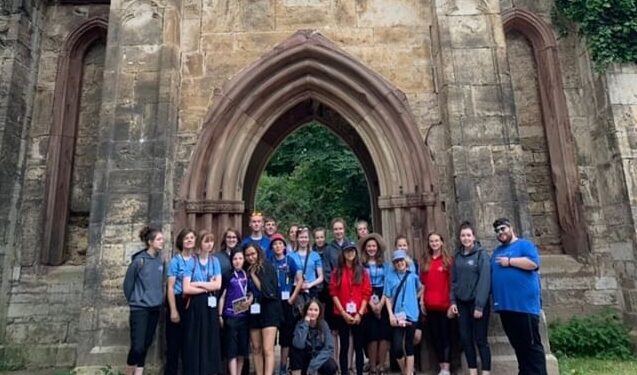
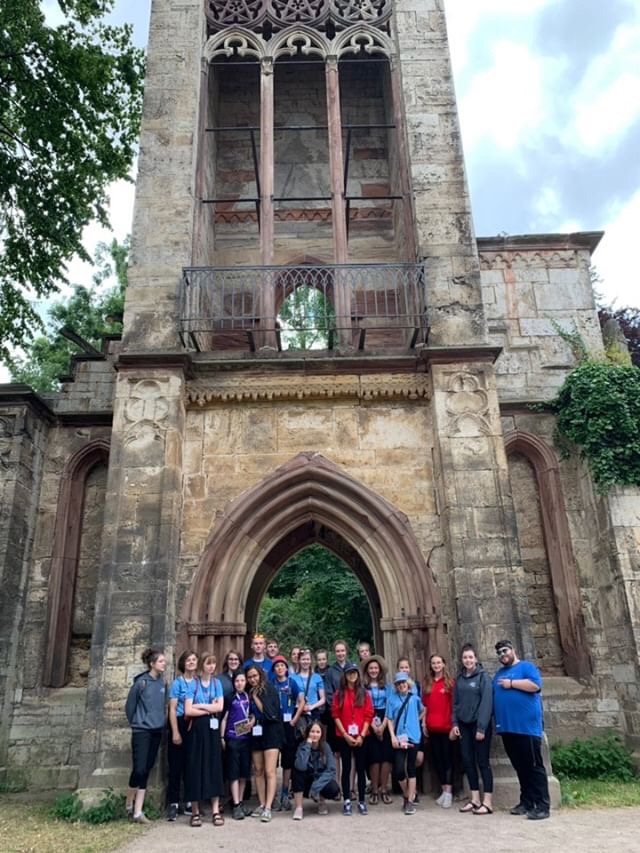
    The choir started the day off bright and early to travel to Ohrdruf to visit the house Bach stayed in with his brother after his parents had died. It was  a a little windy, but the cooler weather was very welcome! After a short time in the square we once again hit the road traveling now to Arnstadt!

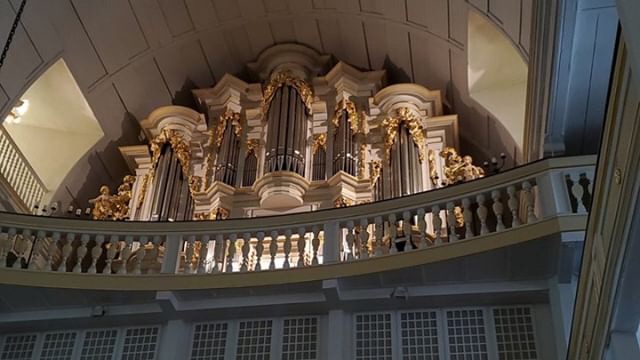
    Once we arrived, we took a short walk to the first church Bach had worked in, as the organist! In the year 1703 Bach traveled to Arnstadt to inspect the churches organ. The choristers can attest to how gorgeous the organ is, the photos just dont do it justice.

    Next we were off to Weimer! After some free time in the towns main square, we started our guided tour, observing some of Weimers most famous buildings and houses; including the very famous Elephant hotel!

    Our long day ended in Leipzig, with everyone checking into the beautiful hotel, and having some free time for dinner in the square! We can certainly verify that the bratwurst in Germany is like no other.

    We are both joyed and sorrowed to say that baby Bach, our beloved mascot for the trip, fell back in love with his home town of Eisenach, and decided he would take a leave of absence from the group to catch up with some old friends, he will be missed, but we wish him all the best! 

    Gute Nacht!

  • 2019 Tour | Day 5 – Eisenach

    Baby Bach here! Hope you’re ready to find out all about our day today back in my hometown. We started off the day on the bus from Prague to Eisenach.

    I stayed up to watch the rolling hills of my home country for a while, but eventually most of us decided to catch some z’s to pass the time.

    After a few stops to grab some lunch and have a break, we arrived at my house! At least, what is used as the museum and was once thought to be my childhood home. At the Bachhaus, I was surprised to see how much artwork there was of me! I really liked this one:

    We got some time to look around, and was happy to be able to see the beautiful, old garden.

    After watching a presentation on the instruments that were used during my time (such as the harpsichord and chamber organ), we were back on the bus to head to Wartburg castle!

    The architecture was absolutely lovely, and we got to enjoy a guided tour of the castle. We had time to wander the museum and were able to enjoy the exhibits and learn about the history of this city. After all of that, we headed to dinner to end the day.

    We got to enjoy German food in a tavern-style restaurant. Everything was modeled after what seemed to be medieval-era décor and the people who worked there were dressed up in era appropriate garb as well. Overall, today was a blast and I’m sad to leave my hometown so soon, but on to the next town!

    See ya,
    Baby Bach (also Carly, Meghan, Rachael, and Sasha)

  • 2019 Tour | Day 4 – Prague

    2019 Tour | Day 4 – Prague

    Our morning began, as most fine mornings do, in the sweltering heat, on the Prague metro, in wool kilts, getting laughed at by crazy people.

    We then made our way back to St. Vitus’ Cathedral to participate in Sunday mass with all other members of the festival. It was cool to see how the different eras affected the architecture.

    On our way to the tram, we quickly stopped at St. Wenceslas’ Vineyard for some pretty pictures and souvenirs! 

    We took a quick trip on the tram to the Old Town Square for lots of free time to get yummy food, and spent the rest of our Czech Korunas before we leave for Germany tomorrow. 

    We made our way to the (thankfully cool) Church of St. Gallen to perform our shared concert with the Prague Lady Teachers’ Choir. It was a beautiful space to sing in, and both choirs did an excellent job! 

    Finally, the crown jewel of our evening; our dinner cruise on the Vltava River. With food, a view, and the most beautiful souls we’ve ever had the pleasure of encountering. We shared the night with the Spjevule and Strumochok choirs from Slovakia and the Ukraine respectively. Although we only parted mere hours ago, we miss them all dearly. We laughed, we cried, we left. We exchanged Instagram’s. It’s been an emotional night. 

    It’s now very late. We have to pack so we can say goodbye to Prague and continue with our shenanigans in Eisenach tomorrow. We hope the rest of the trip is as good as today was! 

    xoxo,

    Baby Bach & the Gang 
    (Adriana, Grace, and Sarah)

  • 2019 Tour | Day 3 – Prague

    Today the choir group started their day with a delicious breakfast followed by a trip down to the hotel’s pool to dip their toes into the water. Next up they took the metro to meet other choirs at the St. Vitus cathedral.

    St. Vitus is the cathedral which is connected to the famous castle just outside of the city center in Prague. The choir then got to listen to some of the other groups in the amazing space. After being treated to the performance the groups began rehearsing for mass. The choir then got to sample some delicious mozzarella pizza for lunch and enjoyed the rest of the sunny day!

  • 2019 Tour | Day 2 – Prague

    2019 Tour | Day 2 – Prague

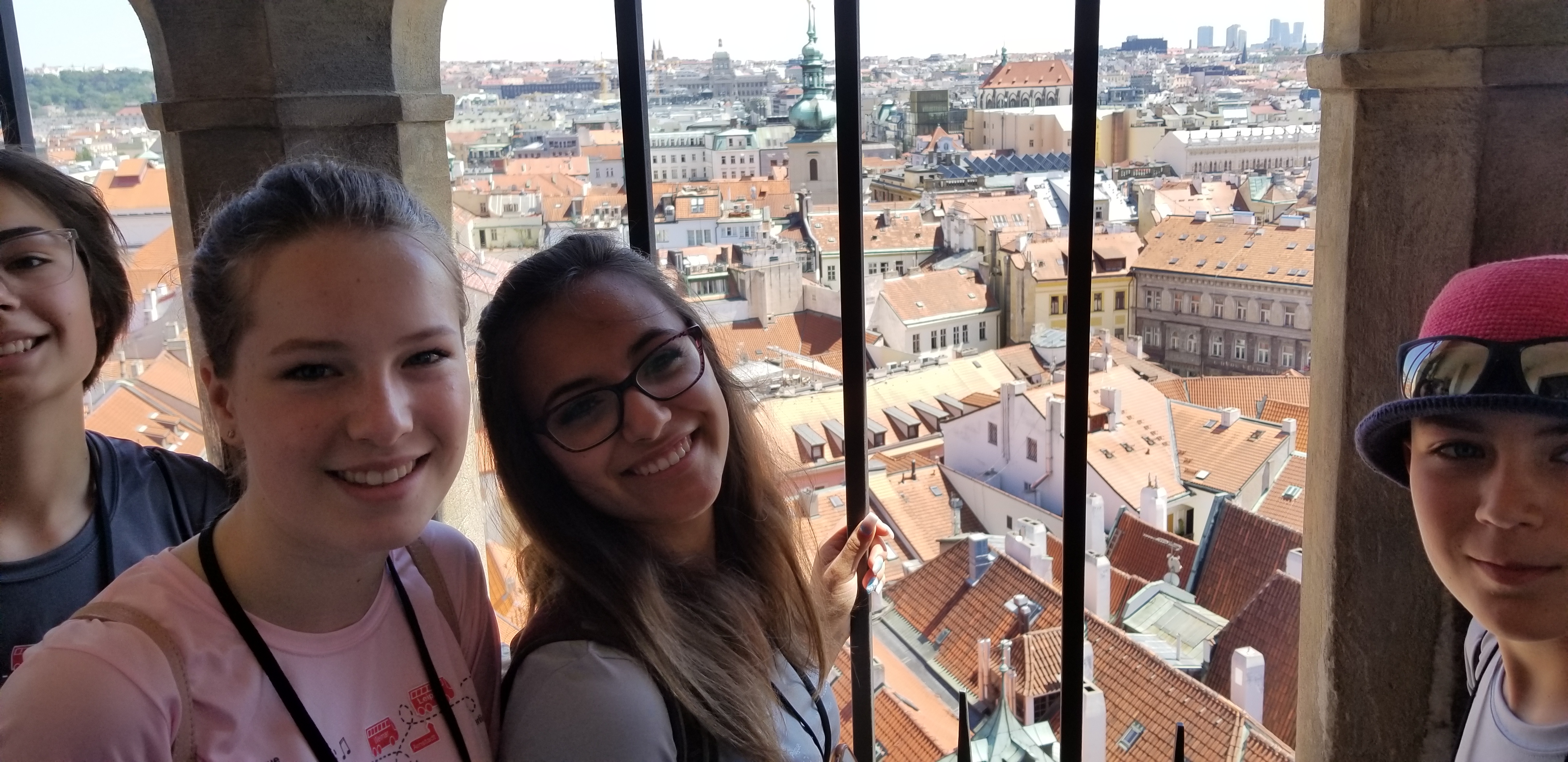
    Friday morning we took the subway and the tram to the center of town and had a two-hour master class at the Music Conservatory. There, our conductor taught us some folk-songs in Czech! It was a great session. After lunch, there was a welcome ceremony at City Hall, where we were addressed by the Mayor of Prague and other dignitaries. This was followed by a tour of the city hall and a climb to the top of the clock tower. Once we reached the top we were treated to stunning city views.

    In the late afternoon, all the choirs sang a brief program for each other. We enjoyed hearing the other choirs with their unique sound, style repertoire and uniforms! Everyone was fantastic and it was interesting to hear the differences between them all. We rounded off the day with a dinner of pork, a LOT of it, with potato dumplings, cabbage, and carrot cake for dessert! After a subway ride home at 11 pm, we were all ready to settle in for a good nights sleep. Thankfully, our day tomorrow is a later start and we can sleep in a bit.

  • 2019 Tour | Day 1 – Prague

    It has been a busy, exciting tour so far. After we arrived in Prague at 7:00 am and grabbed a quick airport breakfast. It was about midnight our time when we met our tour guide but the kids and chaperones held up extremely well and had a great time on the morning walking tour of parts of the old city. We went to the castle, saw St.Vitus’ church, (where we will sing on Sunday), walked across the famous Charles Bridge, and had lunch in the town square. The weather was hot and humid, and in spite of our lack of sleep, we were able to enjoy the morning. We even had an impromptu performance in an echoey archway at the castle, which was subject to numerous cell phone cameras!

    After lunch we arrived at out hotel and many of us couldn’t wait to get our room key so we could catch a nap.

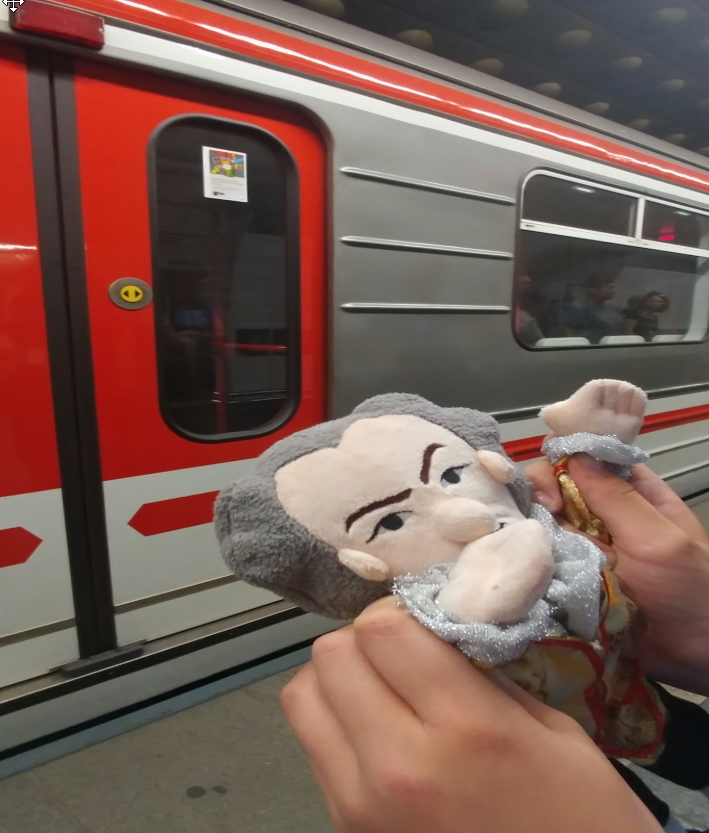
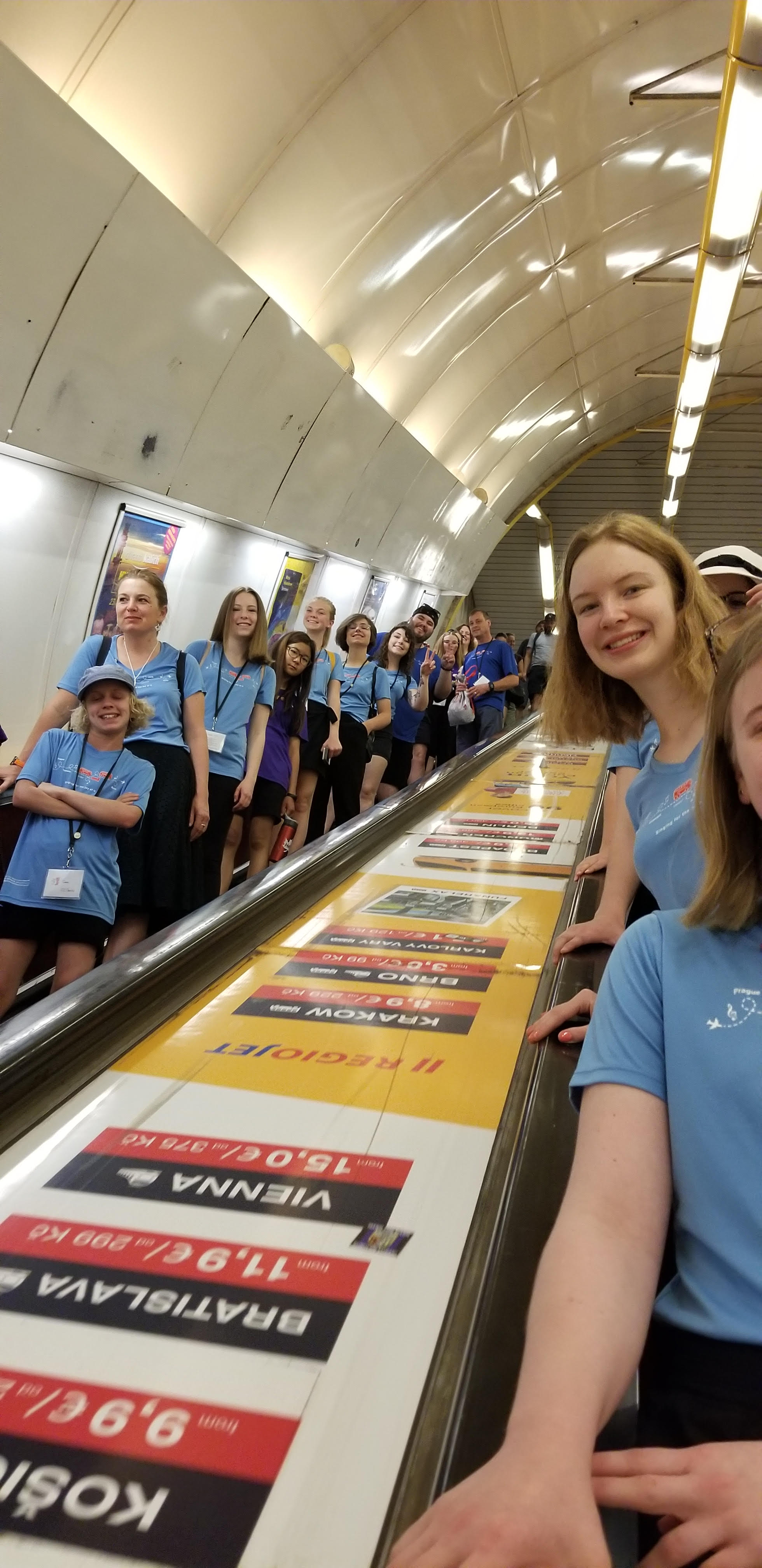
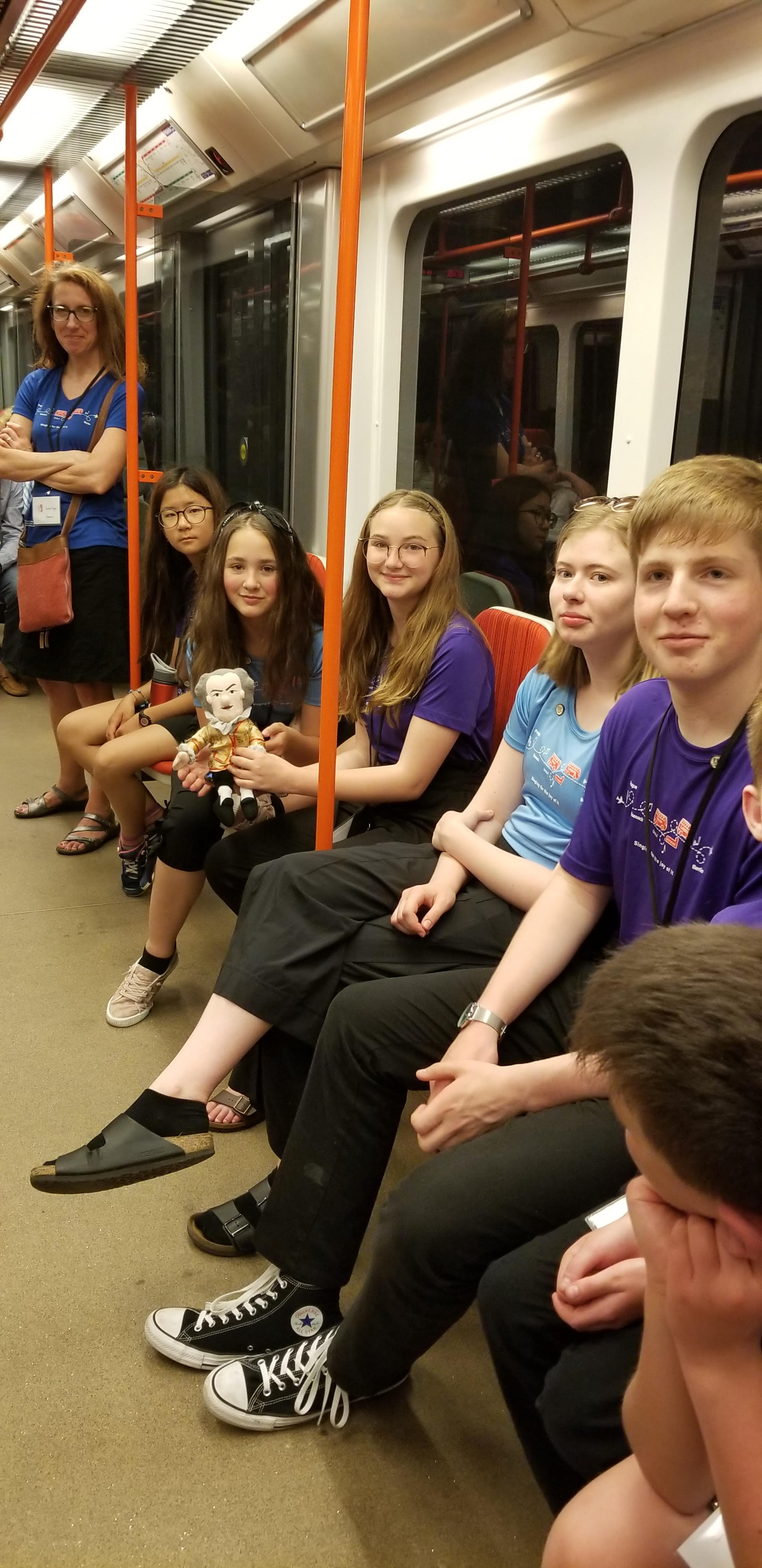
    In order to get around we have become subway pro’s. Thursday night, when we caught our first subway to our restaurant for dinner and our mascot, “Baby Bach” enjoyed the ride, and the steep escalators!

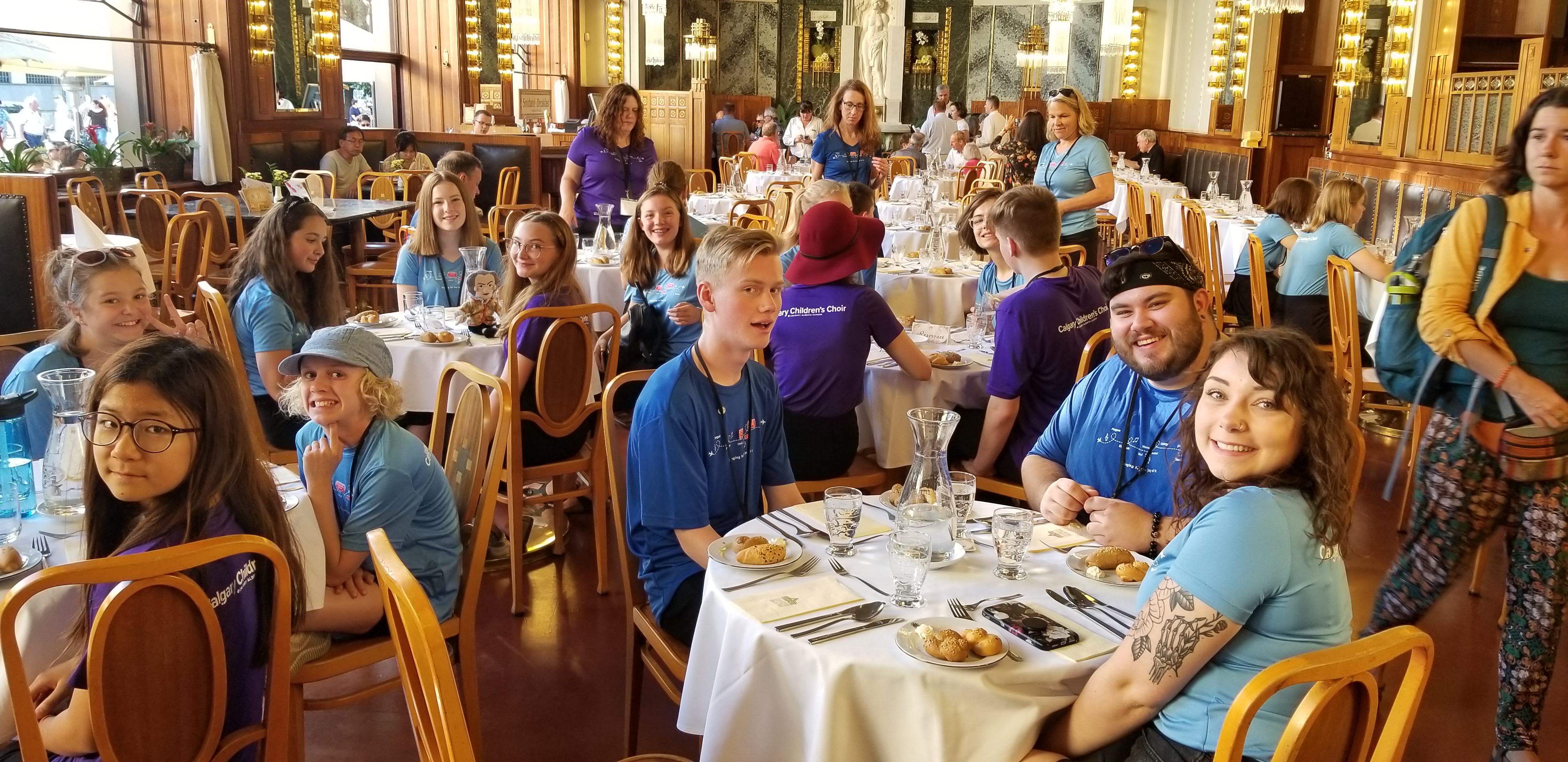
    We enjoyed meeting and sharing a song with the Young Men’s Ensemble from the LA Children’s Chorus, after a beautiful welcome dinner at Smetana Hall. This choir, along with choirs from Slovenia, Ukraine, Slovakia, and the surrounding area, are all participating in the choral festival.

  • Calgary Children’s Choir presents Bach to Rock

    Saturday May 11, 2019 at 7:00pm. 🎫 Tickets Now Available!

    Purchase yours here!

    Eckhardt-Gramatte Hall (Rozsa Centre)
    206 University Court NW
    Calgary, AB

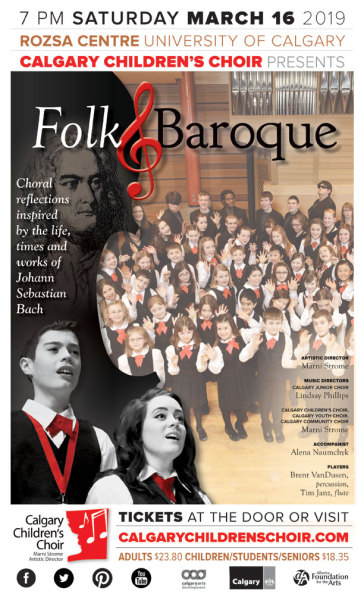
  • Calgary Children’s Choir presents Folk & Baroque

    March 16, 2019 at 7:00pm. – Tickets Now Available

    Purchase yours here!

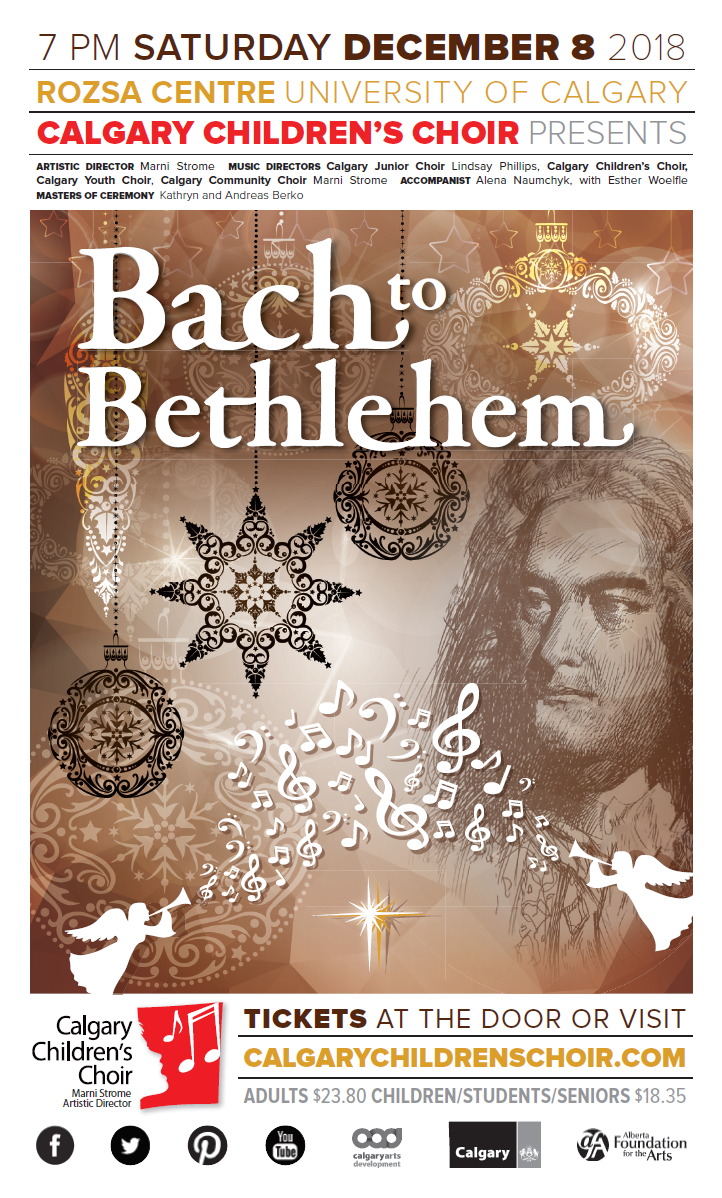
  • Calgary Children’s Choir Presents Bach to Bethlehem

    We are super excited to announce our Christmas concert, Bach to Bethlehem!

    Tickets will be a hot commodity so be sure to purchase yours here!


  • 2018 Fall Choir Camp

    2018 Fall Choir Camp

    This year’s camp was yet another success!

    Choristers showed up at Camp Horizon buzzing about the weekend to come and were already looking forward to Skit Night, campfire songs and all the other activities camp has to offer.
    After the first night of icebreaker games, the real “work” began.

    The first full day at camp was a mix of choir rehearsal time and regular camp activities like capture the flag and practice time and arts and crafts. All this rehearsing and running around, however, did little to tire the campers out for skit night. Campers were sorted into teams and were tasked with creating a Bach themed skit. (We think the choir should look into musical theater based on what we saw.) Every group pulled off some very unique plays that thrilled chaperons and choir members alike.

    After the skits were concluded, the group huddled around the campfire singing everything from old repertoire to call and repeat songs under the stars as dusk turned into night. Little ones were sent to bed group by group and soon everyone was back in their cabins dreaming of the popcorn fairy.
    The next morning was a whirlwind of rehearsals in preparation for the day’s concert for the parents. After a successful concert, it was time to collect compliment envelops and head home!

    We are certainly looking forward to winter camp this January and even more forward to our first concert of the year, our Christmas concert on December 8th.

    See you there!

  • Introducing the Calgary Community Choir!

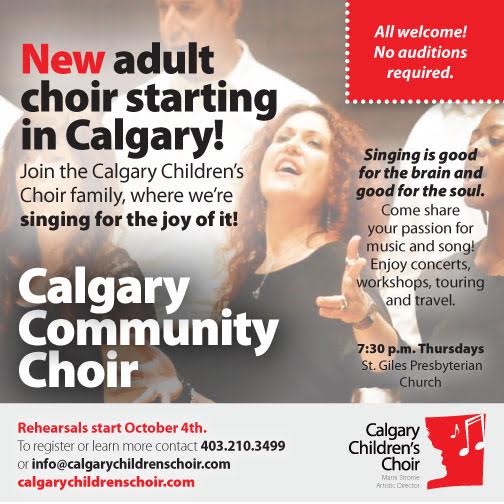
    The Calgary Children’s Choir is pleased to introduce the Calgary Community Choir. This is the newest addition to our multi-age program and will welcome choristers 21 and older. Anyone with the desire to sing is invited to enroll regardless of choral experience. The long-awaited, new group will be under the direction of Marni Strome, the current musical director for the Calgary Children’s Choir and the Calgary Youth Choir.

    “This has been a highly demanded group and I think now is just the right time to start it up,” says Marni Strome.

    The group will be practicing once a week from 7:30pm to 9pm on Thursdays beginning Oct. 4 leading up to the Christmas concert in December. The group will then start back up in March in preparation for the final May concert. With a total of 10 rehearsals before performances, YYC CC is a low commitment group perfect for those with limited time.

    “There is a possibility that with enough demand we would consider restructuring the rehearsals to span the entire year,” explains Marni, “but during this trial period we will start with less commitment and see how it goes.”

    The group will be an amalgamation of the St. Giles Church Choir and Calgary Community Choir members. Members have the opportunity to enroll with the church choir and join them on Sundays for the service free of charge. Registration for the new group includes a fee of $130 per semester or $260 for the full year. We hope to see alumni and newcomers alike!

    If you or anyone you know has questions about the YYC CC, contact Business Manager Linda White at info@calgarychildrenschoir.com

    To register to the Calgary Community Choir please click HERE.

    Happy singing!


  • How To Practice Singing Over A Break

    #1. Use Your Voice:

    The most important thing you can do for your voice over a break is to continue singing – every day if possible. It can be easy to stop singing as much during a break, and choristers often find that their range is not quite as large when they come back from a break. This is easy to mitigate, by continuing to sing, even if it’s just in the car, or the shower!

    #2. Work On Musicianship Skills:

    One of the most important skills for a singer is musicianship skills – improving your ear, and ability to understand the relationship between different pitches. There are many ways to do this, from ear-training websites, to practicing by yourself with a piano (or a piano app!)

    #3. Use Your Break To Discover:

    There are so many different genres of music, as well as different fields of study within music. A break is a great way to discover what other aspects of music interest you – whether it be learning more about music history, or music theory, exploring composition or improvisation, or even learning more about a genre of music you aren’t as familiar with – like jazz, or Baroque music. There are hundreds of years of music history, from all over the world, so use your break to discover what else is out there!

    How else can you use a break well? Tell us in the comments below!

  • 3 Reasons Why You Should Join A Choir Right Now

    #1. Singing together:

    Singing is a wonderful activity, as good for your physical health as it is for your mental well-being. While it’s wonderful, and very valuable to get one on one instruction in singing, learning how to sing with others is every bit as valuable! Choral singing has its own technical requirements and requires different skills than singing by yourself – such as harmonizing, blending, balance, and intonation.

    #2. Meet new people:

    Singing in a choir is a great way to meet new people from many different backgrounds, and life experiences. Bonding over music can lead to life-long friendships, as well as an appreciation for people who have different perspectives from your own. Choir attracts a wide variety of people, all with a shared interest and love of music, and is a great activity for people who are interested in getting to know others in a low-pressure setting.

    #3. Learn something new!

    Expanding your skill set is always valuable, and if you’ve always had an interest in music, but been a bit uncertain about taking lessons, or unsure about which instrument to try, a choir is a wonderful way to learn more about music without investing as much money or time, as other instruments. Because choir is a group activity, it has other wonderful benefits too, like shared community, built-in support system, and a sense of teamwork and working towards a common goal!

    Why else should you join a choir? Tell us in the comments below!

  • 3 Tips To Help You Get The Most Out of a Choir Workshop

    3 Tips To Help You Get The Most Out of a Choir Workshop

    Choir workshops only happen a few times a year, and at the CCC we like to schedule them a couple of weeks before a concert. They’re an excellent chance for us to really get into the feel of the overall concert, and to discover any areas of the music that aren’t quite working yet, or that need extra work. Here are three ways to help choristers get the most out of choir workshops:

    #1. Be Prepared to Work:

    Workshops can feel frustrating sometime because they are an opportunity to really get into the details of a piece of music, as well as to iron out any problem areas. This sometimes means that we don’t sing a piece through fully, or that we go over a particular passage a number of times. Workshops are exactly for this sort of targeted, specific practice, so lean into it, and appreciate that all this repetition, or focusing on just a few notes, is what will make the piece sound beautiful!

    #2. Make it fun!

    Workshops are often a chance for all of us to be together, all three of our performing choirs, all conductors and accompanists, and any of the musicians who will be joining us at our concert. It’s always so nice to see everyone, and catch up, so we try to have fun with our workshops and make sure there’s time to socialize.
    We also sometimes like to make it themed – for examples, we’ll often invite choristers to wear their pajamas to workshops!

    #3. Take responsibility:

    A workshop is a great way for individual choristers to evaluate how their own progress is in relation to the group’s progress. If you notice that there’s a part that you need to practice, make a note of it, and take another look at the section at home. Doing the best job you can do is part of being a good team member!

    How else can choristers make the most of choir workshops? Tell us in the comments below!

    Calgary Children's Choir

  • 5 Misconceptions About Choir

    5 Misconceptions About Choir

    #1. It’s too hard:

    It’s true, singing can be hard work, physically, mentally, and emotionally. But this is why choir is great – you don’t have to go it alone. In choir there is always someone willing to help you, whether it’s staying in tune, reading your music, or keeping in time with the accompaniment. Choir is a great place to learn, and to be surrounded by others who are learning too!

    #2. You have to already be good at singing to join:

    While there are some groups that are auditioned, and some groups do require prior singing knowledge, that’s not true of every group. We are pleased to be a non-auditioned choir, because we believe that everyone can be taught to sing, and most of all that anyone who enjoys singing should be able to do it!
    But don’t be scared off if you do find a choir that requires an audition – often the audition process is really just to find out more about your instrument – your range, and timbre, and what you know about music already. Many choirs are ‘teaching choirs’, so just because it says there’s an audition, it doesn’t mean you won’t get in, if you don’t know much about singing yet!

    #3. You have to sing and dance and act:

    While there are some groups who sing and dance (show choirs or glee clubs generally), most classical choirs do not sing and dance. While there are some pieces that have movement, or we may decide stylistically to add some movement, generally choir is about sound production above all else, so singing is the number one objective of a choir.

    #4. It costs a lot of money:

    Choral programs can sometimes be expensive, because there are many elements that make up choral programs – conductors, accompanists, music fees, rehearsal space rental, and uniform costs are just a few. Still, the CCC is proud to offer a low cost program, for exceptional instruction, with no mandatory fundraising. We believe in accessibility, which means that we also offer scholarships, and options for choristers who need some extra help.

    #5. Choirs only sing old, boring music:

    There are many choirs who sing classical music, but that’s not the only repertoire that they sing. As well, just because a choir sings using ‘classical’ technique, that doesn’t mean that they only sing classical repertoire.
    The CCC has sung many classical pieces, but we’re also big fans of folk music, pop music, jazz, and modern music. We also love supporting local musicians and composers, and we have even performed songs written and arranged by our own choristers! You can check out our YouTube Channel to hear examples of the many different kinds of music we sing!

    What are some other misconceptions about choir? Tell us in the comments below!

    Calgary Children's Choir

  • The Importance of Presentation In Choir

    The Importance of Presentation In Choir

    Presentation in a choral concert is an essential aspect of every performance – and there are several different kinds of presentation that inform a performance:

    #1. Visual presentation:

    The goal of choir is to present a multitude of varied sounds as one voice. Our objective then, could be hampered by an incongruous visual presentation. This is why we wear uniforms at concerts – when we look uniform, our visual presentation becomes unified, and helps us to present a unified sound. We also strive to stand still, or if we are using movement, we seek to have unified movement as well, helping us to present the best choral sound possible!

    #2. Auditory presentation:

    Our presentation of sound is obviously one of the most important aspects of a choral concert. We spend a great deal of time working on creating blended sound; focusing on our vowels, listening, and our harmonizing skills. More than that though, we work on the dynamics, tempo, and word-painting to present our best sound during a concert. The mood that we can create with our sound helps us to convey the essential aspects of music that audiences love!

    #3. Storytelling:

    Another essential aspect to a choral performance is storytelling. Music is about communicating, and since singers have the added layer of text to inform our performance, how we present our pieces to the audience is essential. Our choristers spend time in rehearsal discussing the meaning of pieces, as well as the history of the music, and the composer who wrote the music. All of this information, as well as our own interpretations of the music help us to convey the meaning of our music to the audience!

    How else is presentation important in choir? Tell us in the comments below!

    Calgary Children's Choir

  • 5 Ways To Cultivate Community In Choir

    5 Ways To Cultivate Community In Choir

    We are so very fortunate in the CCC to have a thriving community of not just present choristers, but alumni as well. Creating a sense of community, and belonging, is very important to us, and we work hard to make sure that the only requirement for inclusion in the CCC is a love of music! Here are 5 ways to help you cultivate community in choir:

    #1. Join!

    The single best way to help you cultivate community in choir is to join! Choir is tailor-made for celebrating our community, and at the CCC we pride ourselves on being welcoming, inclusive, and open to everyone who loves music! If you want to sing for the joy of it – come join us!

    #2. Attend camp:

    We purposely open our year with a camp – away from the city, and out in beautiful Bragg Creek, so that we can really bond as a group before we get into the busy singing season. This is one of the best ways to really form relationships with other choristers, because we spend all day together, for a whole weekend! Our children’s choir and youth choir also go on a winter retreat in January!

    #3. Buddy up!

    At the CCC we are all about mentorship! We are proud to have a long legacy of choristers who take care of one another, and so we have a buddy system, where the older choristers mentor the younger ones, and in turn are mentored by our Youth choir members. Being a good buddy is an excellent way to foster a community feeling, so lean into it!

    #4. Learn from your neighbours:

    Although we seat our choristers by section, getting to know the people sitting next to you in choir is a great way to meet new people. Have a chat with the person next to you (before choir starts, or at break!), and you’ll learn so much about them. Choir is all about listening, and learning from those around you, so make sure to absorb everything you can from those around you – no doubt they’re doing the same!

    #5. Stay awhile:

    Many of our choristers stay for years (sometimes even decades!) in the choir. We have medals that we give to choristers who stay in the CCC for 5, 10 and recently 15 years! It can be difficult to stay in one activity for a long period of time, especially when there are so many interesting activities out there, but we promise if you stay with us for a while, you will make some life-long friends, gain a new appreciation of quality music, and some essential life skills!

    What are some other ways to cultivate community in choir? Tell us in the comments below!

    Calgary Children's Choir

  • What Is The Best Age To Start Singing?

    What Is The Best Age To Start Singing?

    The obvious answer to this question is – as soon as possible! Babies start ‘singing’ as soon as they’re able to vocalize – experimenting with their instrument, and exploring the range and versatility of their voice!
    For the purposes of this blog post though we’ll discuss the best age to start formal instruction in singing:

    #1. Early childhood music education:

    There is quite a bit of research that shows that the earlier a child is exposed to music education, the more benefits they receive from that education.
    At the CCC we start our Music Makers program as young as 3 years old. We begin our musical instruction by introducing children to basic musical concepts, such as rhythm, pitch, and the diatonic scale through a mix of games, group singing, and movement. The goal of these classes, is to develop an inherent understanding of music, through fun and enjoyment of learning, without the pressure of performance.

    #2. Choir versus singing lessons:

    Choir and singing lessons are often viewed as an ‘either/or’ proposition, but at the CCC, we don’t believe that division is necessary – each type of instruction can benefit the other! We believe that choir is the best place for younger voices to begin, since there’s less pressure to focus on projection, and more importance is placed on blended sound. The human voice doesn’t fully mature until our mid to late 20’s – so putting too much pressure on young voices can harm them prematurely.
    In both choir and voice lessons, instruction includes introduction to basic music theory, and music history elements, good vocal health, musicianship skills (ear training), and application of this knowledge to repertoire. Both choir and singing lessons teach confidence, project management (in preparation for concerts and festivals), and organization.
    Choir focuses more on blended sound, harmonization, and excellent listening skills, while voice lessons focus more on projected sound, presentation and storytelling, and working closely with the accompaniment.
    We recommend that children interested in singing should begin their musical education in choir, and wait to start singing lessons until they are in their tween/teen years.

    #3. Singing for community:

    Voice lessons aren’t for everyone. Many people are nervous about performing by themselves, particularly as their voices change and develop in their young teenage years.
    This is why we believe in the power of choir! Singing with others is an excellent way to boost self-confidence, to develop a sense of community and teamwork, and becoming more attuned to your body and mind through singing!
    The sooner you start singing with others, the more time you have to enjoy! Many of our choristers have made life-long friendships with other choristers, and have developed a love of music that will extend throughout their entire lives!

    Do you have any other questions about when to start singing? Let us know in the comments below!

    Calgary Children's Choir

  • Imperfection In Singing

    Imperfection In Singing

    Singing is difficult for many reasons, but one of the hardest things to deal with is how personal our voices are to every individual singer. Each voice is unique to that person, and as such, singers have an extra level of difficulty to deal with when learning how to use their instruments. Here are three ways to deal with imperfection in singing.

    #1. Mistakes are expected:

    Making a mistake in singing, or having your voice not respond in the way you’d like shouldn’t be considered a source of embarrassment. Our voices don’t come out of a manufacturing plant, or a production line, as many other instruments do. Our instruments are also not only affected by weather, and temperature, but also by the food we consume, and even how we’re feeling each day. This means that from day to day our voices can sound different. ‘Mistakes’ or variations in our voices are not only expected, but natural, which is why we spend a lot of time discussing how to manage our voices, instead of trying to control them.

    #2. Something new:

    Sometimes, what seems like an imperfection actually becomes a part of something new. Take pitch bending for example. In Classical music, singing in tune, with a high degree of accuracy is essential. ‘Scooping’ (dragging sound from one note to another) is not regarded as good technique. However, in pop music, and much of jazz, scooping, or pitch bending is considered essential, and is a skill to be developed in its own right! What is regarded as imperfection in one style, can be essential in another style!

    #3. Individuality:

    The individuality, and unique quality of our voices, which can sometimes feel imperfect, because they do not conform to any one sound, actually contribute to making our music feel more human. There is plenty of research to show how positively humans are conditioned to react to the sound of human voices, even from the womb.
    This means that the very imperfections, which we sometimes criticize ourselves for, are the very things that set our instruments apart from others, as well as what makes people so intrigued by, and musically responsive to, the human voice.

    What are some other tips to helps us with imperfection in singing? Tell us in the comments below!

    Calgary Children's Choir

  • The Importance of Music Theory In Singing

    The Importance of Music Theory In Singing

    Music theory is often a chorister’s least favourite part of choir. But learning to read and understand the technical aspects of music, though difficult, is ultimately extremely rewarding.

    #1. Musicianship:

    Singing requires an excellent understanding of the relationship between notes, because unlike other instruments, singers do not have keys, or strings, to manipulate to elicit the appropriate pitch. Instead, singers must have a clear understanding of pitch in their brain, and then employ a wide variety of other techniques in order to produce the correct pitch. Understanding the fundamental aspects of music theory is essential in developing good musicianship skills, and will enable singers to excel.

    #2. Mimicry:

    Unfortunately mimicry is often what happens when singers don’t learn music theory fundamentals. ‘Learning to sing’ via mimicry (which is enabled by the ubiquitous nature of YouTube and similar platforms) is incredibly limiting, and does not allow singers to learn anything about music outside the context of the song they’re mimicking. Without the crutch of the piece they’ve learned to mimic, singers who learn in this way, flounder, and have difficulty succeeding.

    #3. Improvisation:

    Improvisation is the ability to take a musical idea, and make it your own. It is a feature common in jazz music, and more popular music, although there are aspects of it in classical music – particularly in the Baroque style. Although improvisation is technically ‘making something up’, those musicians who truly excel at improvisation and composition, are ones who have an incredibly detailed knowledge of music theory. They excel at ‘making things up’ because they know how the rules of music work, and thus know which rules can be ‘broken’ in a way that sounds interesting and creative. Singers interested in improv or composition must have a solid knowledge of music theory!

    What are some other reasons music theory is important in singing? Tell us in the comments below!

    Calgary Children's Choir

  • 3 Tips To Protect Your Singing Voice

    3 Tips To Protect Your Singing Voice Calgary Children's Choir

    The human voice, though one of the most powerful instruments, is also an extremely delicate instrument, and can be adversely affected by any number of seemingly innocuous forces. Here are three tips to help you protect your singing voice:

    #1. No screaming:

    This is, hopefully obvious, but people frequently misuse their voices; by raising their voice, by not supporting their sound, or even by talking too much. There are a number of ways to misuse the voice, but in general people know when they’re doing it. So if you know you’re going to be talking a lot, make sure to hydrate really well the day before. And if you must scream, make sure you support that scream with excellent breath management techniques.

    #2. Coughing:

    Although coughing can sometimes feel helpful, and can sometimes feel involuntary, excessive coughing, or even clearing your throat can be wearing on your voice. As much as possible, try to swallow if your throat feels irritated, instead of coughing. You can also try a throat lozenge, or some tea with honey!

    #3. Sing!

    Using our voice regularly, and with good technique is one of the best ways to protect our instruments! By making use of your voice habitually, you will condition it, as well as the important muscles used in good breath management, to work well for you. Singers who frequently sing have improved breath flow, posture, and even improved circulation. Protect your singing voice by using it!

    How else can you protect your singing voice? Tell us in the comments below!

    Calgary Children's Choir

  • How To Deal With Comparison in Choir

    How To Deal With Comparison In Choir

    Singing in a choir means singing with other people, of different ages, abilities, and interests. This can be wonderful for many reasons, but it can also cause us to compare our voice to others, and find ourselves lacking. Here are three ideas for how to deal with comparison in choir:

    #1. Don’t compare apples to oranges:

    Comparing your voice to someone else is inevitable, but unfair to yourself. Unlike every other instrument, which are made to industry standards, and often manufactured from pre-set specifications (check out a Steinway piano factory here), human voices are incredibly unique. In fact, they’re so unique that they can be used to identify individuals, much the way fingerprints are used in biometric scanners. The quality and tone of your voice can even change on a daily basis, due to illness or even changes in hormone levels. So comparing your voice to someone else’s is an exercise in frustration, because they will naturally be quite different.

    #2. Choir composition:

    Because our choirs are composed of singers at all different levels of music education, it makes sense that you might hear some voices that sound ‘better’ than yours. Instead of hearing someone who’s musical education is more advanced than yours, and feeling despair, use this as inspiration!
    One of the reasons we have mixed age choirs is so that our choristers can learn from each other. If you know someone near you understands music better than you do, and has more control over their instrument, be sure to watch how they learn, or ask them for help! Your fellow choristers can often offer insights that will be very beneficial to you, since they are also learning!

    #3. Subjectivity:

    Beauty is entirely subjective, and so too is the perceived beauty of an individual’s voice. Some people love Adele’s dark, huskier sound, while others prefer Mariah Carey’s lighter coloratura. Just because you don’t find a particular voice tone or colour beautiful, doesn’t mean everyone else does. Remembering this when you find yourself comparing your voice to another voice will be helpful. In the same way that someone who is short cannot magically wish themselves tall, you can’t wish the natural sound of your voice away – and you never know who might be wishing they had your voice, instead of the other way around!

    What are some other tips for dealing with comparison in choir? Tell us in the comments below!

    Calgary Children's Choir

  • 3 Unusual Reasons We Love Singing

    3 Unusual Reasons We Love Singing

    Singing is wonderful for a number of reasons, but here are three slightly unusual reasons why we love to sing!

    #1. It’s hard!

    This may seem like an odd reason to love something, but the truth is that singing is difficult. It’s difficult physically; from breath management, to core support, and projection. Singing is difficult mentally – from learning songs in different languages, to text analysis and memorization, and it’s also difficult psychologically, in how we think about our unique voice and sound.

    But engaging in difficult activities is wonderful for us, and gives us something to strive for. The feeling of accomplishment, and confidence that comes from tackling a difficult subject and succeeding cannot be overstated! So even though singing is hard – we love it!

    #2. It teaches us to think about our body differently:

    Because we cannot see the parts of our body that allow us to sing, the way other instrumentalists can look at and manipulate their instruments, singer have to think about their body in a very different way. We teach singers to cast their ‘mind’s eye’ inwards, and to create pictures in their head of what their diaphragm, esophagus, and larynx look like. We also focus on teaching choristers how to make minute adjustments to their mouths, tongue, and lips to create the sound we want.

    This incredible focus inwards on our bodies, changes our relationship with our bodies – making us more attuned to slight misalignment, and to the subtle nuanced messages our bodies relay to us.

    #3. Singing gives us other life skills:

    When we learn how to sing, and to sing well, we aren’t just learning about music and vocalizing. We are learning a variety of other skills that can have a host of benefits in areas other than music.

    From presenting information, to meeting deadlines, learning to project our voices, organize our time, and to discipline ourselves towards a goal, singing gives us many skills which will be essential in other areas of our lives.


    What are some other unusual reasons you love singing? Tell us in the comments!

    Calgary Children's Choir

  • Constructive Criticism In Choir

    Constructive Criticism In Choir

    Getting feedback on your performance is a common aspect of almost every endeavour. While it can be a bit uncomfortable to receive feedback about something as personal as your voice, and your singing, constructive criticism is an essential aspect of singing, and particularly singing in a choir. Here are three things to remember about constructive criticism in choir:

    #1. Singing is not about perfection:

    Singing, and music in general, is a very subjective experience. Like many art forms, there is no simple formula for getting it ‘right’, because ‘right’ is different from performance to performance. There will never be a perfect performance, because perfection is an impossibility. There will always be something to be improved.

    Instead of viewing this as negative, re-frame this idea as positive. There will always be something to work on, some aspect of the performance to improve. The beauty of this is that there is no ‘finish line’, the work is never done. It also means that each performance can have a different quality, making each experience individual and unique.

    #2. Choirs receive feedback as a group:

    Because choirs are, by their very nature a group endeavour, constructive criticism is almost always delivered to the group at large, or by section. It is very rare, and frankly not entirely helpful for an individual to be singled out and criticized. After all, when the choir is successful we don’t praise individuals, we praise the group. The same is true for feedback.
    It can feel very true that there is safety in numbers, but there is something solidifying and unifying about receiving constructive criticism as a group – it reinforces the sense of team, and community, and also makes any criticism feel less personal, and more constructive.

    #3. Feedback can come from your peers:

    One of the best ways we have of learning is from our peers. When we sing in a choir we have the voices of many people around us to instruct us. Their feedback doesn’t even need to be conscious or spoken. If you can tell that your sound isn’t quite matching that of your peers, listen and adapt your sound to try and match.

    In the CCC we also teach theory, and use solfege to help our singers learn to sight read. All of our choristers are more than happy to help those around them, who may not have as good a grasp on music theory or solfege as they do. This sort of peer feedback is essential in making sure that we help one another to grow as a group!

    How else is constructive criticism delivered in a choral setting? Tell us in the comments below!

    Calgary Children's Choir