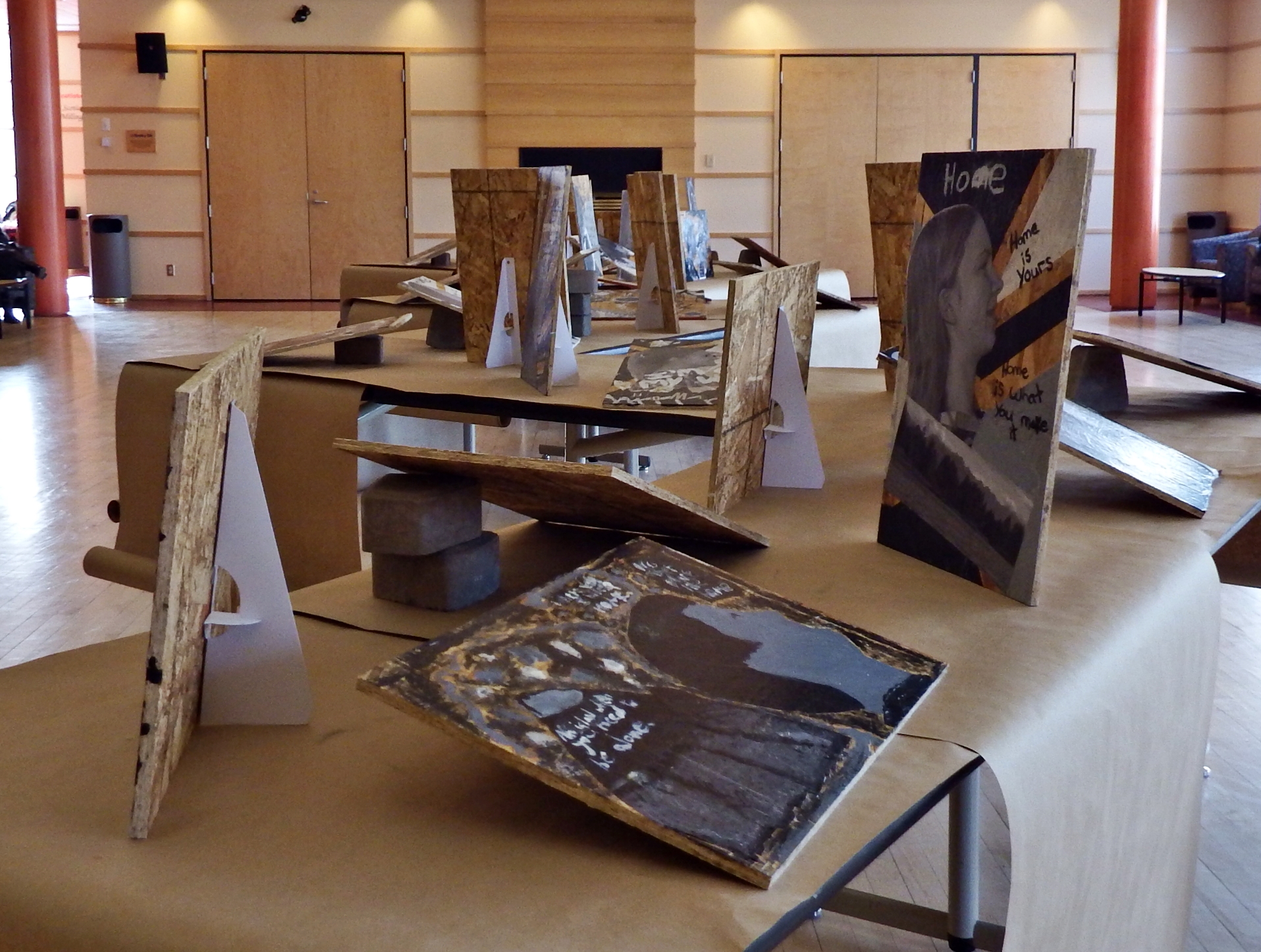
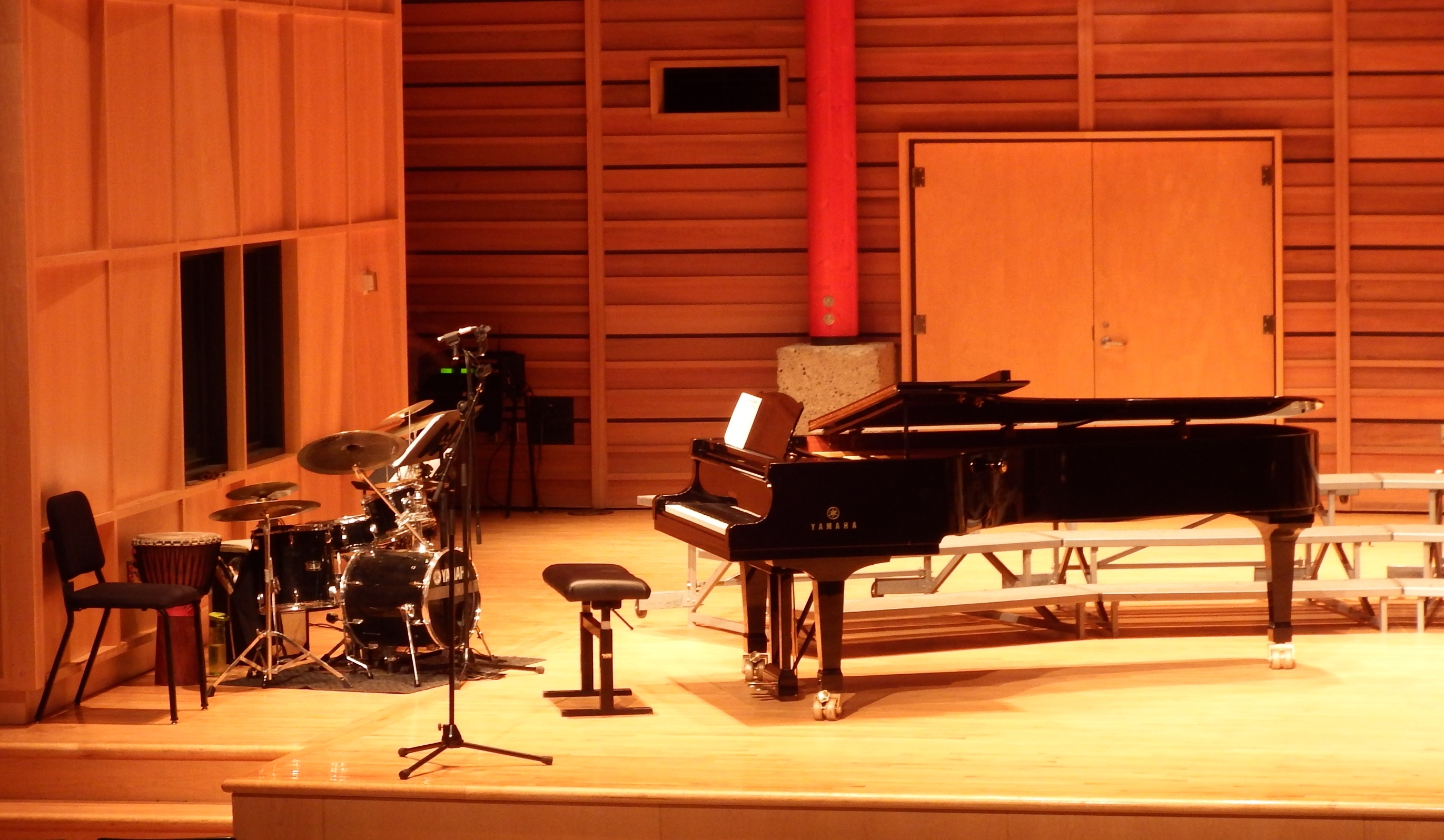
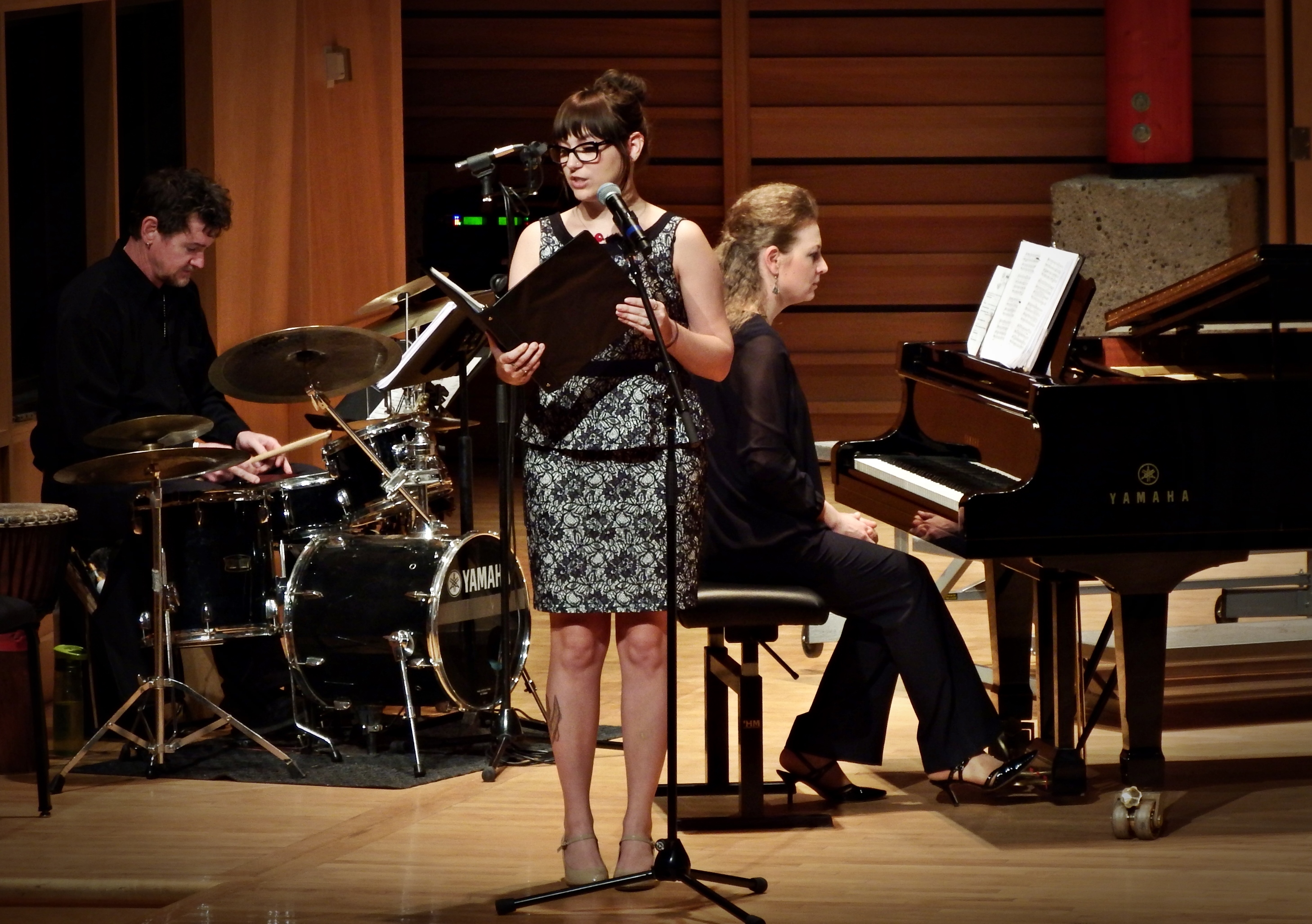
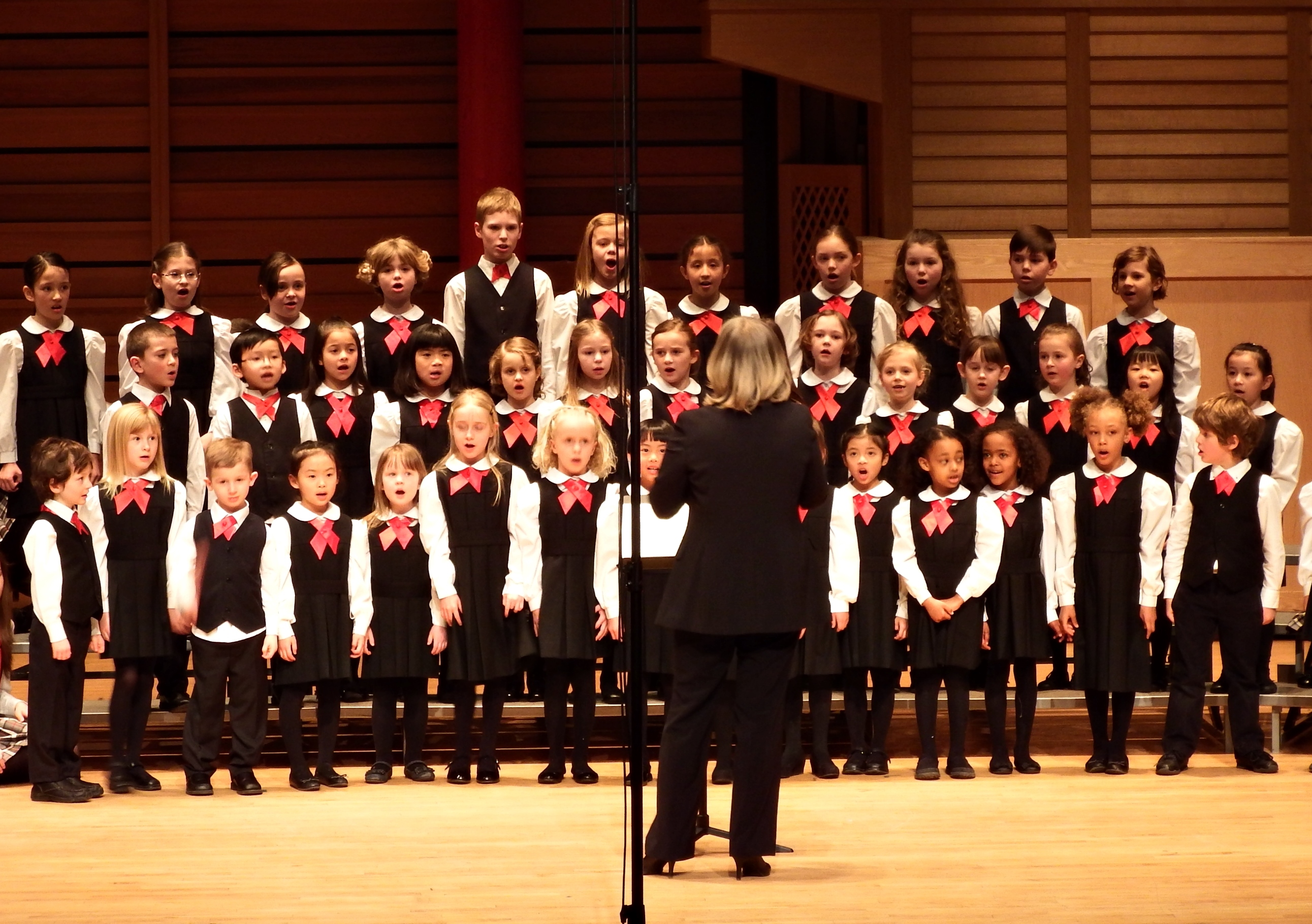
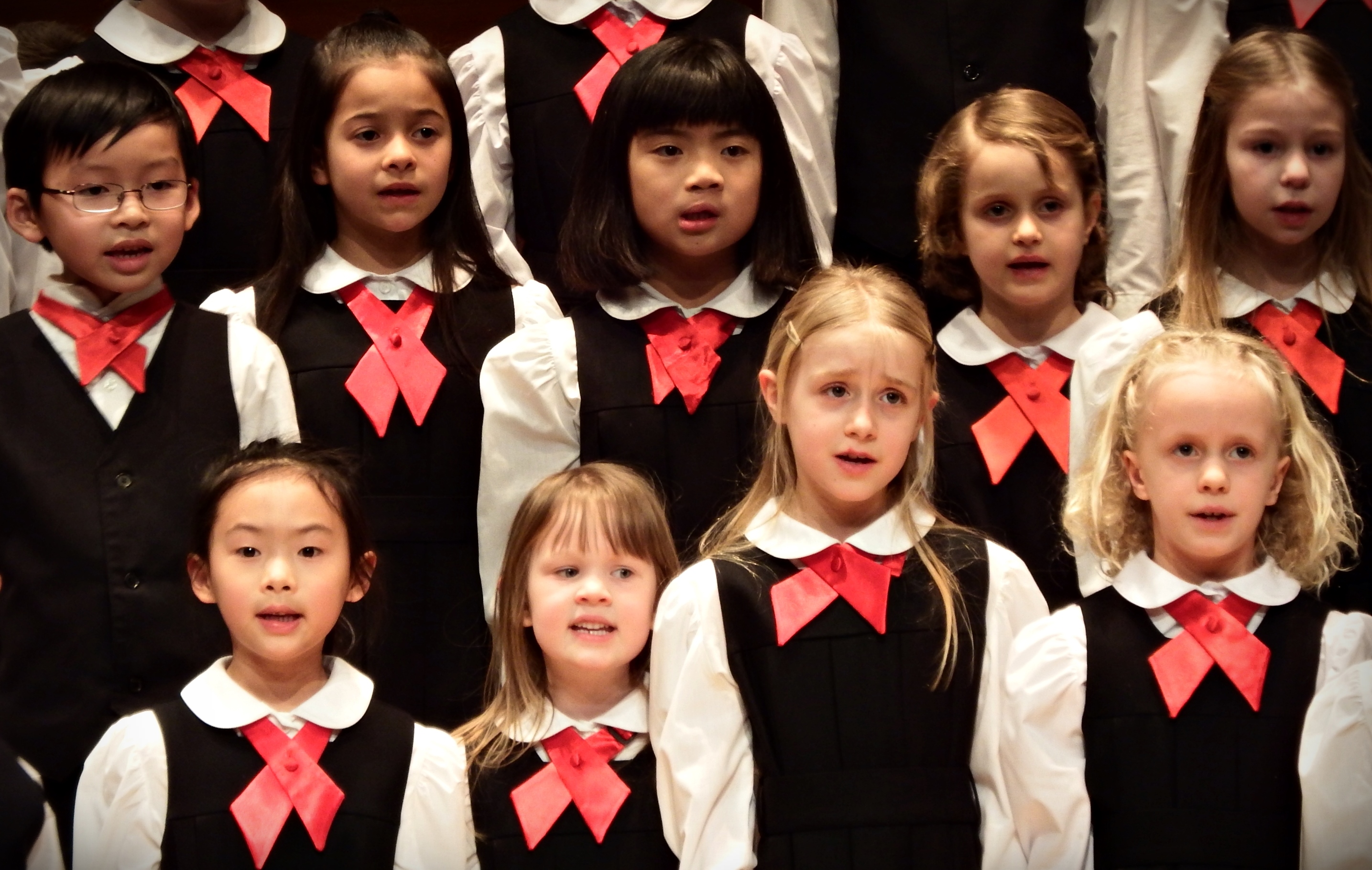
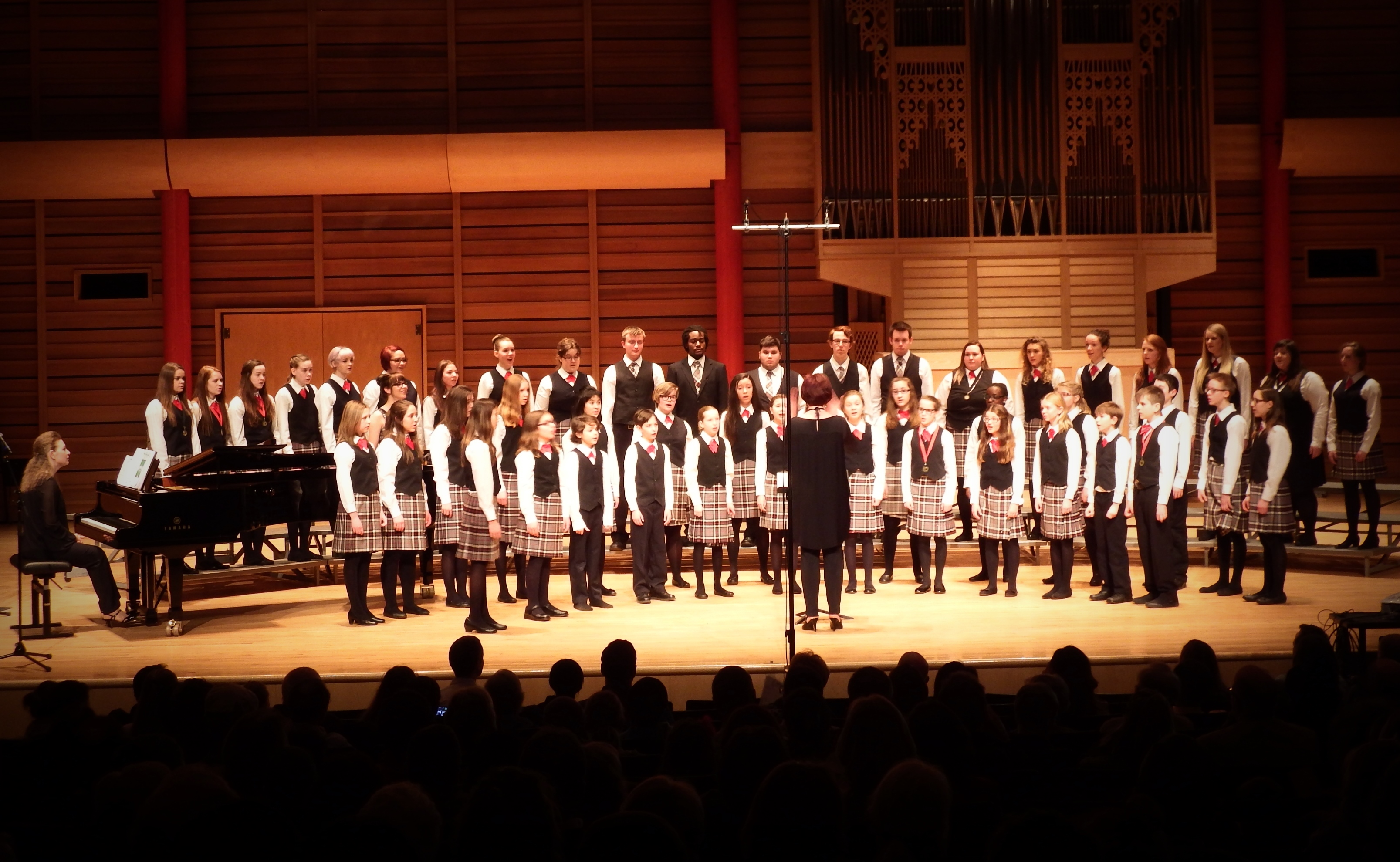
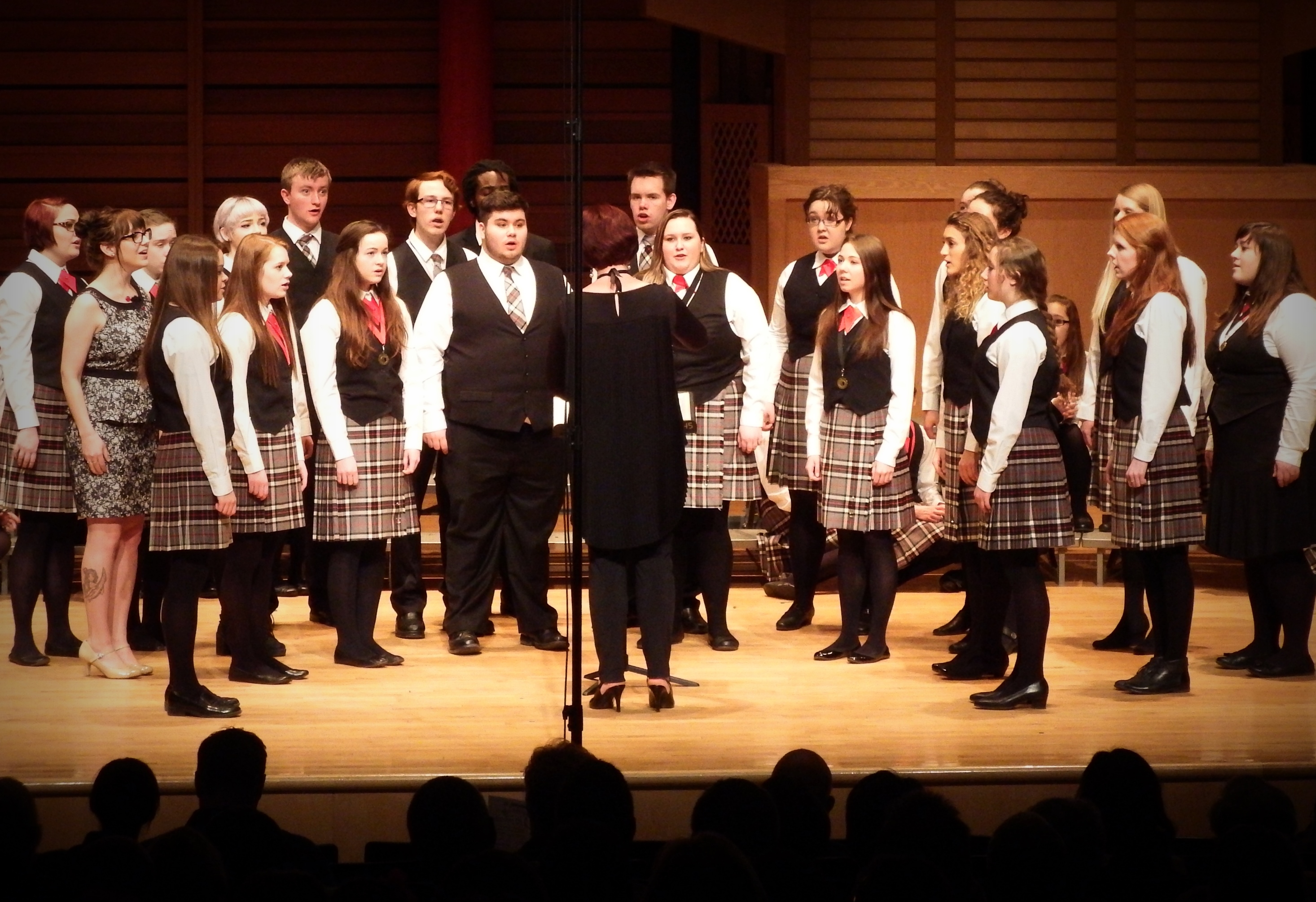
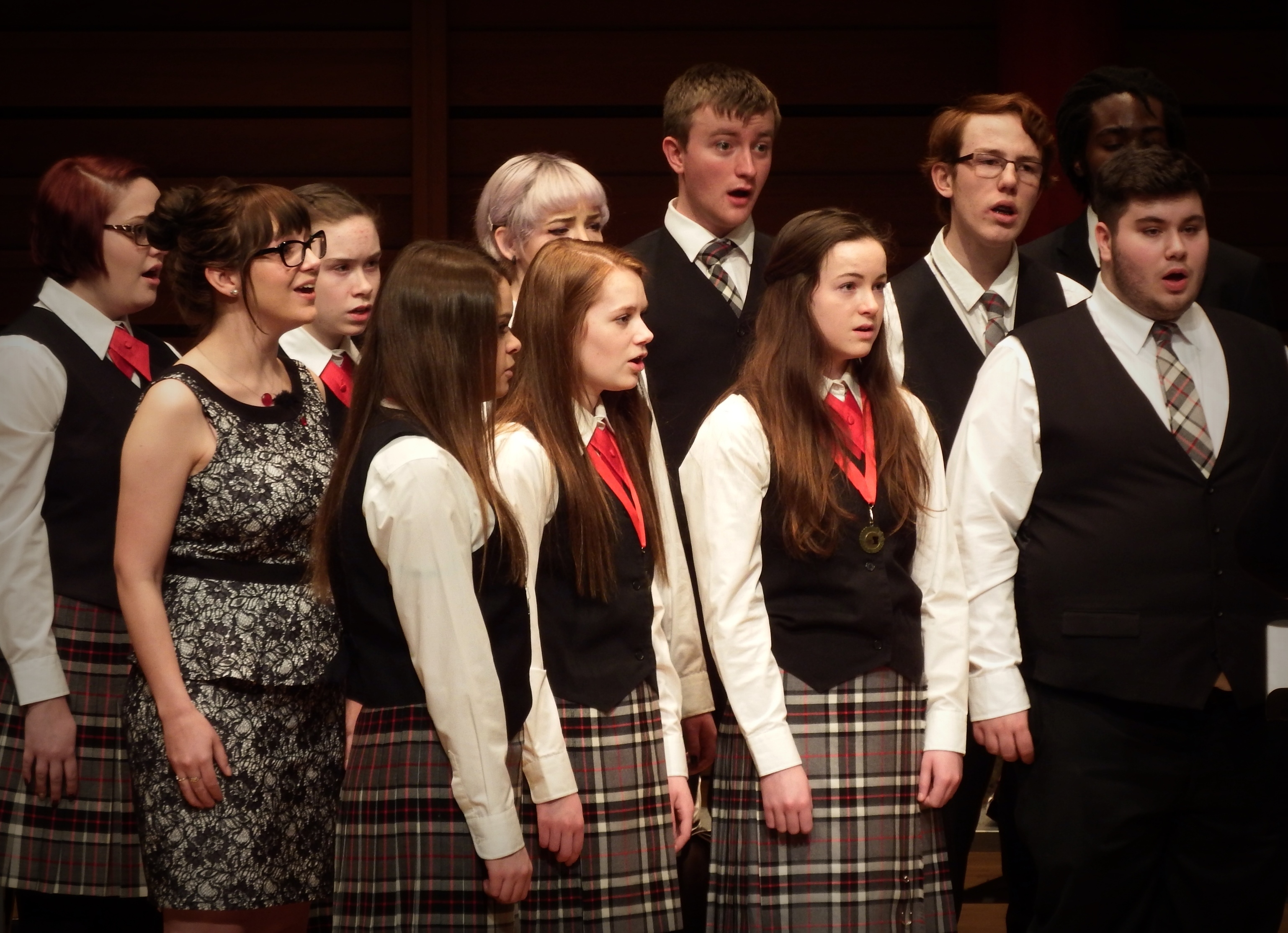
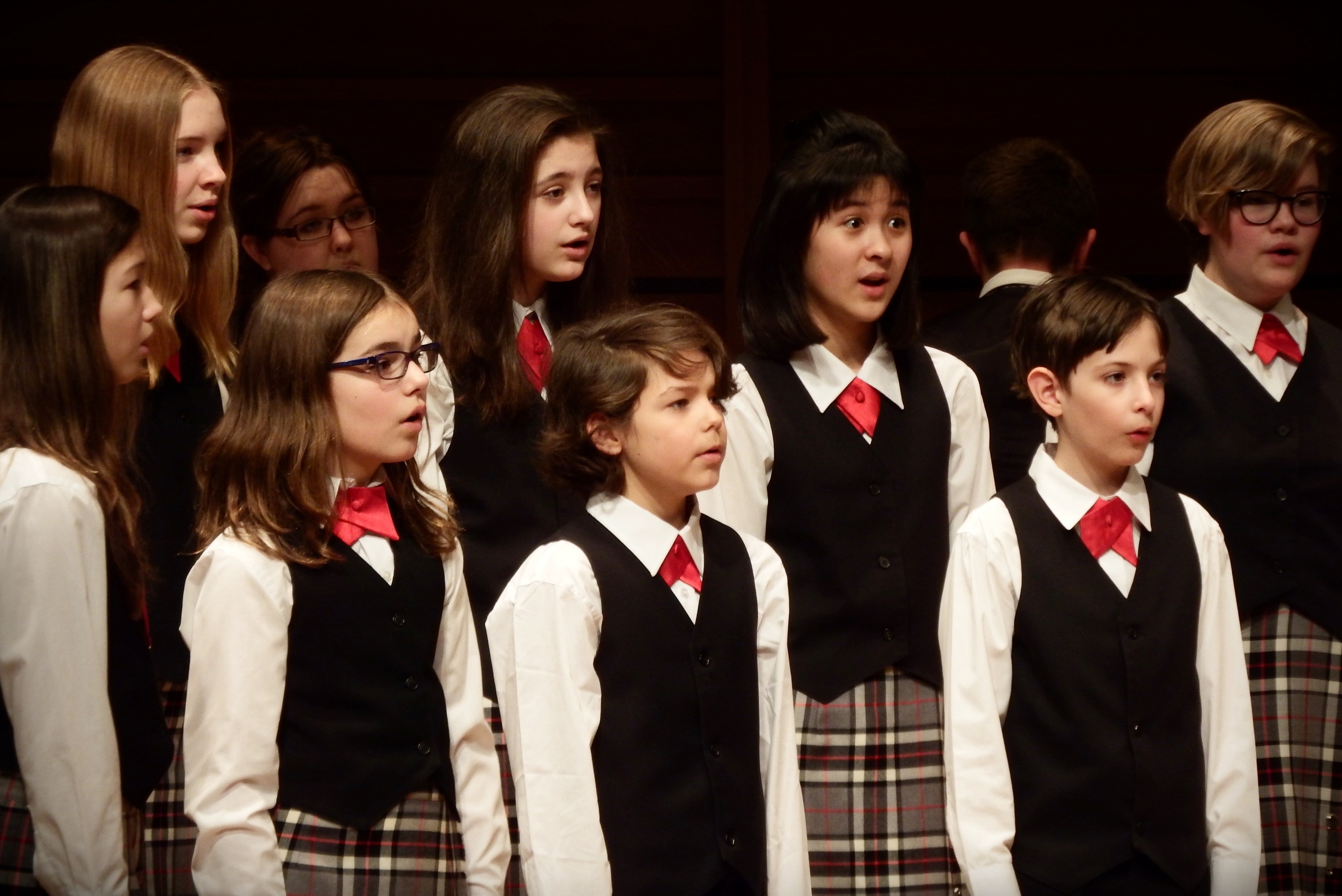
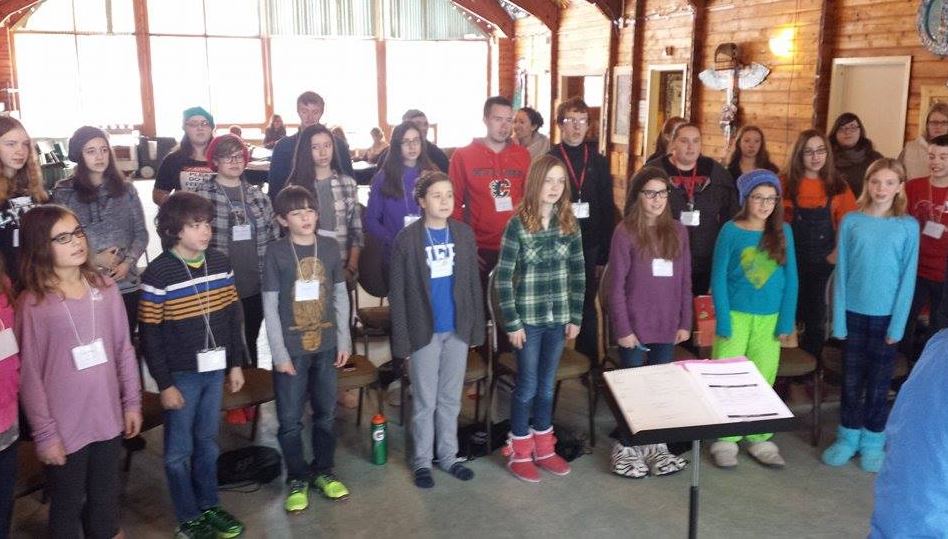
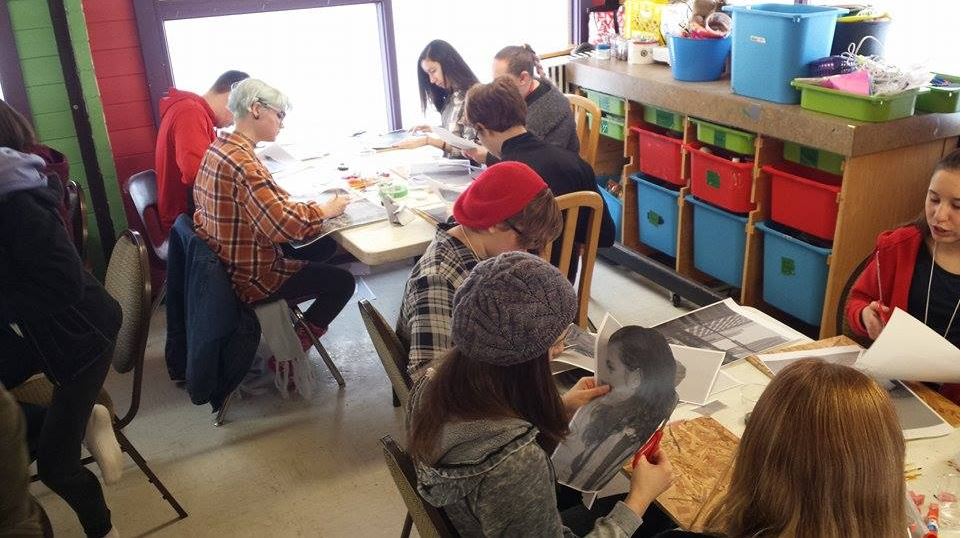
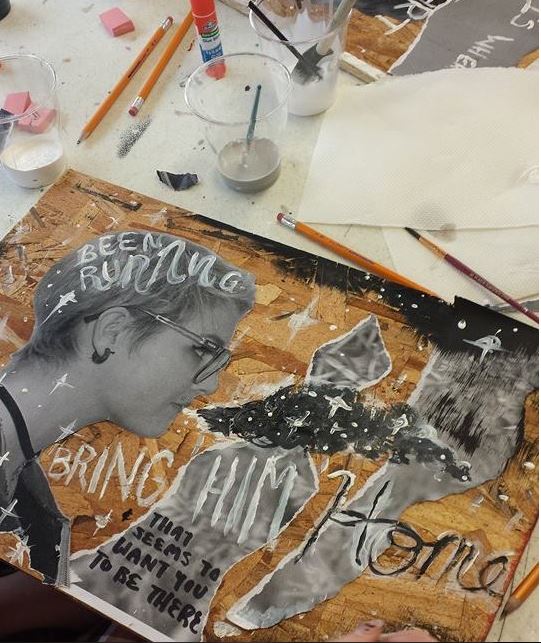
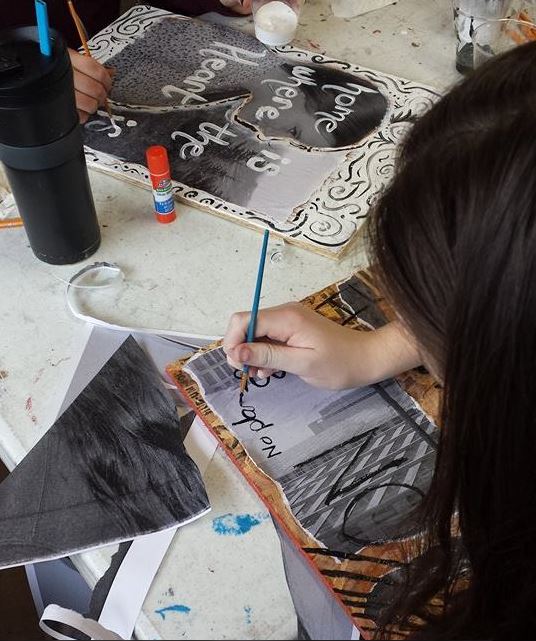
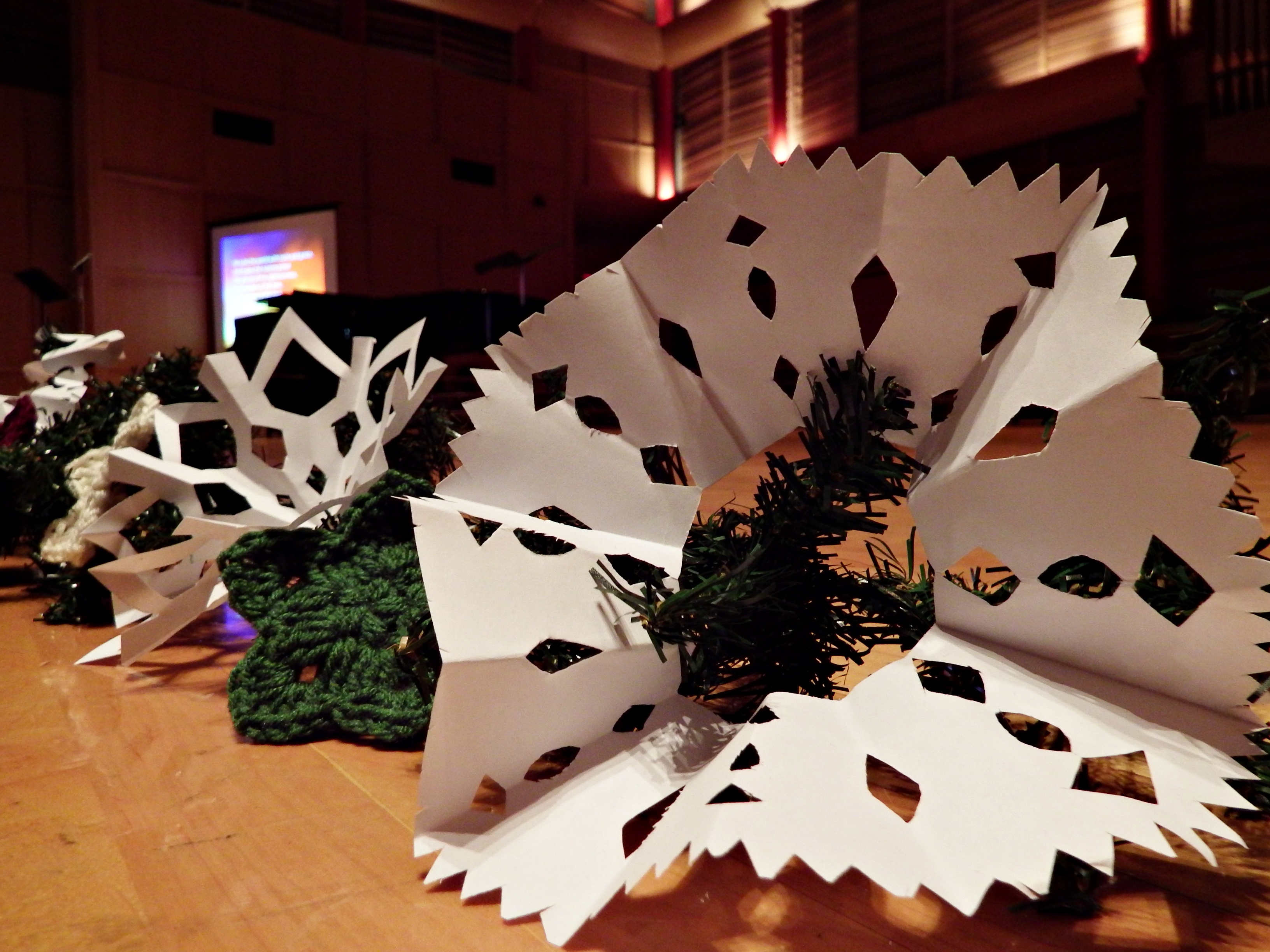
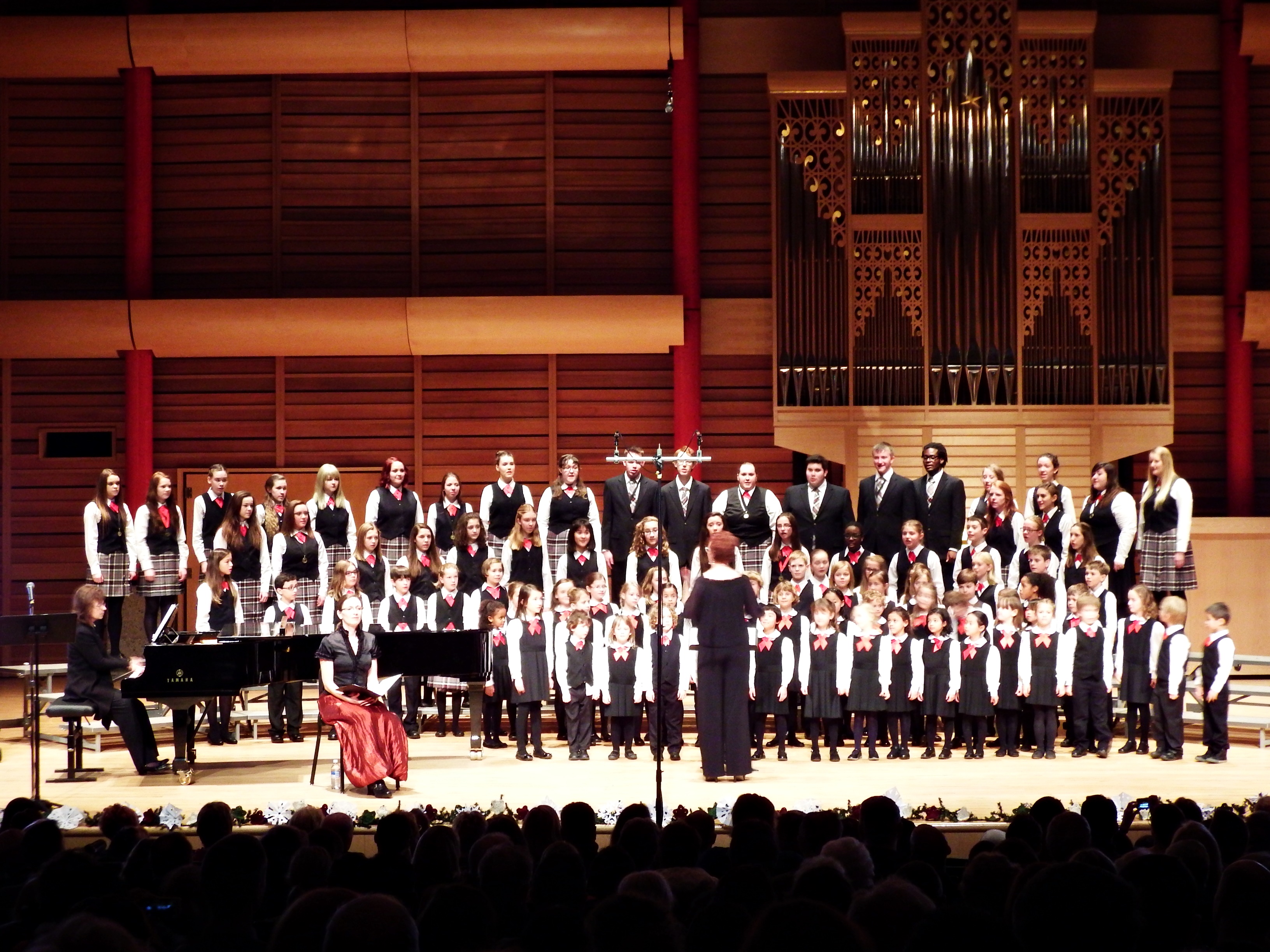
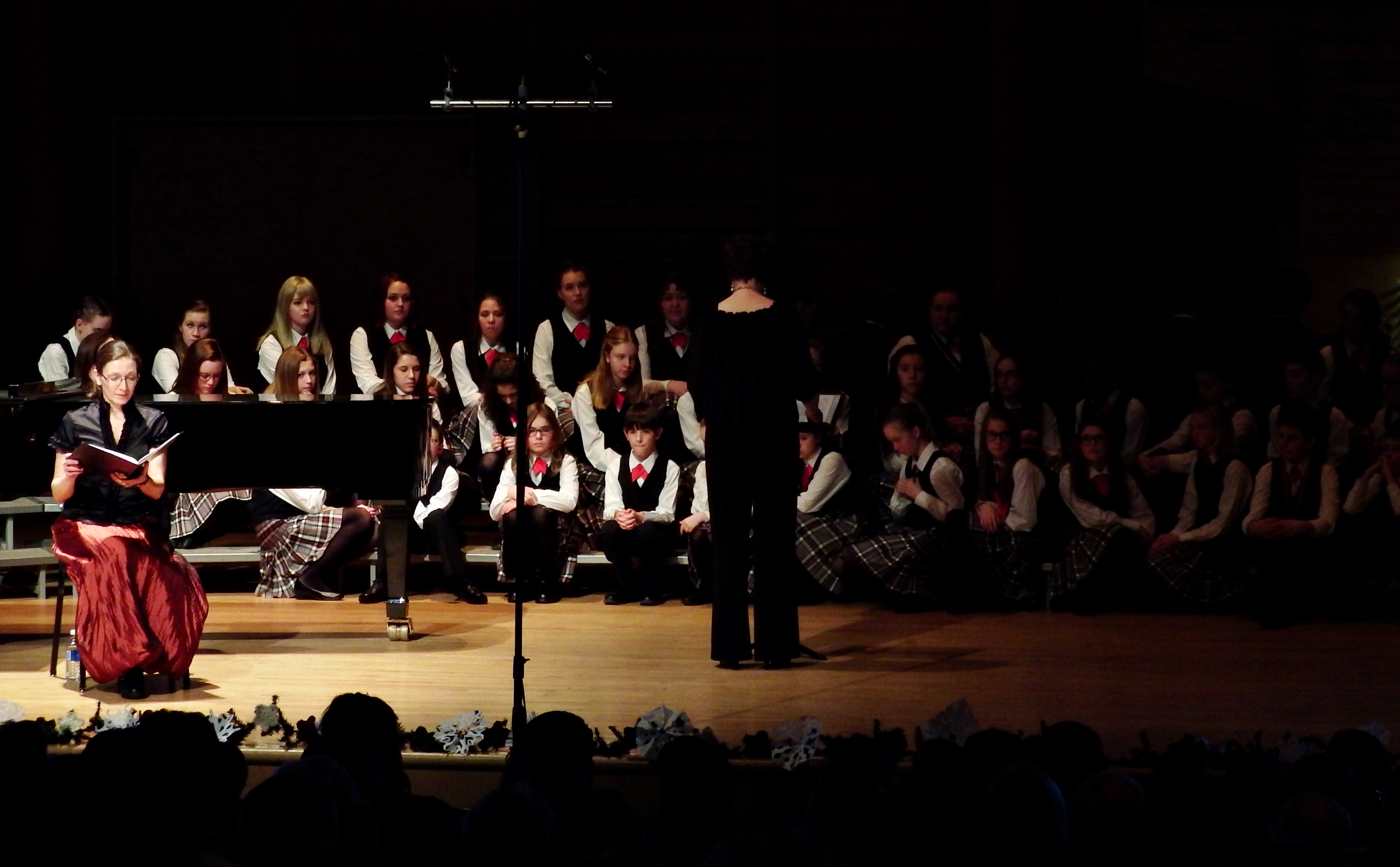
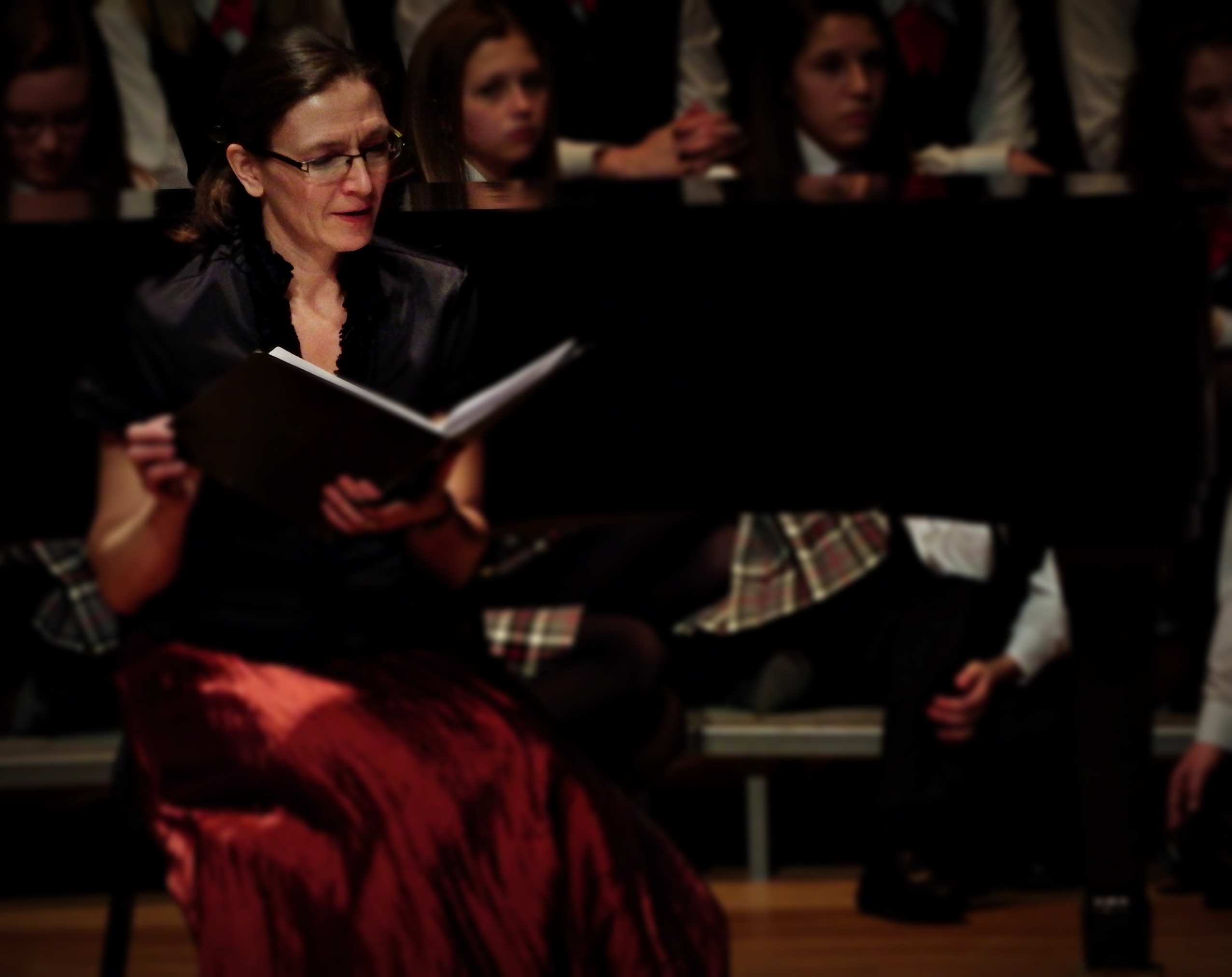
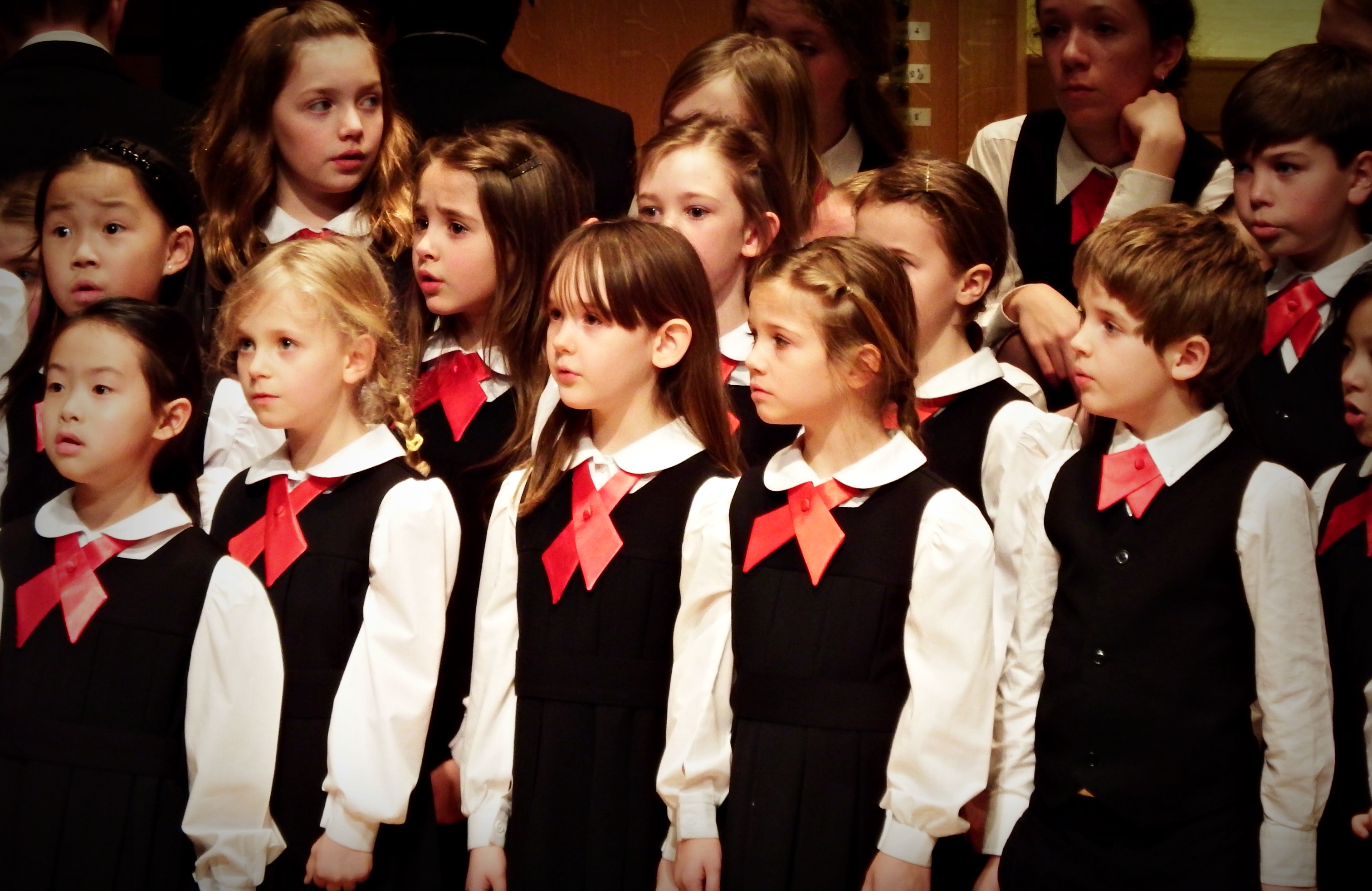
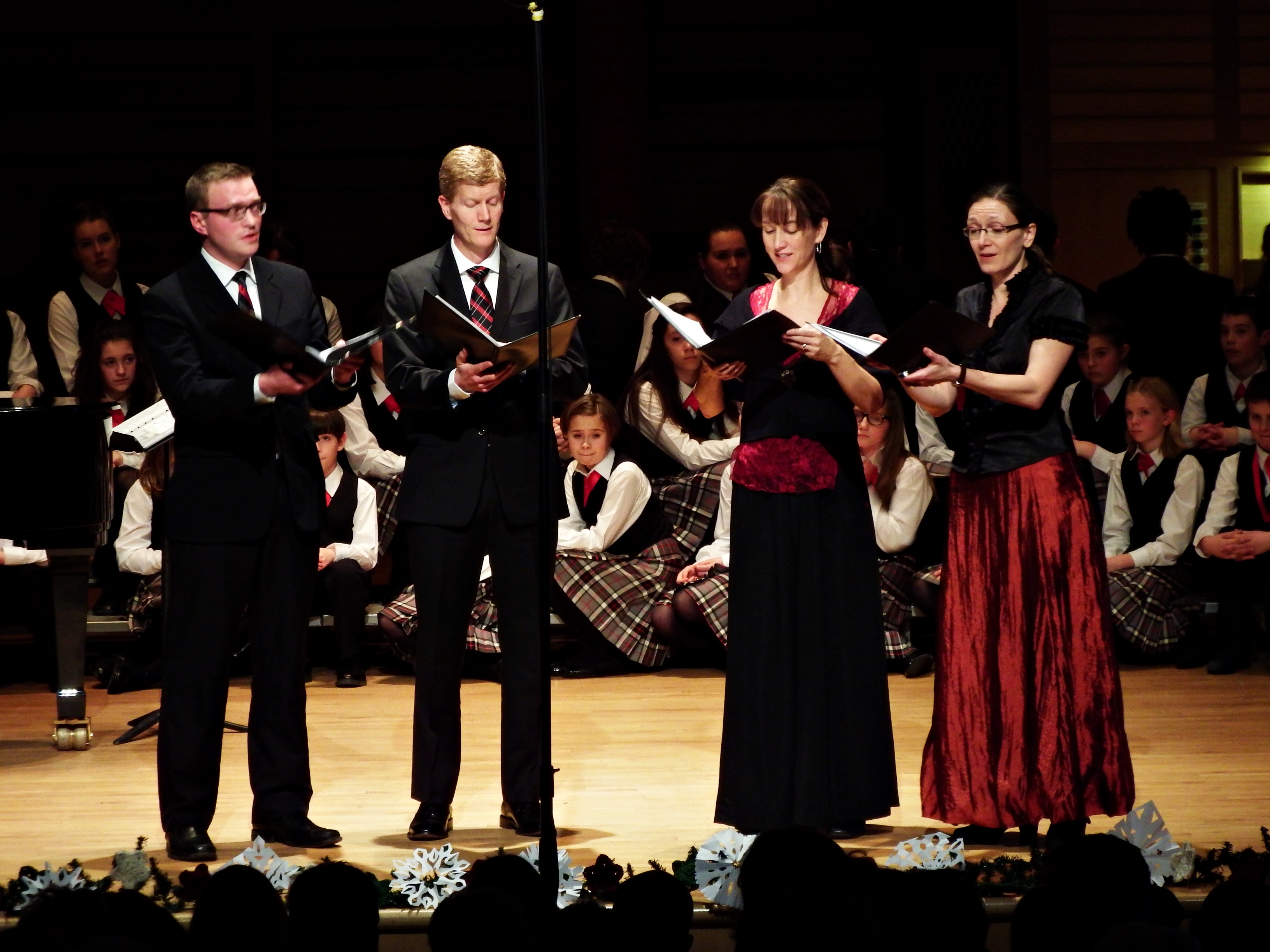
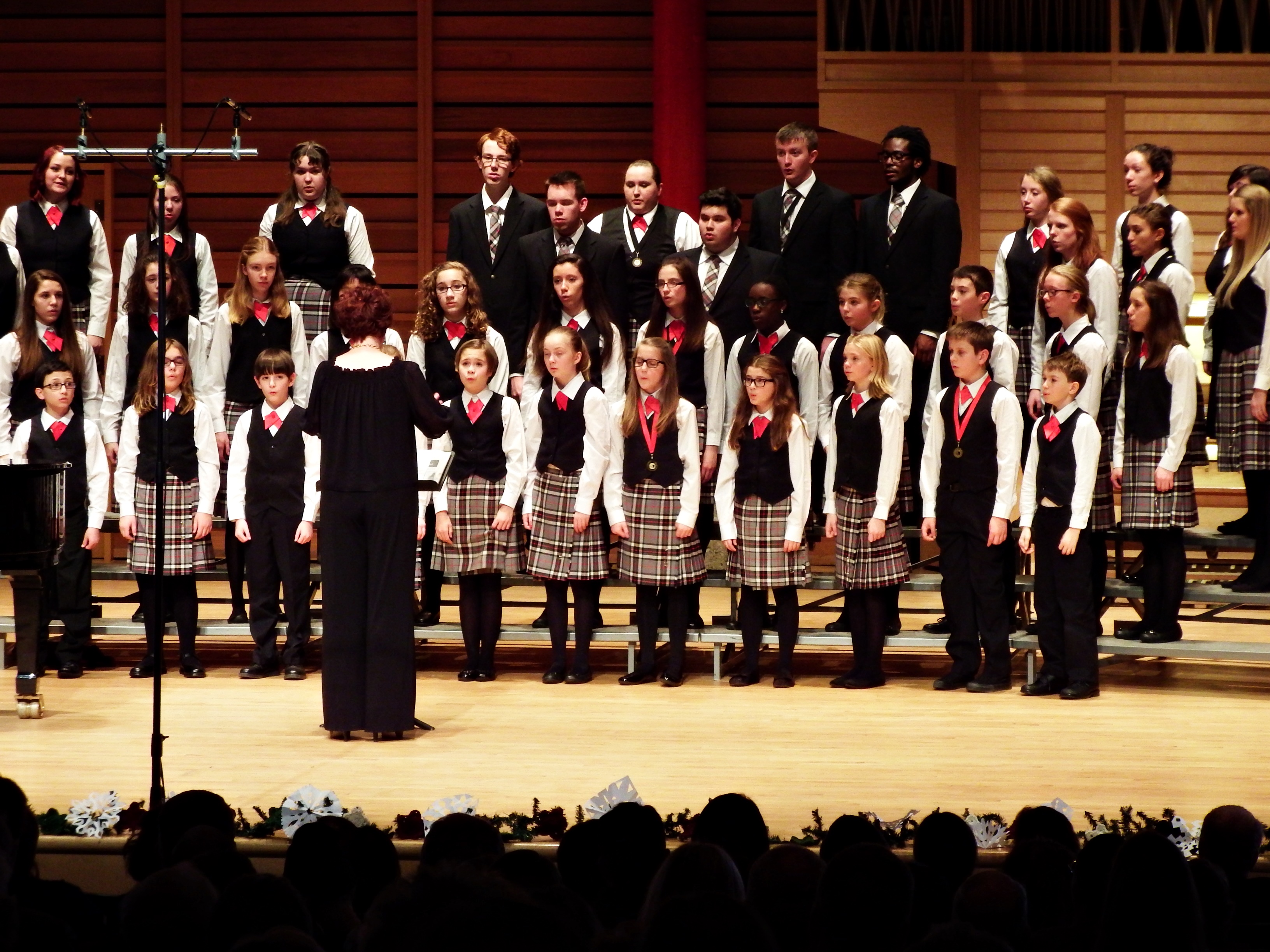
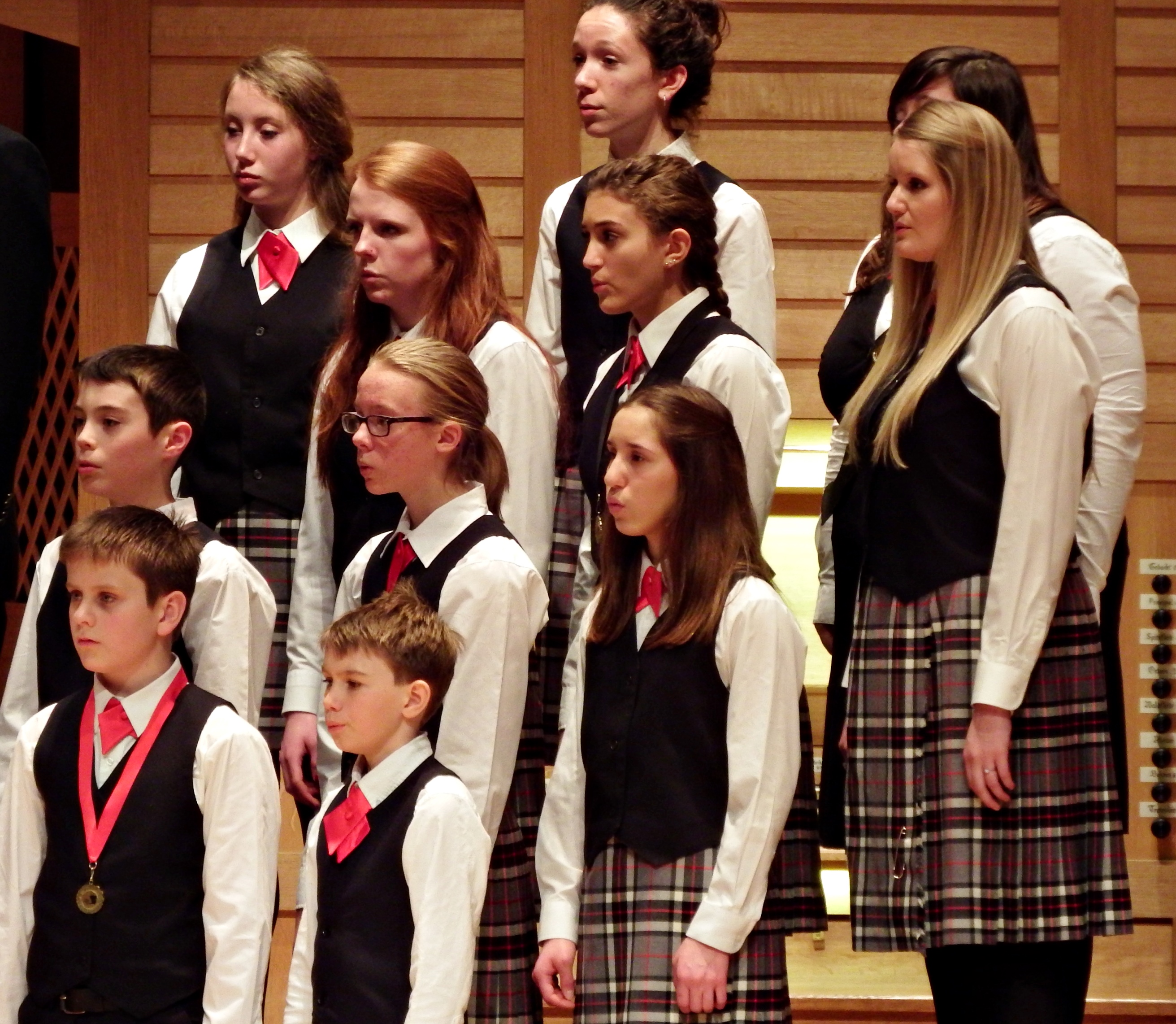
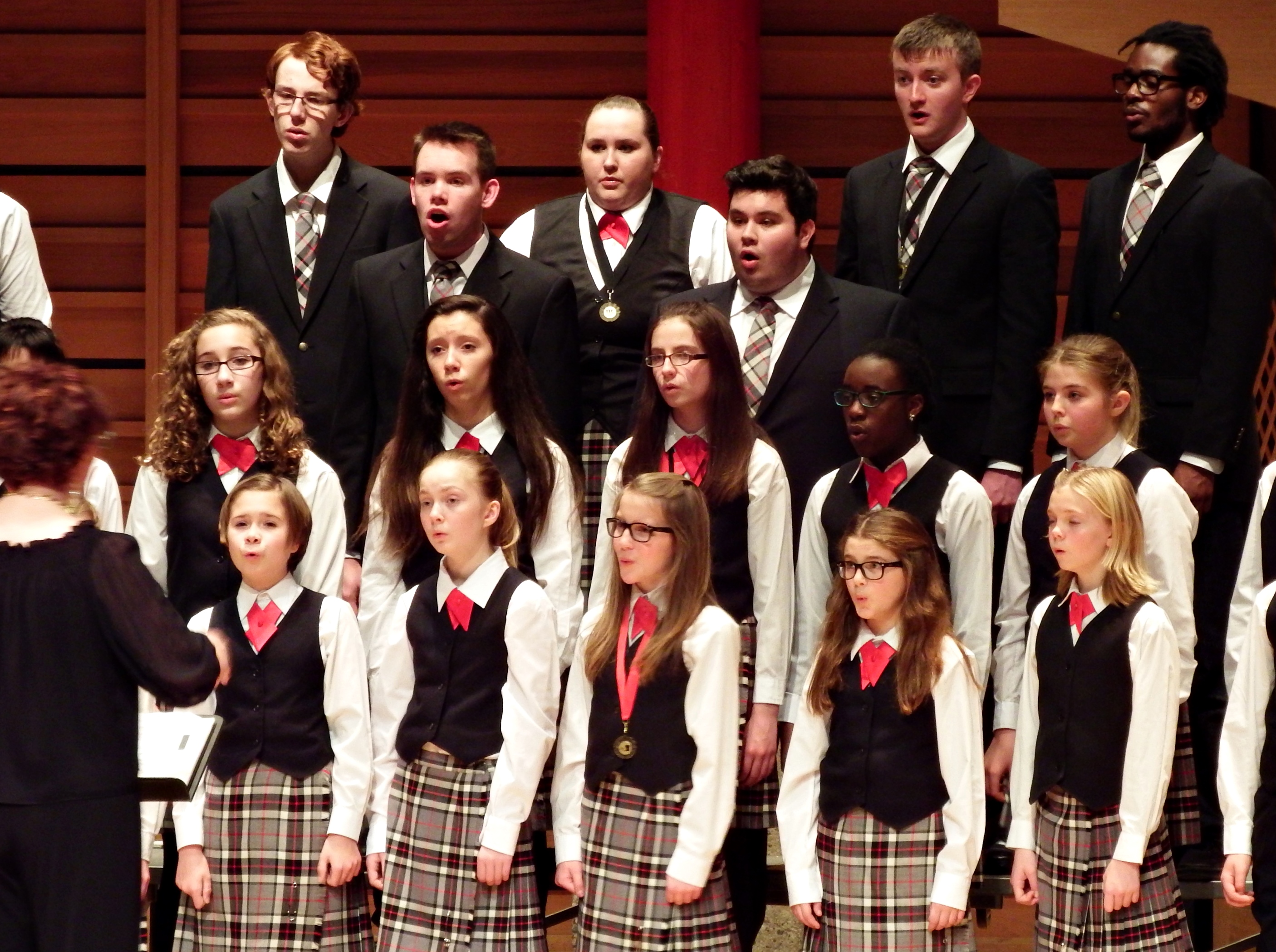
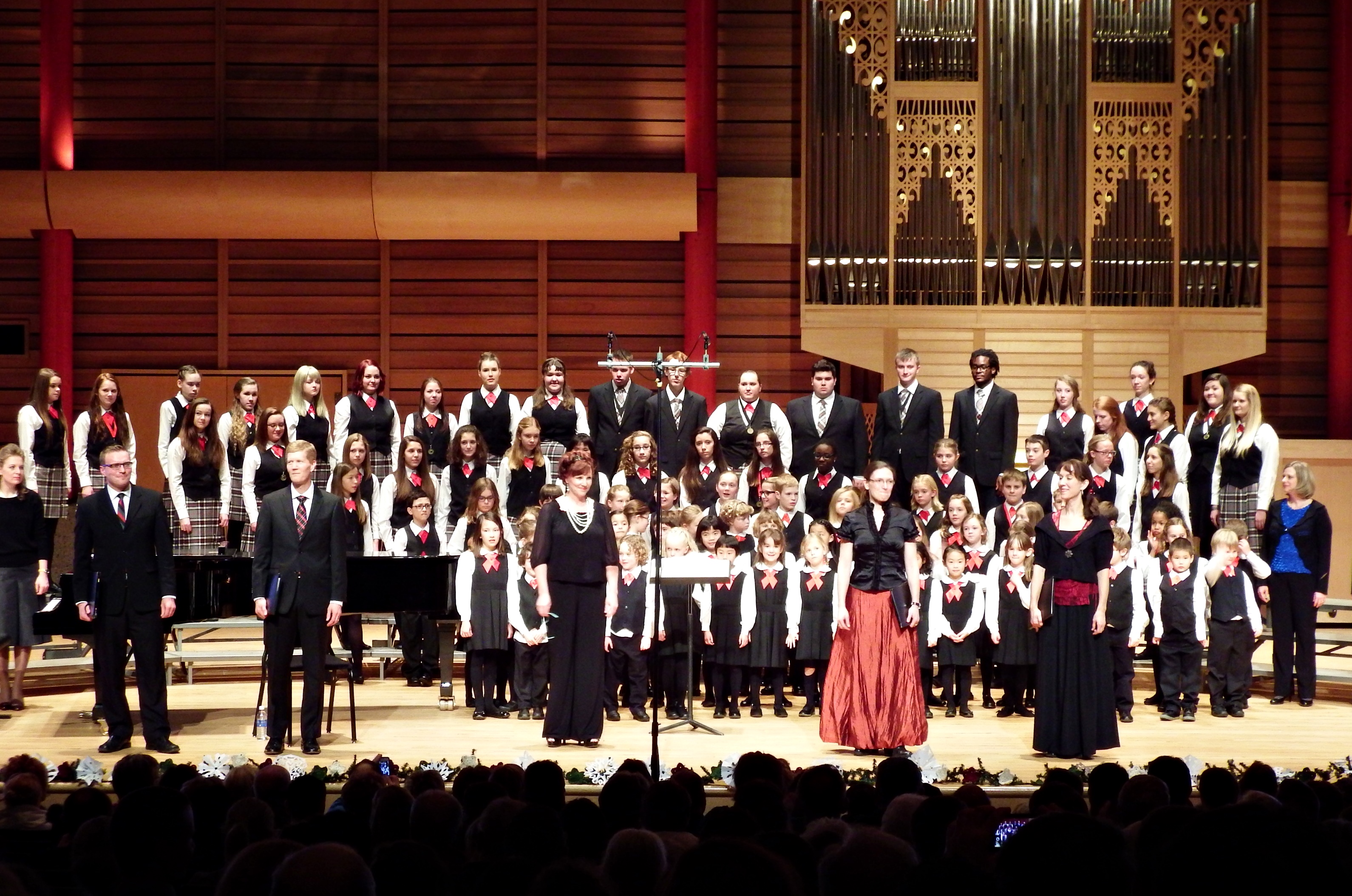
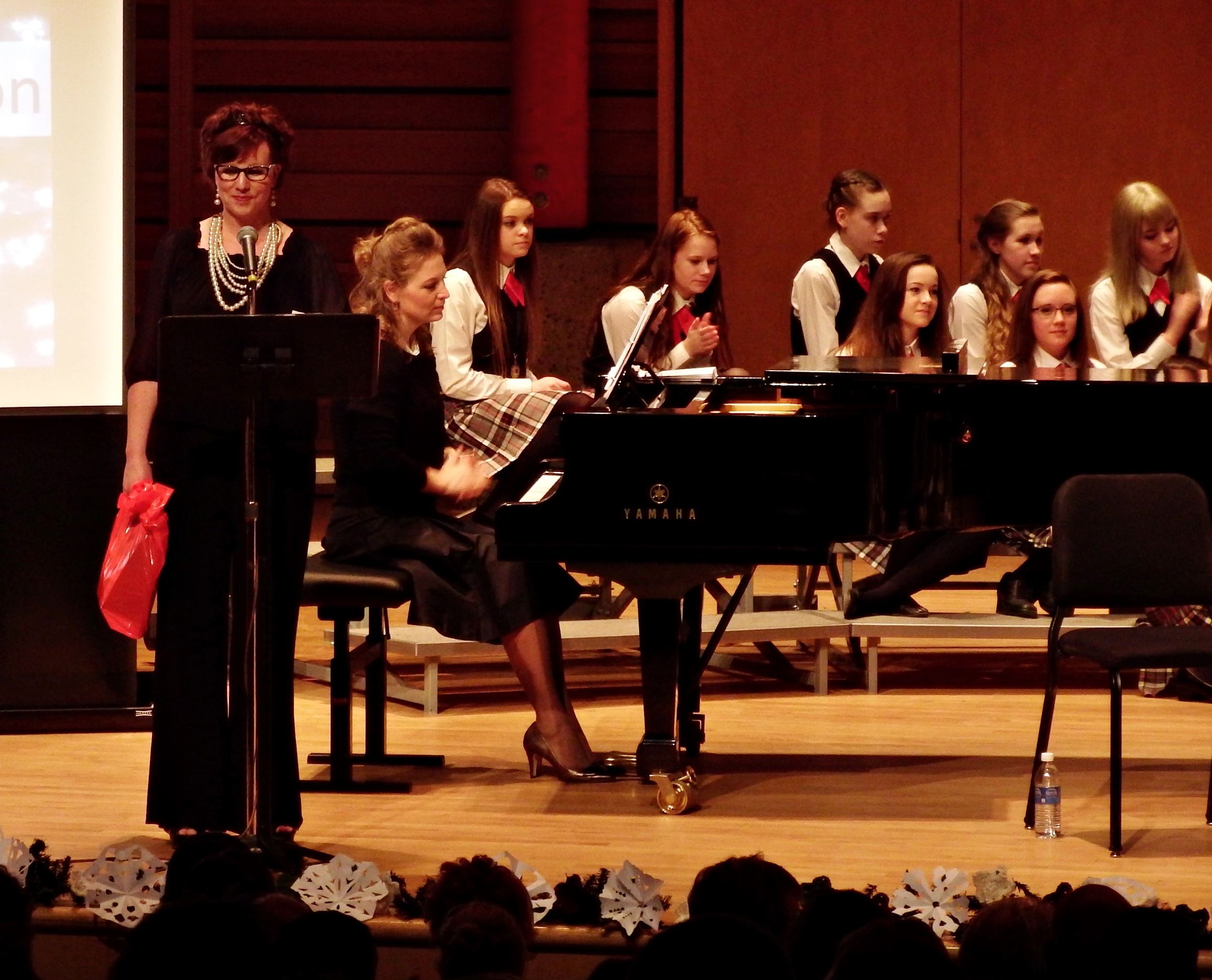
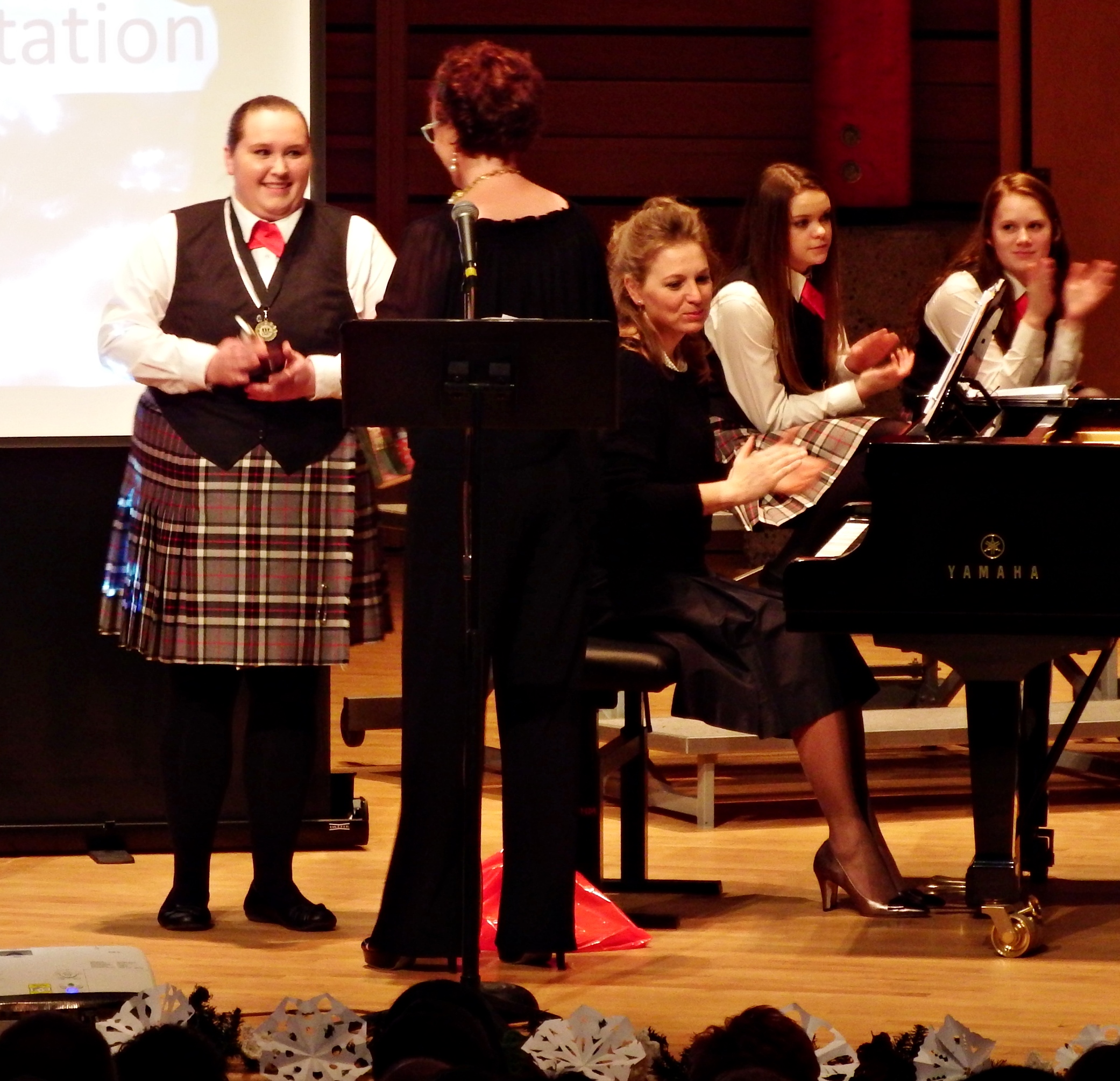
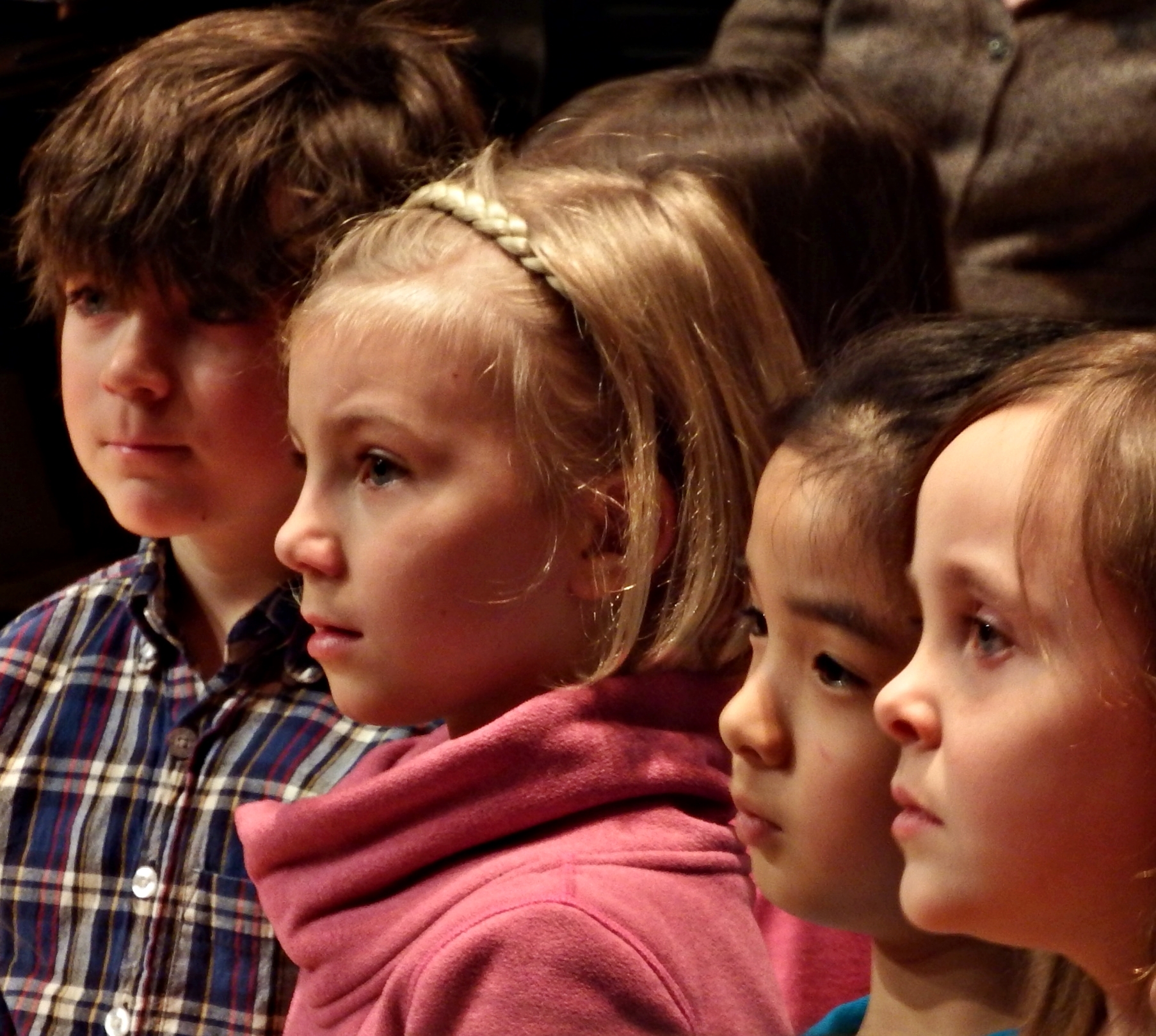
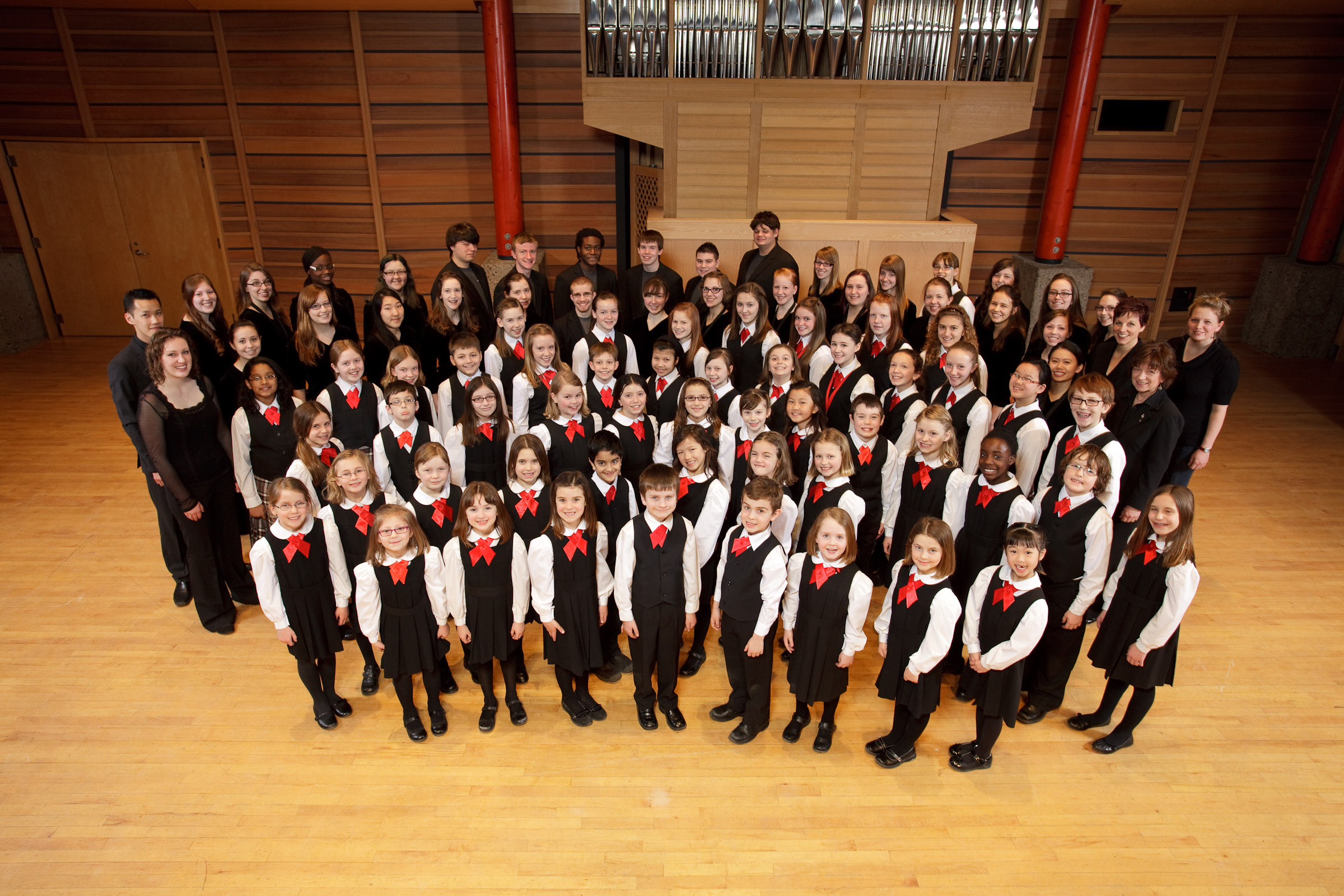
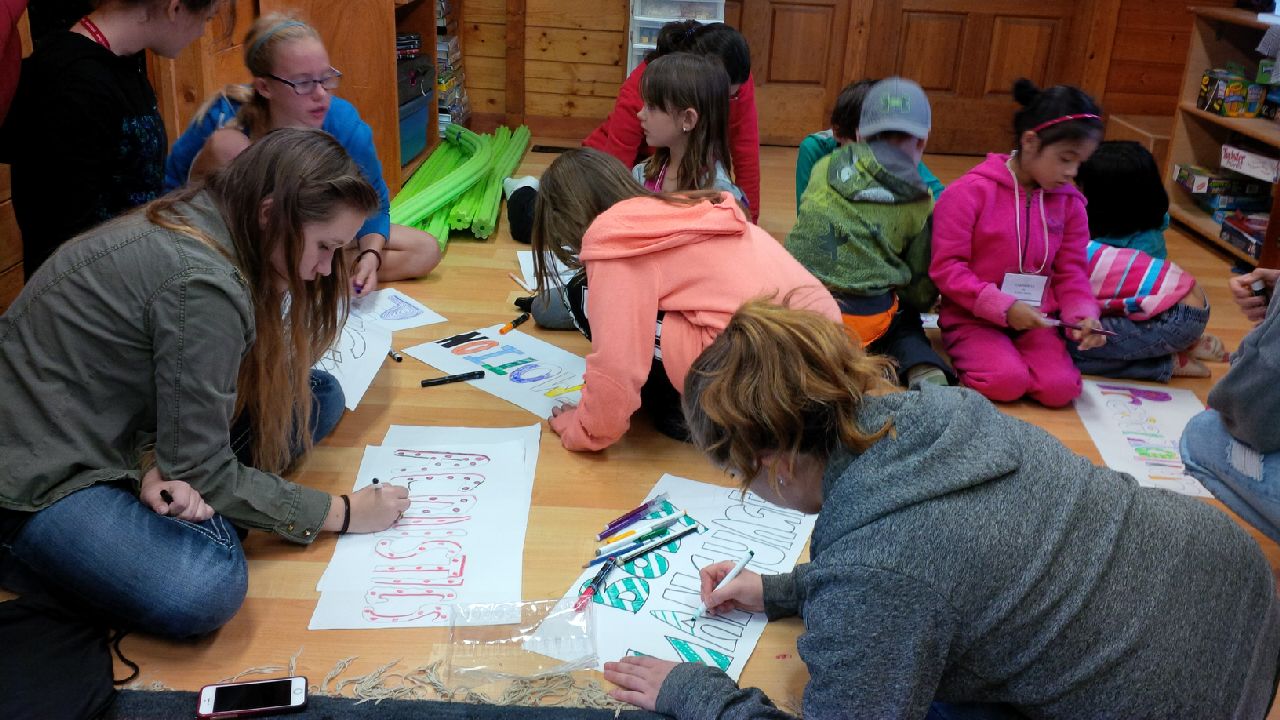
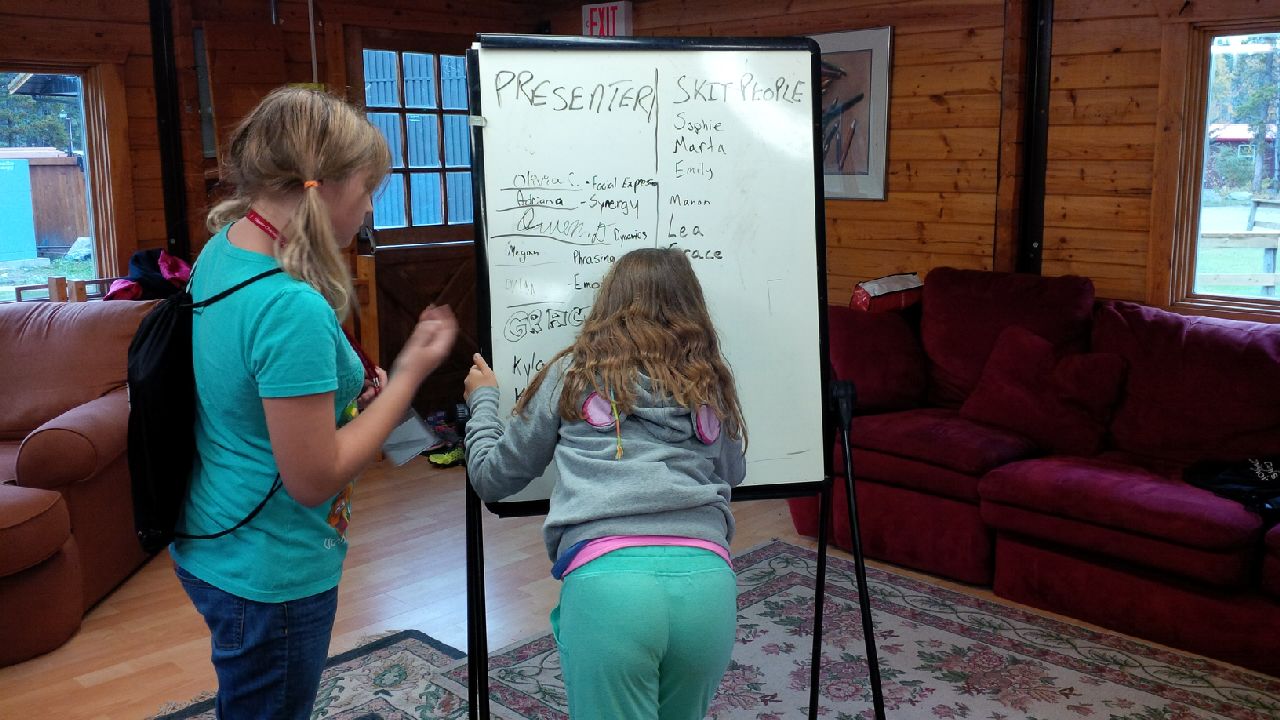
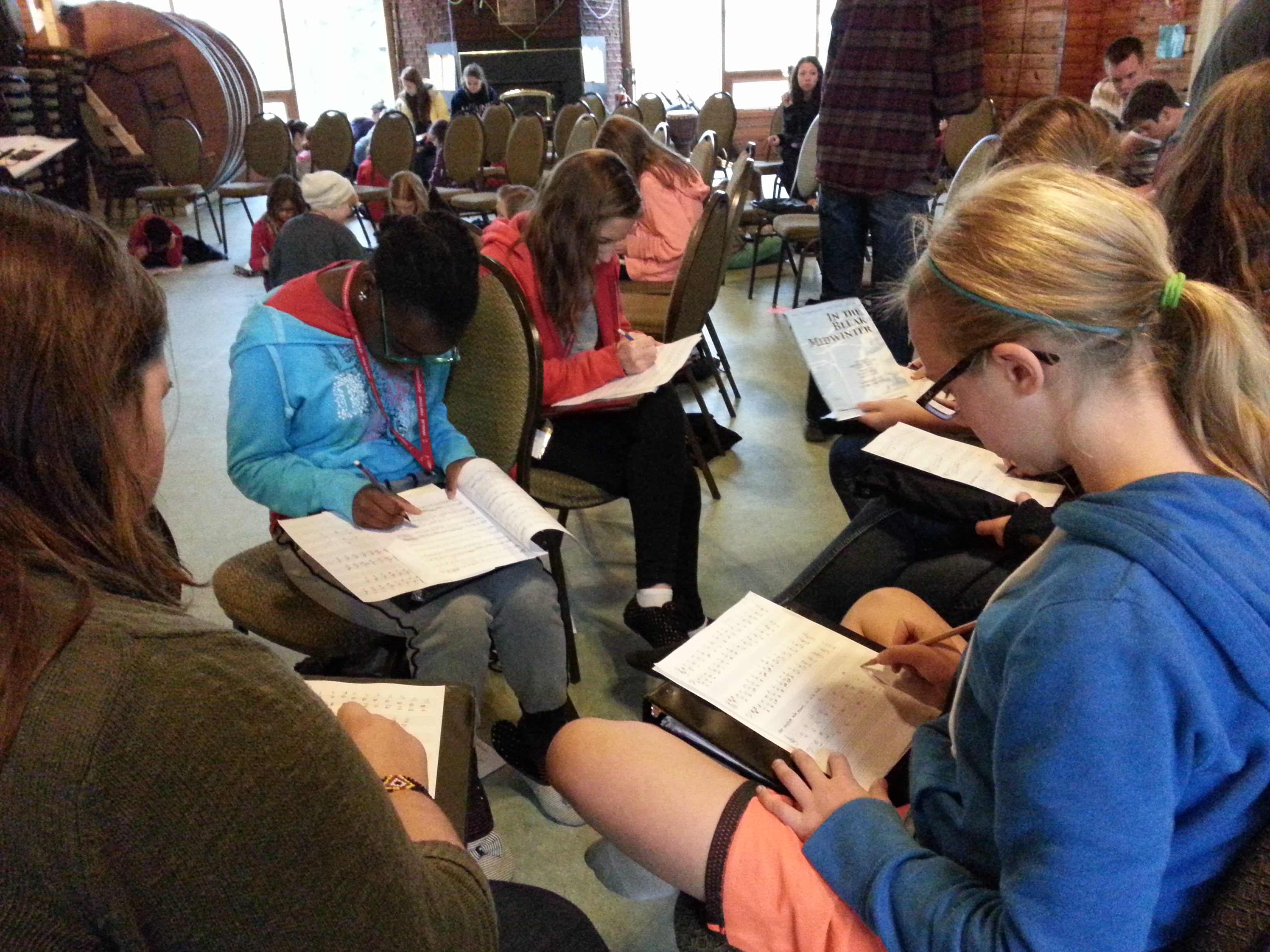
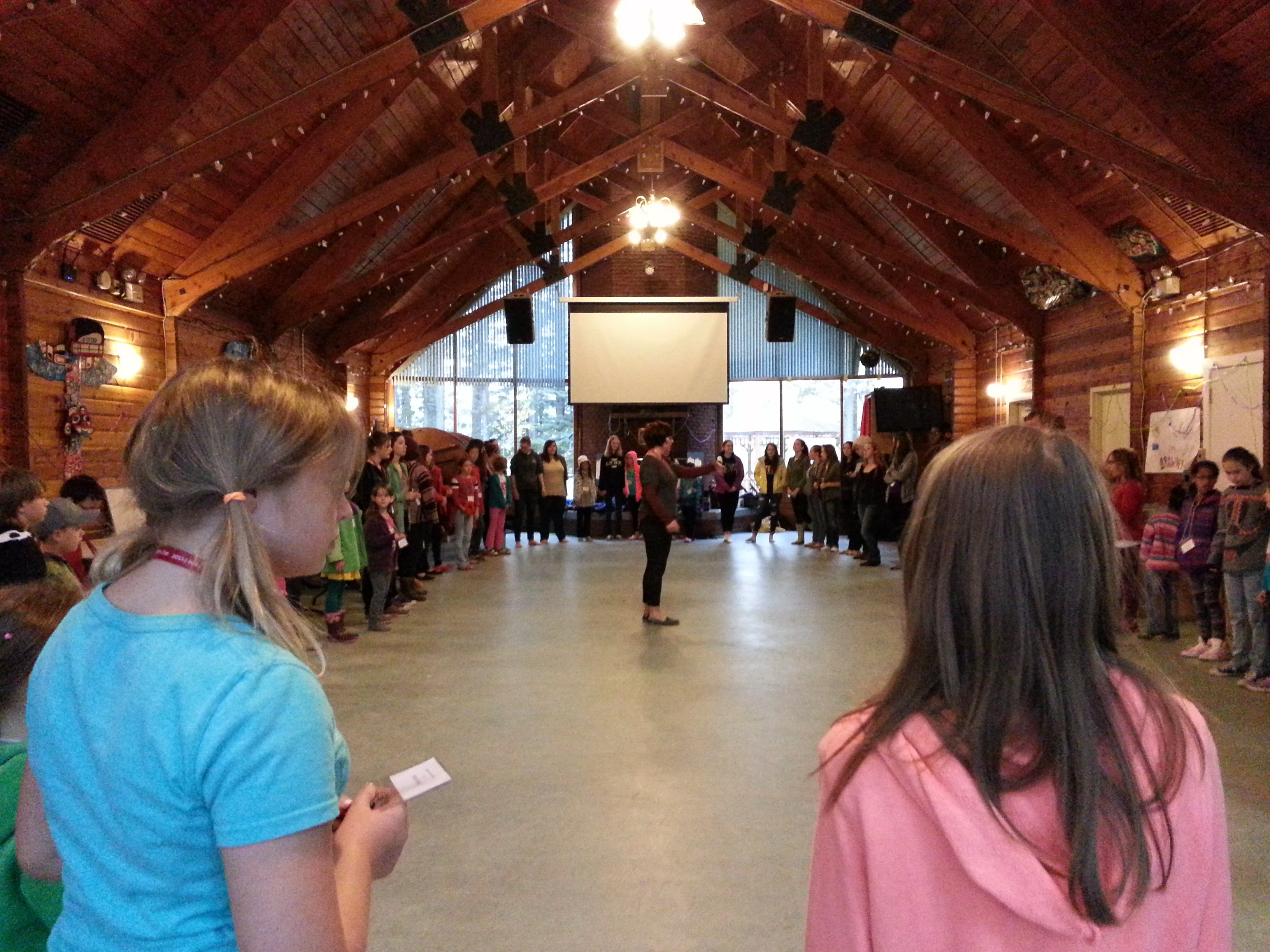
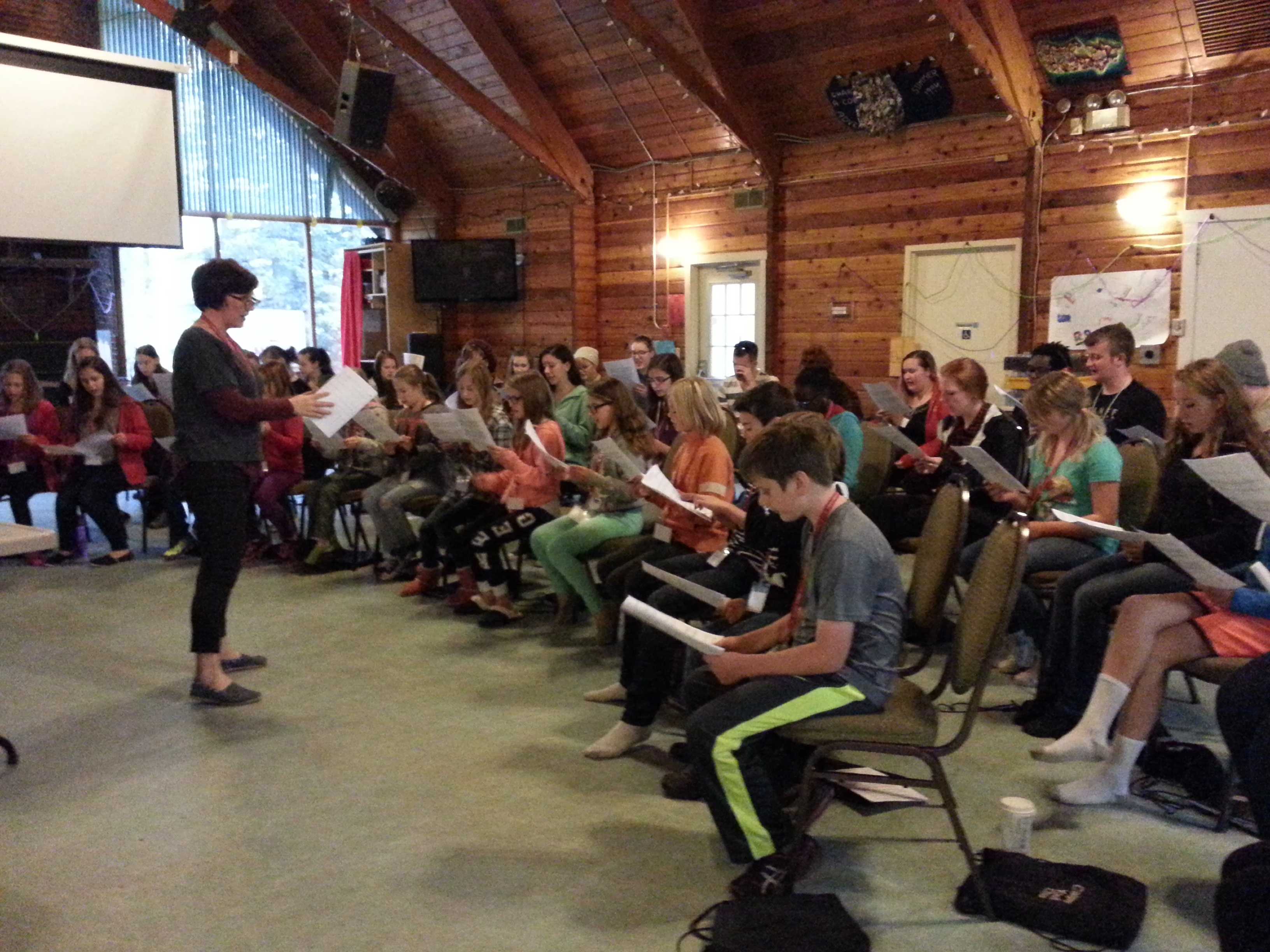
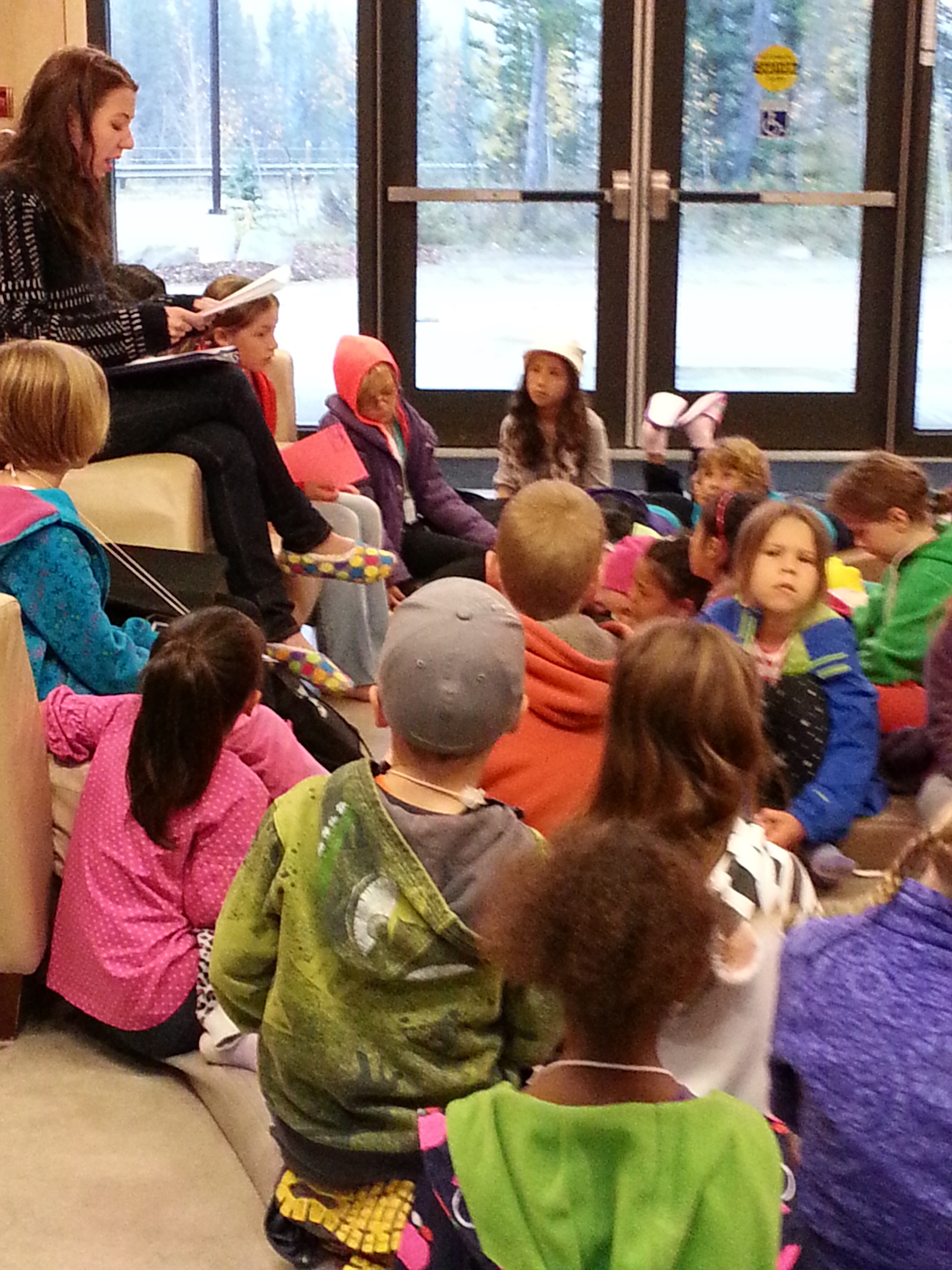
On Sunday afternoon, March 1st 2015, the Calgary Children’s Choir performed at our annual Folk Music concert at the Rozsa Centre. The theme of this year’s Folk Concert, was ‘Home’, and our concert was emceed by our talented Creative Consultant, Kat Long-Jones. Our concert featured artwork made by the choristers at our recent Winter Retreat, and embody the choristers’ vision of ‘Home’. A big thanks to our Artist in Residence during our Winter Retreat, Lisa Hodgkinson who helped us with this beautiful project.
We sang a variety of different pieces that encapsulated our ideas of ‘Home’, and different perspective on that theme, including: Hey Ho, Nobody’s Home, Almost Home, 900 Miles, and Woodsmoke and Oranges.
It was a wonderful concert, and a great way to celebrate all the different perspectives on ‘Home’! Thank-you to everyone who came out to see our concert!
What was your favourite part of the concert? Tell us in the comments below!
#1. Awareness:
A singer’s instrument is different from other instruments, because it is contained within a singer’s body. This means that singers have to have an excellent awareness of their own body, and they need to visualize their voice in a way that other musicians don’t have to. The inability to see one’s instrument allows singers to think uniquely, and create their own picture of their voice, and the singing process in their mind’s eye.
#2. Characterization:
When singers perform a piece, they think about the meaning of the piece, and often the character embodied within that piece. Performing requires singers to adopt the persona of the music itself, and to think about the emotions, and events described by the piece. This ability gives singers a unique perspective, and insights into how others view the world; a valuable aspect of creativity.
#3. Teamwork:
Singers rarely sing alone. Whether they’re singing with others, or accompanied by other musicians, they need to be taking the other musicians into consideration. Performing live with other musicians requires incredible communication, usually through nuanced body language and cues, subtleties of performance, and consideration for the musical elements the other musicians bring to the performance.
#4. Expression:
All musicians express emotion through their music; it is part of what makes music so compelling to listen to. But singers have an added layer of emotive power because we sing text as well. This allows singers to make connections between the music itself and the text. Often, composers have written music to reflect the words in the text, and singers need to identify those moments, and respond to them musically, to best communicate the message of the music to the audience.
#5. Vulnerability:
To get up on a stage in front of other people and perform, requires an immense amount of courage. Any performer understands that every time they get up on that stage, they might fail, and fail in front of other people. This kind of courage comes from the ability to express your vulnerability, to expose your innermost thoughts and emotions, and then communicate them to an audience. and it is a powerful tool for any singer.
“Before you can inspire with emotion, you must be swamped with it yourself. Before you can move their tears, your own must flow. To convince them, you must yourself, believe.” – Winston Churchill
Do you think singing can contribute to creativity? Tell us how in the comments!
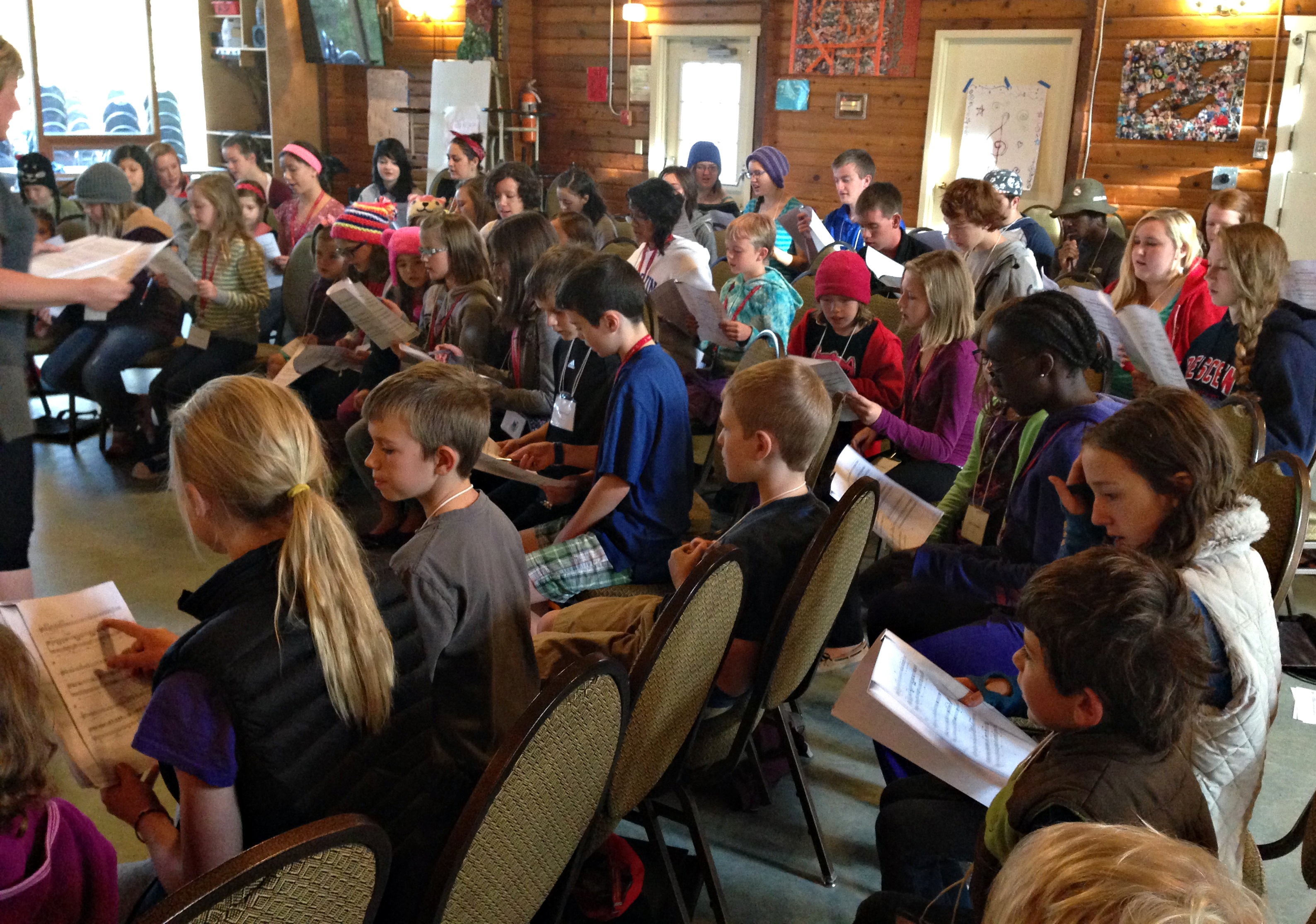
On the weekend of January 30th, to February 1st, the Calgary Children’s Choir went up to Camp Horizon in Bragg Creek for our first ever Winter Retreat! The weekend was absolutely magnificent!
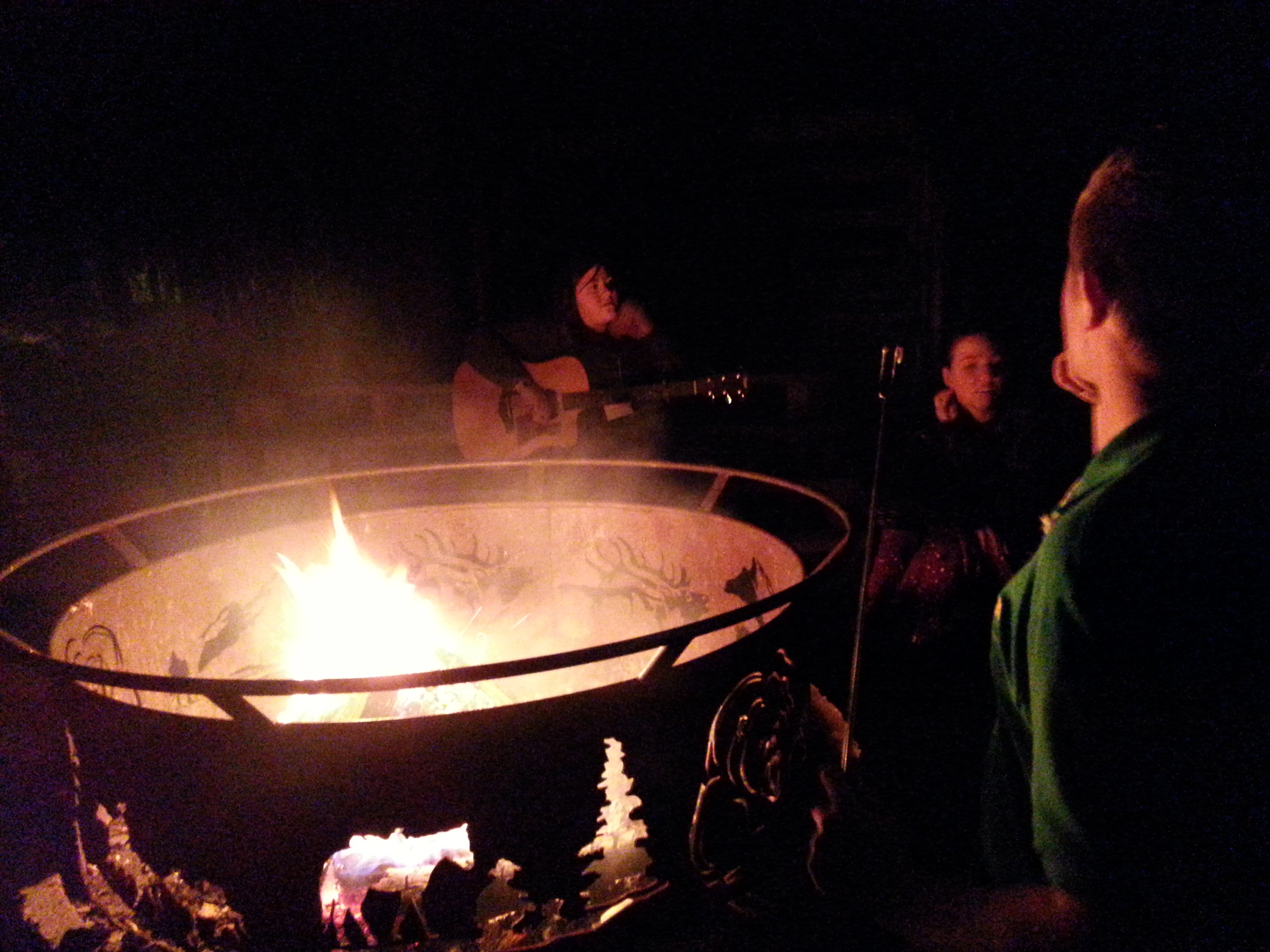
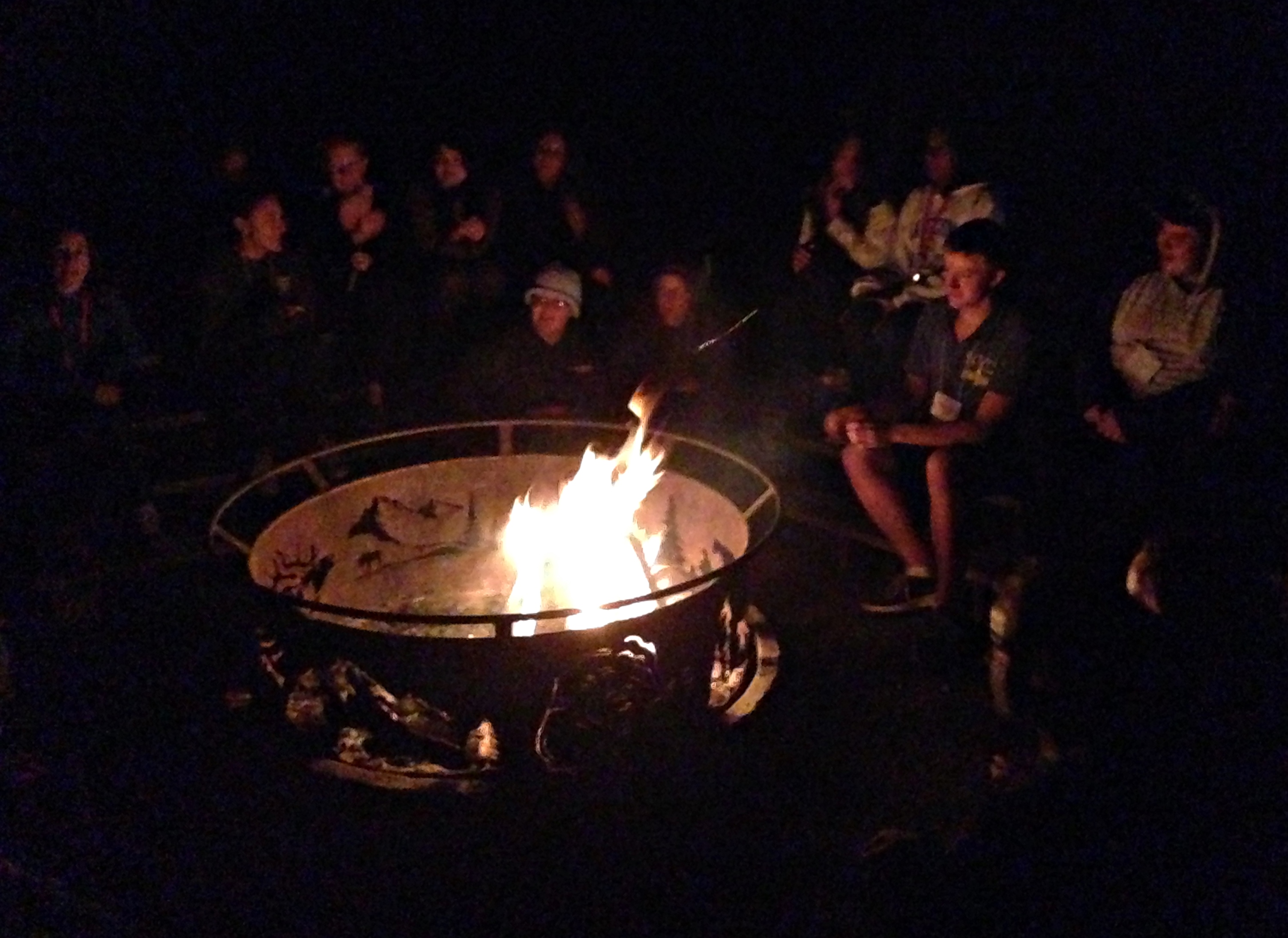
Friday January 30th – We arrived at camp in the evening and where excited to begin! We played a really fun-and competitive game where the groups had to out-sing each other based on different categories. Our awesome camp leader, Andrew, set up a roaring fire for us outside, and even though it was snowing it wasn’t too cold and we all bundled up to sing camp songs and tell jokes into the night. We all agreed singing in the snow was a unique experience!
Saturday January 31st – We awoke to a perfect fresh layer of snow, ideal for the activities ahead. After an amazing breakfast of chocolate pancakes, and a morning rehearsal, the choristers split into three groups. Each group took a turn doing music theory with Ms.Strome, an art project with our visiting artist, Lisa, and snow shoeing with Andrew.
With Lisa, the choristers turned their portraits into a unique embodiment of their visions of home. This art project will be displayed at the ‘Home’ concert coming up this March, and it was wonderful to make something so meaningful to go along with our concert.
The snow shoeing expeditions were amazing. The weather was perfect and the campers got to follow animal tracks through the woods, slide down hills, and laugh in the snow whilst wearing old fashioned “beaver tail” or modern “bear claw” snow shoes. We even had races!
Throughout the weekend, the choristers had cards read to them with secret facts about all the choristers, and based on the facts they had to guess who the card was about. It was great to see how well we all know each other. A real turkey dinner was followed by skit night, and the choristers were true to form with funny skits, amazing singing, and poetry. As a special treat, whipped cream was provided so the choristers could have fancy hot chocolate while we played board games by the fireplace. There was Twister, Disney Charades, and more!
Sunday February 1st – On Sunday we ate a breakfast of cinnamon buns, and had another rehearsal. The choristers really delved deep into the music, learning new pieces quickly and really fleshing out the meaning of each work. We thanked Andrew for all of his help and leadership, and Lisa for lending her amazing skills to us over the weekend. We thanked the kitchen staff with rousing applause, as we all agreed it had been the BEST camp food we’d ever had!
Winter Retreat was a huge success and hopefully it will become an annual event!
* Blog post and all photos by Kat Long
What was your favourite part of camp? Tell us in the comments below!
The best kind of music is influenced by small, seemingly insignificant elements. Where the musicians stand or sit, how well they watch their conductor, the way in which they listen to the other performers. One of these subtle elements, is the space in which a musician performs.
A ‘live’ space, is one in which there are many hard surfaces. This allows the sound to bounce off of those hard surface. In live spaces it takes the reverberation from your sound longer to decay. It makes your sound linger, and it sounds very pleasant to the ear. This is why everyone sounds great singing in the shower!
Still, there are occasions when a space is too ‘live’, and the reverberation of sound can be disorienting.
Ex: When the choir toured to New York in 1999, we performed in St. Patrick’s Cathedral, a beautiful venue that has exceptionally live acoustics.
Unfortunately, the organ, which we were using for our performance, was located at the opposite end of the cathedral to where we were performing. The cathedral was so massive, that the reverberations from the organ took a few beats to reach the choir, and the reverberating sound from the choir took a few beats to reach the organ. In that case it was very difficult to rely on the sound we were hearing as feedback, because the reverb of our singing in such a live space, was interfering with the reverb from the organ.
A ‘dead’ space, is one in which there are sound absorbing materials present in the room. These can include carpets, wall hangings, and certain materials that are specifically designed to absorb sound. Another example of a ‘dead’ space is the outdoors. There is simply too much space for the sound waves to escape, and so the reverb from singing decays almost instantaneously. A ‘dead’ space can be very difficult space in which to perform, or even in which to practice.
In which spaces do you prefer singing? Tell us in the comments below!
Apps have become prevalent with our use of technology, and they can be highly beneficial for singers on the go. There are a myriad of excellent resources available for musicians at the touch of a finger, but here are 5 apps that we think are some of the best for singers.
YouTube is a platform that allows users to post, share, and view video. It is incredibly useful for singers because it allows them to view as well as hear performances by other musicians. There are millions of hours of video to choose from, and YouTube has a very powerful search algorithm to allow users to find what they’re looking for.
Cost:FREE!
This is a great free piano app, designed to look and sound like a real piano. Virtuoso is particularly valuable because it names the true note names on the keyboard, and users can play multiple notes (like a chord) at the same time. In the app’s latest update, they’ve included new sounds; guitar, clarinet, as well as dual keyboard function.
Cost: FREE!
Android alternative – Real Piano
Shazam is a music identification app. It allows users to press a button when they hear a song they like. Shazam then listens to the song, identifies it, and provides links to where the song can be found online. It’s a great app for anybody who loves music, because it allows you to discover new music you like, simply by pressing a button.
Cost: FREE!
This is a very powerful tool that can be used on Apple products. GarageBand allows users to create multi-layered music, as well as podcasts. It includes several powerful editing features, as well as multiple instruments, and its latest update allows users to access music lessons.
Cost: FREE!
Despite the cost, EarBeater is the best ear training app available. It includes over 200 exercises in each section, and contains lessons about intervals, chords, and scales in an extremely user-friendly design. Its latest update allows users to create their own ear-training exercises.
Cost: $7.99
Android alternative – Perfect Ear
What is your favourite music app? Tell us in the comments below!
Getting sick at some point during the singing season is inevitable, but it doesn’t necessarily mean that a singer is completely out of commission. Here are three ways that singers can manage illness:
#1. Be proactive:
The best thing a singer can do is to prevent themselves from getting sick by being proactive. This can be done in a variety of ways, but the first step is to make sure you’re washing your hands on a regular basis. Every surface we touch is coated in germs and viruses just waiting to take us down. Ensure that you’re getting enough sleep, and that you’re well rested. Eat food that is nutritious and healthy, and be sure that you’re using your voice in a healthy way – no shouting, please!
#2. Assess your illness:
Do you have a sore throat? Are you stuffed up? These symptoms don’t necessarily mean that you can’t participate in a choir rehearsal. Just because you can’t sing, doesn’t mean you still can’t learn something at a choir rehearsal. Unless you are bed-ridden, you can still come to choir practice, and follow along with your music. This will ensure that you don’t fall behind, even if you’re unable to sing.
This can go the other way, as well. If you are very sick, and bedridden, then you should definitely not attend choir rehearsal, to prevent the illness from spreading, and making other choristers sick.
#3. Get Better Soon!
Make sure you’re doing what you can to get over you illness as quickly as possible. This usually involves getting as much sleep as possible, and eating well. By taking good care of yourself, you can be back to your regular singing self in no time!
How do you manage illness as a singer? Tell us in the comments below!
The Calgary Children’s Choir has been very fortunate over the years to have performed with a variety of musicians both locally and internationally. It is of the utmost benefit to young minds to be as exposed to as many kinds of performances as possible. From our concerts with local musicians, to our yearly participation in Alberta Ballet’s Nutcracker, we have had several wonderful opportunities to perform with orchestras. Here are three benefits of singing with an orchestra:
#1. Everybody is necessary:
Although there can be many different people involved in a concert, every single member of an orchestra, or a choir, is essential to that performance. Understanding this kind of teamwork is important to one’s growth as a musician. Even if you are only one part of the entire performance, you are still an essential aspect. Performing with other musicians is a great joy, and it can be highly beneficial, both physically and mentally.
#2. Seemingly disparate parts make up a whole:
It is always amazing to hear how the radically different sounds of a trombone, and a violin can sound so wonderful together. Orchestras are composed of a myriad of different sounds, and it is an excellent skill to be able to determine by ear which instrument makes which sound. Performing with an orchestra enables singers to become adept at picking out different sounds, and focusing on them, at hearing subtle differences, and understanding how the disparate sounds work together. These abilities have numerous non-musical applications, like memory retention, problem-solving skills, and the ability to focus intently.
#3. Focus is key :
With so many elements involved in a performance, it can be easy to become distracted. This is why focus is an essential skill a singer must develop. By learning to focus on the subtle instructions a conductor gives, or the variations in sound being produced by all of the different musicians in an orchestra as well as the singers around you, a singer can truly hone this important skill. Focus is an incredibly valuable skill outside of performance, as our world becomes increasingly filled with distractions.
What are some other benefits of singing with an orchestra? Tell us in the comments below!
Welcome back to 2015 everyone! We have a very exciting year ahead of us, and we’re thrilled for you to join us!
At the end of January, our Children’s Choir, and Youth Choir will be returning to Bragg Creek for a Winter Choir Camp retreat! This is the first time we’ve held a winter retreat, and we’re very excited! In March we will have our annual Folk Music concert at the Rozsa Centre, on March 22nd. On May 24th, we will have our annual spring concert, also at the Rozsa Centre.
The Calgary Children’s Choir will be touring to Ottawa this year at the beginning of July, to participate in the Unisong festival for our second time! We are very excited to be returning to the music festival and celebrating Canada Day with good friends and good music! We will be featuring a tour blog again right here on our website so you’ll be able to follow along with the tour, and hear what the choir is doing every day!
We are also very excited to announce that the Calgary Children’s Choir website will have online registration available for spring 2015. This will enable returning choristers to register efficiently, and new choristers to have a quick and easy way to register via the website!
What are you excited about for 2015? Tell us in the comments below!
On Saturday December 13th, we were thrilled to present The Christmas Miracle of Jonathan Toomey in concert with VoiceScapes! The evening was a wonderful combination of storytelling and holiday music. The beautiful Rozsa Centre was decorated by our amazing Creative Consultant, Kat Long, who crocheted 385 stars for us by hand! We were also very excited to present the Chandler Zawalykut scholarship to longtime member, Chantel Witherly!
Check out these photos from the concert!
What was your favourite part of the Christmas concert? Tell us in the comments below!
The Calgary Children’s Choir wishes you all a Merry Christmas, and Happy Holiday! We’ll see you all in the New Year!
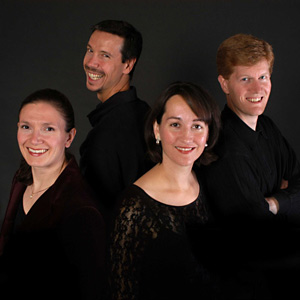
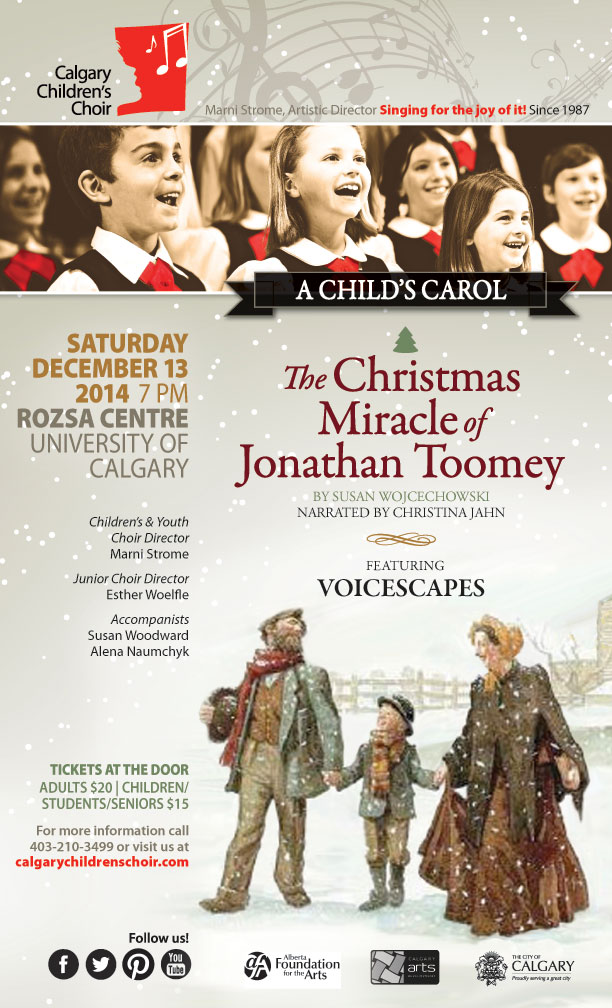
We are very excited this year to be sharing our annual Christmas concert, A Child’s Carol, with the professional vocal group; VoiceScapes!
VoiceScapes is a four member vocal group that was formed in 2000. Their members have extensive experience in vocal music, and we have been very fortunate to feature two of its members, Christina Jahn and Paul Grindlay in concert with us before! Throughout their 15 year history, Voicescapes has performed across Alberta, collaborating with a variety of Canadian musicians, in diverse vocal performances, including: the Early Music Voices Concert series, and performance with the Alberta Baroque Ensemble, the Red Deer Symphony, and the Calgary Philharmonic Orchestra.
We are thrilled to be presenting The Christmas Miracle of Jonathan Toomey with Voicescapes, on Saturday December 13th, 2014, and we hope you’ll be able to join us!
For ticket information regarding our Christmas concert, contact our business manager, Linda White.
The Calgary Children’s Choir will also be joining VoiceScapes on Sunday, December 21st, for their 13th annual Sing Along Messiah! We would love to see you there! Ticket information is available here.
Are you looking forward to this year’s Christmas musical celebrations? Tell us in the comments below!
Since the Calgary Children’s Choir is a Canadian choir, a large portion of the music we sing is in English. We have also sung in French, German, Italian, Spanish, Finnish, Japanese and several other languages! Singing in your native language is great, because you already understand the text. But there is a great deal of value in learning to sing in other languages:
#1. The Challenge
Singing music in another language provides another layer of difficulty to the learning process. There are so many aspects of language acquisition to consider, including cadence, pronunciation, and the many nuances of the language. As well, the text must be analyzed to ensure that choristers know what they’re singing about, and to communicate that effectively to the audience.
#2. Perspective
Singing in a language other than your native tongue, forces choristers to look at the piece from a new perspective. Context is essential when you don’t inherently understand the words you’re singing. Different languages have different ways of describing details, they come with historical nuances, and correct pronunciation is crucial to ensure that the words are communicated effectively. Learning music in another language demands that singers focus on new and challenging aspects of the piece, that they may not usually consider.
#3. New Learning Opportunities
Singing in other languages does not just provide learning opportunities in language. When we learn music in a different language, we encourage our choristers to explore a variety of aspects of the culture from which the language originate, including food, dance, religion, geography and other customs. This context is crucial in understanding the language in which we’re singing, but also understanding the historical significance of the music itself!
What do you love about learning to sing in other languages? Tell us in the comments below!
For every major concert that we have, we also have a choir workshop. These choir workshops occur on the Saturday two weeks before the concert. They are an essential aspect of our choir year.
Here are several reasons why choir workshops are important:
#1. To work the music:
This is the number one reason why we have choir workshops. Our usual rehearsals only allow us a certain amount of time with our music, so a three hour workshop gives us a lot more time to get down to the detailed aspects of our music. It also allows us to rehearse with other musicians or musical guests we may be performing with at our concert.
#2. To learn new things:
Often times our workshops include guest conductors, clinicians, musicians or other choirs who will be joining us in our concert. Working with them gives our choristers a new perspective, or new information about music. As well, it gives us a chance to work with, and learn from professional musicians from the local Calgary music scene.
#3. To talk about the music:
A comprehensive understanding of each piece of music is essential to performance, and to a well-rounded musical education. It is never enough to just know the words, notes, and rhythms. We spend time during rehearsals, and at our workshops discussing how the text informs the music we’re singing. It gives us a larger sense of the choral music, and it makes us better musicians!
#4. To spend time with fellow choristers:
Part of being in a choir is the great pleasure of singing as part of a group. We are so lucky at the Calgary Children’s Choir to have very inclusive, and engaging choristers! The reason why our choristers enjoy spending time together, is because we encourage them to get to know one another at choir camp, rehearsals, and of course – at choir workshops. At workshops, choristers have time during sectionals, and at breaks to spend time with one another, and find out more about the people they’re singing with!
What is your favourite part of a choir workshop? Tell us in the comments below!
Concerts are some of the most important events for our choir during the year. Here are several tips to make sure you are organized and ready for a concert!
#1. Make sure your uniform is ready:
Our uniforms are an important aspect of our presentation as a choir, so you need to ensure that your uniform is concert ready. When you get your uniform at the beginning of the year, the first thing you should do, is check that it fits properly. And since children grow at an astounding rate, you need to check that your uniform fits, at least one week before the first concert! You also need to make sure that the uniform is clean, and is worn properly. We have a uniform guideline with photos in our Members Portal.
#2. Make sure you have your music learned: Learning your music is an essential aspect of concert readiness. Performing is not just about singing the words and the notes that we’ve learned. It is about responding to the conductor, and the voices around you, as well as the energy from the audience, and delivering a ‘musical moment’. Each performance of a piece is different, because of these nuanced factors. Having your music learned before the concert, ensures that you can respond to each of these subtle aspects, and deliver something spectacular!
#3. Make sure you are punctual:
Arriving for a concert on time is essential. We always have an earlier call time than our performance, but this doesn’t mean you should be late. The call time is important for the choristers to have time before a performance, together, to make sure that everything feels settled, and calm before the concert. At our Christmas concert, we also take our class photos, and if you’re late, you won’t be in the photo!
How do you organize yourself so you’ll be ready for a concert? Tell us in the comments below!
Preparing music is not just about learning words, and notes, and rhythms, it is about how all of those elements come together to make a piece of music. Here are three things to think about when it is time to fine-tune our music:
#1. How the sound blends together:
Choral singing is not just about singing your part, and hoping it sounds good with the other voices around you. Choristers need to make a conscious effort to listen to the other voices around them, and ensure that their voice blends into the rest of the sound. This can be a difficult skill to learn, but it ensures that good choral sound is uniform. When there is one blended sound, the nuance of the musical piece can be communicated more effectively.
#2. How the accompaniment adds to the piece:
Often, choral music is accompanied; by piano, or other instruments. This additional instrumentation is another important element of the music, and choristers need to be sure that they are considering what the accompanying instrumentation adds to the piece. There are many functions that accompaniment performs; setting the mood of the piece, adding layers to the meaning of the piece, and assisting with intonation, to name just a few.
#3. How the text informs the music:
Vocal music is unique, in that it has an added layer of texture in the music – text. Choristers should be thinking about the text, and how it contributes to the piece. This is especially important if the piece is in another language. Here is a post with some additional information on the importance of analysing text.
What is your favourite part of fine-tuning music? Tell us in the comments below!
Sometimes learning all that music can feel overwhelming! Here are several tips to help organize learning your music:
#1. Attend rehearsals:
This is the single best thing a chorister can do to learn their music. Attending rehearsals reinforces the music regularly, and ensures that choristers can learn their music, and feel successful performing. Paying attention during rehearsals, and listening to other choristers is another effective way to learn music quickly.
#2. Listen to recordings:
This has become a very viable option for singers with the advent of technology. There are many recordings available on itunes, or through Youtube, which allow us to listen to other choirs interpretations’ of the music we’re learning. These recordings can be valuable because the give you another example of how to perform a piece. It’s a great way to get inspiration and to learn how other choirs are interpreting the music!
#3. Take time with your music:
Ensure that you don’t feel rushed or overwhelmed with any of your music. For the most part, we can learn our music in rehearsals, but if you’re feeling like you don’t know all the words, or are finding a passage, particularly tricky, make sure you take the time to go over it by yourself. Here are several helpful resources for choristers.
What organizational techniques do you use to learn your music? Tell us in the comments below!
Aside from our regular rehearsals, the choir also has several important dates to remember during the year. Here are several steps to help you remember the important dates for choir:
#1. Ensure you receive a calendar at the beginning of the choir year:
Our business manager Mrs. White, gives each chorister and their parents a schedule for the year upon registration. In addition, all of the important dates for the choir year can be found on our website. We have a dedicated calendar that lists all of the important dates, including workshops, and concerts. By clinking on each event, you can see the full details. We also have a list of the concert schedule for each choral year.
#2. Ensure you don’t schedule any conflicts on these important dates:
Concerts and workshops are an essential part of the choir experience. It is important to do everything you can to ensure you don’t have any scheduling conflicts with these events. Make sure you write important choir dates down on your personal calendars, so you don’t miss anything!
#3. Rest up:
Concerts and workshops take a lot of energy. There is nothing worse than feeling exhausted or sick on a concert day, so make sure that you’re taking care of yourself in the days leading up to these important events. Resting, eating well, and making sure your voice is in good shape, will help you to be at your best for workshops and concerts!
How do you remember important choir dates? Tell us in the comments below!
Our music binders are one of the most important aspects of our choral lives that we need to keep organized. Because of the high volume of music that we learn, especially music that we work on throughout the year, there are several steps we take to ensure our binders stay organized.
The first step is that we give each chorister an assigned binder. The number of the binder is recorded each year, and returning choristers are given the same binder number. We also give out choir bags in which to keep the choir binder, as well as a pencil and a waterbottle. This is to ensure that choristers have one place in which to keep their music.
The second step is our use of sheet protectors. These are plastic inserts that sit in the choir binder. Our music goes inside the sheet protectors, ensuring that the music isn’t ripped or bent, or spilled on!
The third step is organizing the music within the binders. This is left up to the discretion of each individual chorister, but most choristers organize their music alphabetically. When we get closer to a concert, many choristers switch their organization system to reflect the concert order.
How do you keep your music organized? Tell us in the comments below!
How do you organize your choir binder? Tell us in the comments below!
There are many different ways to arrange a choir, based on how the conductor determines the best choral sound can be achieved. This can lead to many variations in performer placement.
#1. In a more traditional choir formation, the lowest voices are usually found in the middle section of the choir. This can be the tenor and bass section in an adult choir, or just the alto voices in a children’s choir arrangement.
#2. It is often helpful to have the strongest voices in the back, and on the ends of rows. This makes their sound carry forward, to provide support for other choristers. In a children’s choir this is especially effective since often the more experienced singers are usually the older choristers!
#3. The choir formation is generally curved for a couple of reasons:
i) It allows the conductor to see, and be able to make eye contact with every single chorister. This is crucial for musical connection and synchronicity.
ii) It allows the sound to come to a focal point, so that first the conductor, and then the audience can hear a blended choral sound.
#4. Since blend is one of the highest priorities of choral sound, some choirs will blend their sections. In blended choirs, singers often stand next to choristers from completely different sections. This allows them to hear the way their part sounds with the other parts, and adjust their own sound accordingly!
If you’re interested in learning more about performer placement, this blog post offers some interesting insights on choir formations.
What is your preferred performer placement? Tell us in the comments below!
This past weekend we returned to choir camp out in Bragg Creek, for a weekend full of fun, laughter, and music!
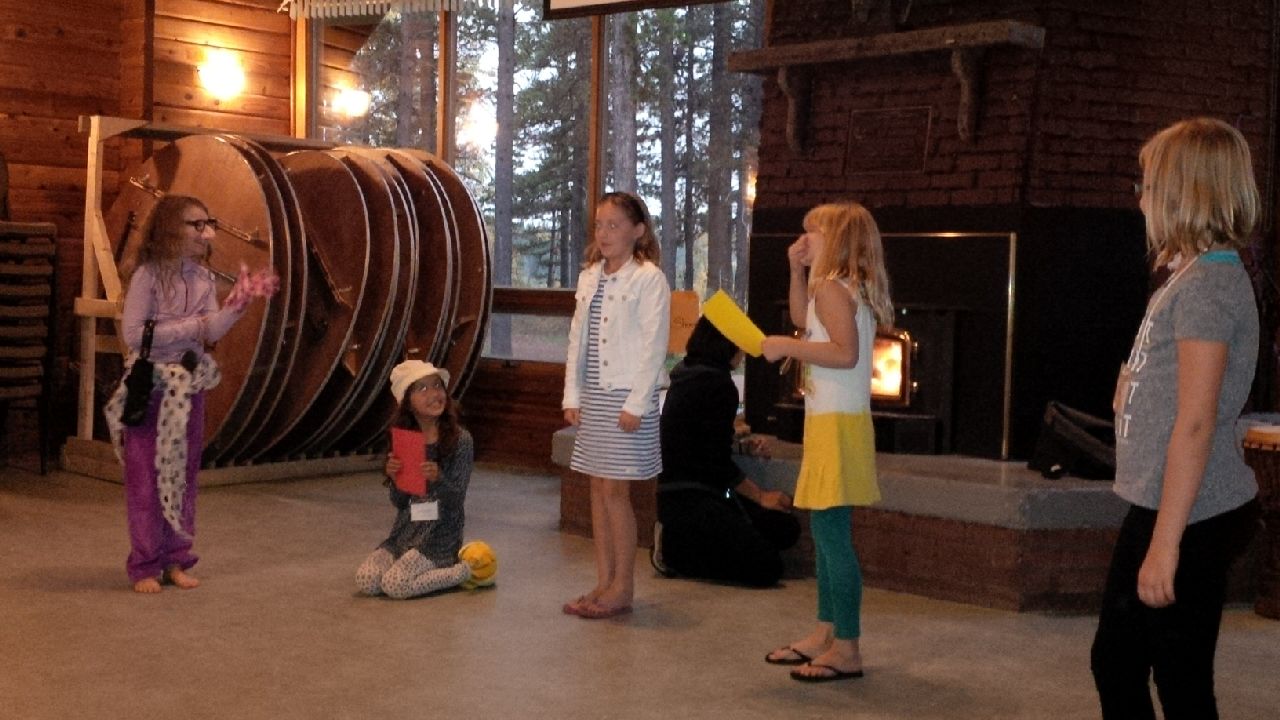
Our theme this year, created and implemented by our brilliant Creative Consultant, Kat Long, was ‘Science Camp!’ The choir was joined by the eccentric ‘Professor Pfiefferhorn’ from ‘Tunesburg’ (played by the wonderful Kat Long.) He told the choristers that he had travelled from the M.U.S.I.C (Musical Understanding of Sound In Children) research facility because he needed their help understanding how science and music were related.
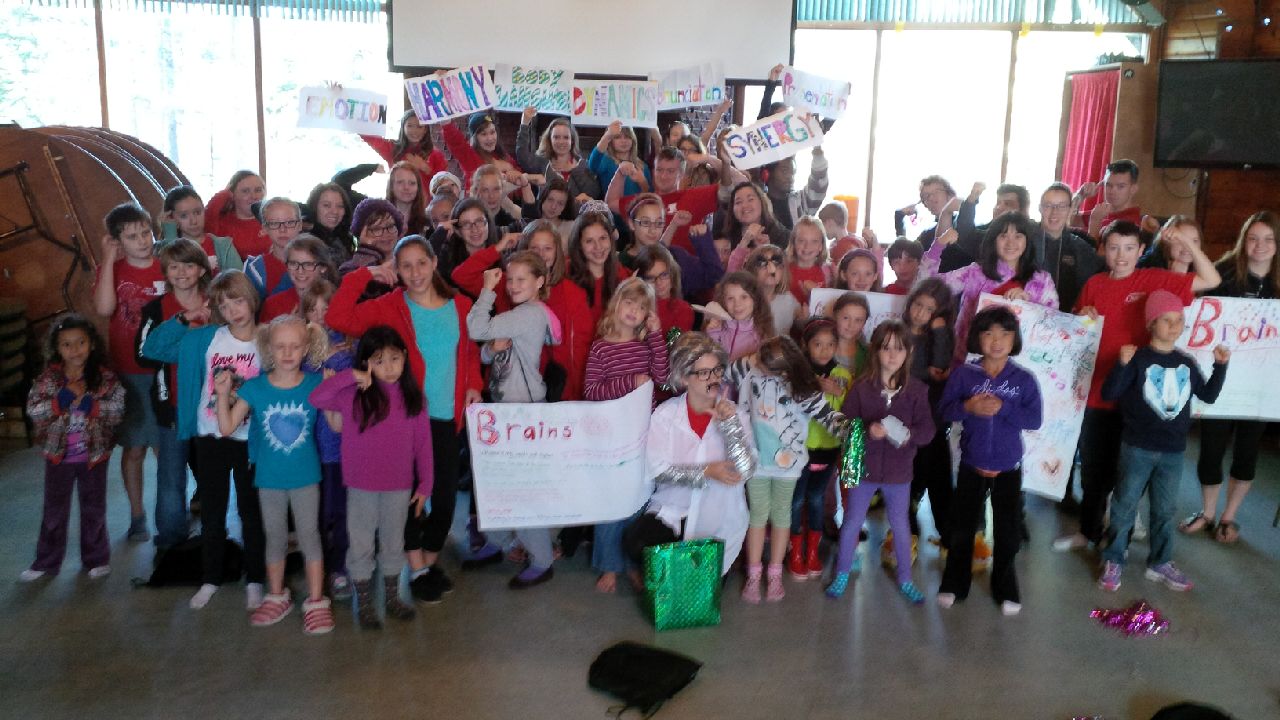
The choristers were divided into three groups including singers from all three of our choirs. The groups were: Brains, Brawn and Beauty. The choristers were asked to think about how these three categories related to music, and in particular to singing.
The ‘Brains’ group looked at how music impacts all areas of learning, particularly in the development of mathematical abilities, pattern recognition, and memorization. Those in the ‘Brawn’ group analyzed how different parts of the body are used to create music, and were particularly interested in good vocal habits. The choristers in the ‘Beauty’ group determined the emotional aspects of music, and singing, focusing particularly on conveying musical lines and text vocally.
The kids were given time to create presentations to make to ‘The Professor’ to aid in his research!
We also rehearsed, played musical games, had free time to relax or play ‘The Animal Game’. On Saturday night we enjoyed a long standing camp tradition of Skit Night! There were some fun skits, silly songs, and some impressive original musical numbers! After skit night, the choristers took advantage of the camp’s new karaoke machine, and had a blast singing old favourites!
We had an amazing weekend filled with friends, laughter, jokes, and best of all – music! Thank-you so much to all the amazing volunteers and staff members who made this weekend possible!
What was your favourite part of camp? Tell us in the comments below!
Every year the Calgary Children’s Choir spends a weekend at camp in Bragg Creek at the end of September. The purpose of choir camp is to get to know one another, and to have a concerted period of time during which we can really get a good start on our music. This is so important because of the nature of choral music, which requires that singers meld their voices to create one seamless sound. This level of trust, and understanding, not only on a musical level, but on a personal level as well, means that spending time together as group is an integral process to creating fantastic choral sound!
Here are three tips to help you get the most out of choir camp:
#1. Bring an open mind and heart:
Camp is about getting to know new people, and having a good time with the people you already do know. If you are brand new to the choir, or even if you’ve been a member for years, remember that camp is all about bonding! Introduce yourself to others, find out about them, and have a good time! By keeping yourself open to meeting new people, or getting to know other choristers better, you can get the most out of choir camp!
#2. Bring your music and get ready to sing!
Camp is also about the music. This is a great time for the choir to get in a lot of practice, and to really learn some of our music. Make sure you bring your music, your pencil, and a water bottle, and be prepared to rehearse!
#3. Participate!
It can be easy to sit on the sidelines, especially if you are new to choir. There are so many activities to choose from; campfire, skit night, crafts, outdoor games, and more! Camp is the most fun when you participate in all of the great activities that are offered!
Who’s excited for camp this year? What’s your favourite part of camp? Tell us in the comments below!
The Calgary Children’s Choir will be going on tour in the summer of 2015, and we are so thrilled to be returning to the Unisong music festival in Ottawa! The choir first attended the Unisong music festival in 2007, and we are very excited to be returning again.
Photo via NAC
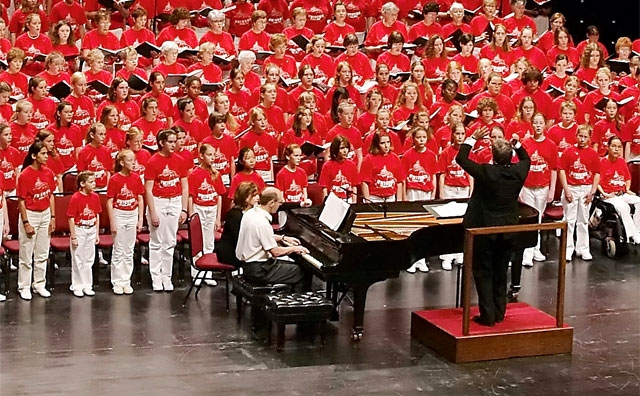
The Unisong choral festival takes place every year at the end of June, and culminates in a mass choir performance on Canada Day! Choirs from all over the country come to take part in smaller concerts, work with different conductors, and then sing as part of the mass choir. This tour is a great opportunity to learn more about our nation’s capital city, to meet people from different choirs across the country, and to sing beautiful music together!
Tour is also a wonderful time to get to know about your own conductor, and fellow choristers. Read more about the value of touring here.
Will you be coming on our 2015 tour? Have you sung in the Unisong choral festival before? Tell us about it in the comments below!
Welcome back to another year of choir! We’re thrilled to see you all again!
This year we have a number of exciting changes:
First, we’re very happy to introduce a new program to the CCC family! The Music Makers program is for 3 and 4 year olds and is intended to introduce young children to the basics of music, by singing, moving and playing musical games. We are very excited to have a CCC alumnus back to teach the Music Makers. Kathryn Berko sang with the CCC for many years before going on to earn her Bachelor’s of Music, and a Bachelor’s of Education from the University of Calgary.
We are looking forward to a great first year with the new Music Makers program!
Second, the Calgary Junior Choir has a brand new conductor!
Shandril Hubley will be taking over the Junior Choir, and we are so excited to have her! Shandril sang with the Calgary Youth Choir for seven years, and recently completed her level 1 Kodaly training! Shandril is incredibly artistic. She dances, sings, conducts, and works part-time painting portraits. We are so lucky to have her teach the Junior Choir!
The Calgary Children’s Choir has an exciting concert season ahead! We have three main concerts, including our Christmas concert, folk concert, and final spring concert, and in the summer of 2015 we will be going on tour! Check back next week for more information on our 2015 summer tour!
So, what are you most excited for in our 2014-2015 singing season? Tell us in the comments below!
On Saturday May 10th, 2014 we had our final concert of the year – our annual spring concert at the Rozsa Centre. This year, our theme was Songs of the Cinema, and we paid musical tribute to all of our favourite music from movies! Featuring music from The Lord Of The Rings, The Lion King, Mary Poppins, Les Miserables, and Frozen, we had so much fun singing music from our favourite films!
We were very fortunate to have Jonathan Love as the Master of Ceremonies for our concert, as well as a myriad of amazing musicians, including David Thaiw as our fantastic drummer! Our voices were joined by those of the St. Giles choir, and the Crescent Heights High School choir. We hope you enjoyed the evening as much as we did!
Photography by Brieannah Mollison-Read
Thank-you to everyone for a wonderful year of music and fun! Hope to see you at our end of year banquet on May 25th!
In preparation for our upcoming concert, Songs of the Cinema on May 10th 2014, we are starting a blog series of the same name, which will focus on a different aspect of ‘movie music’ each week!
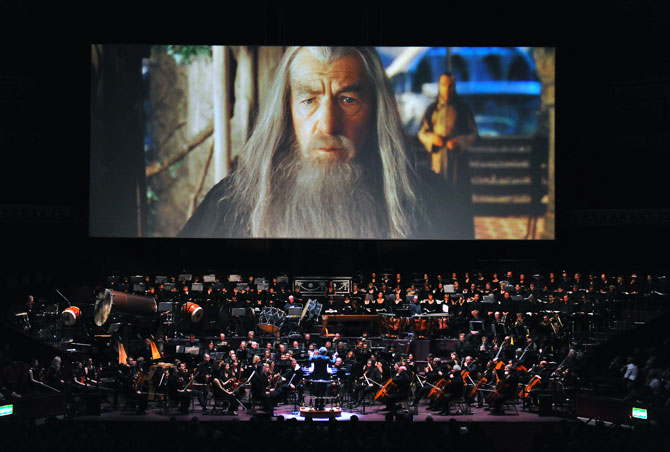
A film orchestra is a very specialized type of ensemble musical group. For the most part, orchestras that have been assembled to record the score for a film do not perform in public. For the most part, the specialty of a film orchestra is to record in studio the music that has been composed for a film.
During these recording sessions, the studio is filled with sound recording equipment, in order to capture the best sound, and minute details. In most cases, the film is projected onto a large screen in the recording studio. This adds greatly to the performance from the musicians. Film orchestras require a level of precision and technicality that greatly enhances the performances from the actors on the screen.
Here is a great video demonstrating the scoring, and recording of the music from Canadian composer Howard Shore for the movie The Hobbit:
Here is a similar video from Star Wars composer, John Williams:
https://www.youtube.com/watch?v=K0ezvZo2AWc
An interesting area in which orchestral recordings is developing is in the music for video games. Here is a video looking at the music, and orchestral recording for the Harry Potter video game:
For those interested, this is a very informative blog that takes a look at scoring for film. It has some fascinating insights into sound recording, and orchestral film recordings.
What do you think of film orchestras? Tell us in the comments below!
In preparation for our upcoming concert, Songs of the Cinema on May 10th 2014, we are starting a blog series of the same name, which will focus on a different aspect of ‘movie music’ each week!
Music plays an important, and often essential role in creating the appropriate atmosphere in a movie. The score of a film can help to convey subtle emotions, and enhances the performance of the actors greatly. For instance, if you watch a horror movie on mute, the film is nowhere near as frightening. The music adds, suspense, anticipation, and often foreshadows story elements.
Another, important use of music in film and theatre, is the use of musical themes. Often, important characters in scored films will have a theme associated with their character, as in the case of the massively popular series, Star Wars. Here is the theme music written for Princess Leia:
This music is heard throughout the film, associated with Princess Leia, and it helps the audience to familiarize themselves with her character. The most popular theme from the Star Wars films, is the infamous Imperial March. This music conveys power, and control. It is precise, and militaristic, and perfectly encapsulates the character of Darth Vader.
https://www.youtube.com/watch?v=xPK3IJBiTDs
One of the most subtle, and nuanced aspects of a scored film, such as Star Wars, is the use of leitmotifs. This is a musical device used most notably by Richard Wagner in his operas. A leitmotif is a musical phrase associated with a person, place, or idea. A leitmotif occurs often within a work, in different incarnations, and there can be multiple leitmotifs, depicting many people, places or ideas.. The rhythm, and structure of the leitmotif can change slightly, but it remains the same musical phrase at its core.
The purpose of the leitmotif is to enhance the characterization and narrative of a story, by adding another layer of information through music. Leitmotifs can help foreshadow, they can serve as reminders, and character associations. Here is a brilliant example of one of the leitmotifs used by John Williams in his Star Wars score. Note how the leitmotif changes slightly in each scene, but is still musically recognizable as the same musical idea.
What’s your favourite film score? Tell us in the comments below!